
The User Datagram Protocol (UDP) is a transport layer protocol part of the Internet Protocol suite, often referred to as the UDP/IP suite. Unlike TCP, which is more commonly used for most internet services, UDP is connectionless and unreliable. This means that data can be sent without establishing a connection first. While TCP guarantees reliable delivery and error-checking, these features come with added overhead and latency.
In situations where real-time performance is crucial, such as online gaming, video or voice calls, and live conferences, UDP is preferred. This is because UDP allows for faster data transfer, even if it means dropping some packets rather than delaying the entire process. Additionally, since there is no error checking, UDP helps save bandwidth. In this section, we will break down the structure of a UDP header and explore an example to help network engineers understand how it functions.
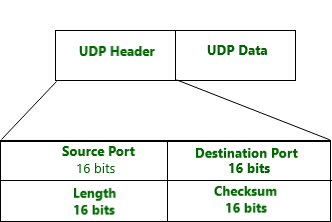
UDP Header
The User Datagram Protocol (UDP) is a simple, connectionless protocol used in networking. It is commonly used in applications where speed is more important than reliability, such as video streaming, online gaming, and VoIP. It is an 8-byte fixed and simple header. The first 8 Bytes contain all necessary header information and the remaining part consists of data. UDP port number fields are each 16 bits long, therefore the range for port numbers is defined from 0 to 65535, and port number 0 is reserved. Port numbers help to distinguish different user requests or processes.
For detailed information, refer to this article User Datagram Protocol
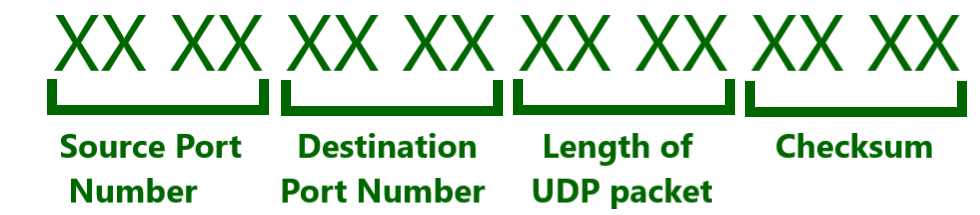
UDP Header Structure
A UDP header consists of four key fields:
- Source Port (16 bits):
- Identifies the port number at the sender’s side.
- Helps the receiver understand which application to send the data to.
- Destination Port (16 bits):
- Identifies the port number at the receiver’s side.
- Used to direct the incoming data to the appropriate application.
- Length (16 bits):
- Specifies the total length of the UDP header and the data.
- Minimum length is 8 bytes (the size of the UDP header), and the maximum is 65,535 bytes.
- Checksum (16 bits):
- Provides error-checking for the UDP header and data.
- Ensures data integrity during transmission.
Example of a UDP Header
Let’s examine a sample UDP packet:
| Field | Size | Example Value |
|---|---|---|
| Source Port | 16 bits | 12345 |
| Destination Port | 16 bits | 80 |
| Length | 16 bits | 32 |
| Checksum | 16 bits | 0x1a2b |
- Source Port (12345): The packet is coming from port 12345 on the sender’s system.
- Destination Port (80): The packet is meant for port 80 on the receiver’s system (usually HTTP).
- Length (32): The total length of the packet is 32 bytes, including the 8-byte header and 24 bytes of data.
- Checksum (0x1a2b): The checksum is used to verify the integrity of the UDP packet during transmission.
UDP Header Structure With Real-World Examples
Example-1
Given a DUMP of a UDP header in hexadecimal format 06 32 00 0D 00 1C E2 17. Find the following:
- Source port number?
- Destination port number?
- Length of user datagram?
- Length of the data?
Solution:
- Source Port- Source Port is 2 Byte long field used to identify the port number of the source. The source port number is the first four hexadecimal digits i.e. 06 32 if we convert hexadecimal to decimal we get 1586.
- Destination Port- It is a 2 Byte long field, used to identify the port of the destined packet. The destination port number is the second four hexadecimal digits 00 0D if we convert hexadecimal to decimal we get 13
- Length- Length is the length of UDP including the header and the data. It is a 16-bits field. The third four hexadecimal digits 00 1C if we convert hexadecimal to decimal we get 16 define the length of the whole UDP packet as 28
- Length of the header - It is 8 bytes as it is fixed. The length of the data is the length of the whole packet — the length of the header i.e. 28 – 8 = 20 bytes.
Example-2
Given a DUMP of a UDP header in hexadecimal format 04 21 00 0B 00 2A E2 17. Find the following:
- Source port number?
- Destination port number?
- Length of user datagram?
- Length of the data?
Solution:
- The source port number is the first four hexadecimal digits i.e. 04 21 if we convert hexadecimal to decimal we get 1057
- The destination port number is the second four hexadecimal digits 00 0B if we convert hexadecimal to decimal we get 11
- The third four hexadecimal digits 00 2A if we convert hexadecimal to decimal 42 define the length of the whole UDP packet as 28
- The length of the data is the length of the whole packet — the length of the header i.e. 28 – 8 = 20 bytes.
Example-3
Given a DUMP of a UDP header in hexadecimal format 03 61 10 1A 10 4C Y2 42. Find the following:
- Source port number?
- Destination port number?
- Length of user datagram?
- Length of the data?
Solution:
- The source port number is the first four hexadecimal digits i.e. 03 61 if we convert hexadecimal to decimal we get 0865
- The destination port number is the second four hexadecimal digits 10 1A if we convert hexadecimal to decimal we get 4122
- The third four hexadecimal digits 10 4C if we convert hexadecimal to decimal 4172 define the length of the whole UDP packet as 28
- The length of the data is the length of the whole packet — the length of the header i.e. 28 – 8 = 20 bytes.
How UDP Header Functions in Network Communication?
When a UDP packet is sent from a source to a destination:
- The source port and destination port ensure that the packet reaches the correct application on both ends.
- The length field indicates the size of the entire packet, helping the receiving system determine how much data to read.
- The checksum ensures that the packet’s data hasn’t been corrupted during transmission, enabling error detection.
UDP Header Use Cases for Network Engineers
- Real-time Applications: UDP is used in applications like VoIP and live video streaming, where low latency is critical, and occasional packet loss is acceptable.
- DNS Queries: DNS (Domain Name System) often uses UDP for quick resolution of domain names into IP addresses. The small size of the UDP header is ideal for these types of queries.
- Gaming and Multimedia: Online gaming and multimedia streaming often use UDP for faster data transmission, as the protocol’s connectionless nature reduces overhead.
Note :
UDP header also contains payload data which is of variable length. Use of UDP is as a tunneling protocol, where a tunnel endpoint encapsulates the packets of another protocol inside UDP datagrams and transmits them to another tunnel endpoint, which decapsulates the UDP datagrams and forwards the original packets contained in the payload.
Conclusion
The UDP header is key to fast and efficient data transmission. With basic information like source and destination ports, length, and checksum, it keeps overhead low, making UDP ideal for real-time applications like gaming, video calls, and live streaming. While it lacks the error-checking and connection features of TCP, this simplicity allows for quicker data transfer, making UDP a great choice for time-sensitive tasks.
