
Message Digest is used to ensure the integrity of a message transmitted over an insecure channel (where the content of the message can be changed). It refers to a fixed-size numerical representation (hash value) of a message or data, created by a hash function.
It's a core concept in ensuring data integrity. The message is passed through a Cryptographic hash function. This function creates a compressed image of the message called Digest.
Message Digests Characteristics
- Purpose: To verify that data has not been altered.
- Security Use: Common in digital signatures, data integrity checks, and password storage.
- Generated By: Cryptographic hash functions like MD5, SHA-1, SHA-256.
- Fixed Output: No matter the size of the input data, the output (digest) is of fixed length.
- Non-reversible: You cannot retrieve the original data from its message digest (one-way function).
- Deterministic: The same input will always produce the same output.
- Collision-resistant: It should be hard to find two different inputs that produce the same digest.
Working of Message Digest
Lets assume, Alice sent a message and digest pair to Bob.
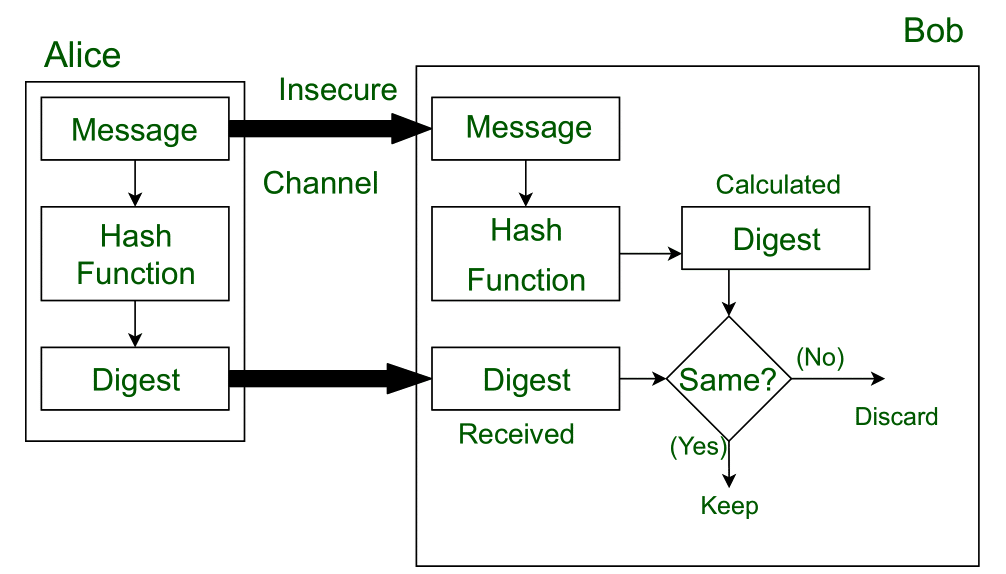
This message and digest pair is equivalent to a physical document and fingerprint of a person on that document. Unlike the physical document and the fingerprint, the message and the digest can be sent separately.
Sender Side (Creating the Digital Signature)
- Compose the Message
The sender writes or generates the message they want to send. - Generate the Message Digest
The sender uses a cryptographic hash function (e.g., SHA-256) to create a message digest (fixed-length hash) from the original message.- Example:
Digest = Hash(message)
- Example:
- Encrypt the Digest with Private Key
The sender encrypts the digest using their private key.- This encrypted digest is now the digital signature.
- Example:
Digital Signature= Encrypt(Digest, Sender's Private Key)
- Send the Message and Digital Signature
The sender sends both the original message and the digital signature to the receiver.
Receiver Side (Verifying Integrity and Authenticity)
- Receive the Message and Digital Signature
The receiver gets the original message and the attached digital signature. - Compute the Message Digest Locally
The receiver uses the same hash function to compute a new digest from the received message.- Example:
Digest' = Hash(received message)
- Example:
- Decrypt the Digital Signature
The receiver decrypts the digital signature using the sender’s public key to recover the original digest.- Example:
Original Digest = Decrypt(Digital Signature, Sender's Public Key)
- Example:
- Compare the Two Digests
The receiver compares:- The locally generated digest (Digest')
- The decrypted digest from the digital signature (Original Digest)
There are two possibilities that happen:
- If they match:
- The message has not been altered (integrity verified).
- The sender is authenticated (only the true sender has the matching private key) .
- If they do not match:
- The message may have been tampered with, or the sender may be fraudulent.
For example : Using SHA-256:
- Input:
"Hello"
Output Digest (in hex):
185f8db32271fe25f561a6fc938b2e264306ec304eda518007d1764826381969
Applications of Message Digest
- Digital Signatures: Ensures the message is not been tampered .
- Data Integrity Checks: Verifies files/downloads have not be changed.
- Password Hashing: Securely stores passwords (usually with salt).
Related GATE Questions:
