
Synchronous Optical Network is a communication protocol that was created by Bellcore and is used to send huge amounts of data over relatively long distances using optical fiber. Many digital data streams are transmitted simultaneously over the optical fiber with SONET. In this article, we will see SONET in detail.
What is SONET?
SONET is a standardized digital communication protocol developed by Bellcore. Using optical fiber, SONET is used to transmit a large volume of data over relatively long distances. It allows multiple digital data streams to be transferred simultaneously over the same optical fiber using LEDs and laser beams.
Key Points About SONET
- Developed by Bellcore
- Used in North America
- Standardized by ANSI (American National Standards Institute)
- Similar to SDH (Synchronous Digital Hierarchy) which is used in Europe and Japan.
SONET Network Elements
- STS Multiplexer:
- Performs multiplexing of signals
- It Converts electrical signal to optical signal
- STS Demultiplexer:
- Performs demultiplexing of signals
- It Converts optical signal to electrical signal
- Regenerator:
- It is a repeater, that takes an optical signal and regenerates (increases the strength) it.
- Add/Drop Multiplexer:
- It allows to add signals coming from different sources into a given path or remove a signal.
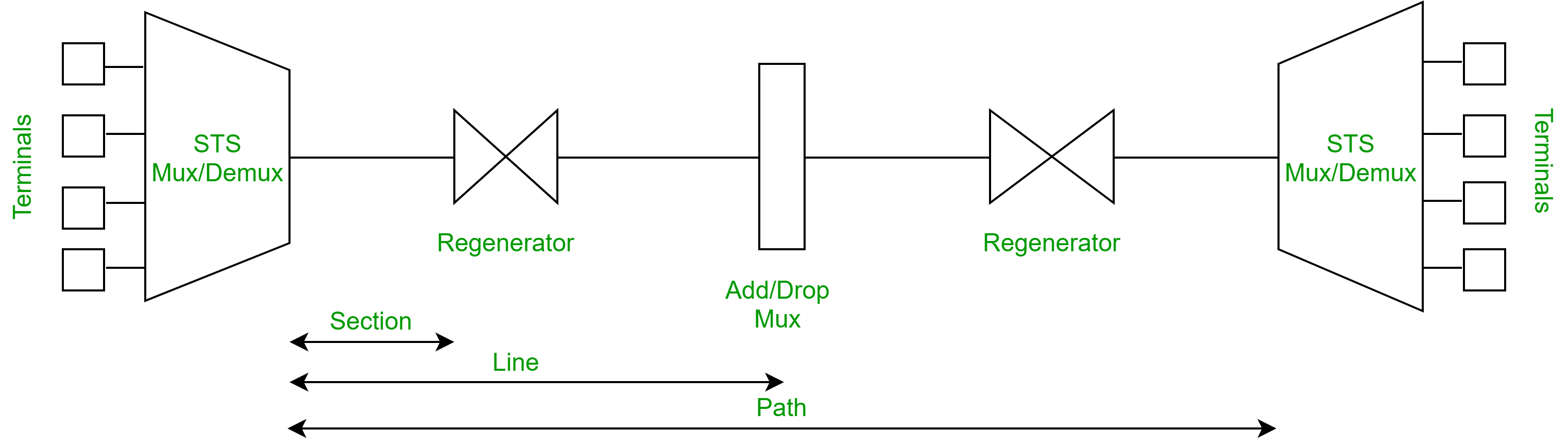
SONET Connections
- Section: Portion of network connecting two neighbouring devices.
- Line: Portion of network connecting two neighbouring multiplexers.
- Path: End-to-end portion of the network.
SONET Layers
- Path Layer:
- It is responsible for the movement of signals from its optical source to its optical destination.
- STS Mux/Demux provides path layer functions.
- Line Layer:
- It is responsible for the movement of signal across a physical line.
- STS Mux/Demux and Add/Drop Mux provides Line layer functions.
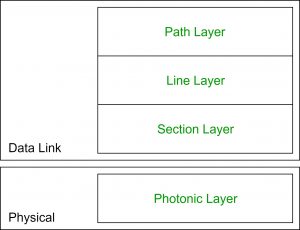
- Section Layer:
- It is responsible for the movement of signal across a physical section.
- Each device of network provides section layer functions.
- Photonic Layer:
- It corresponds to the physical layer of the OSI model.
- It includes physical specifications for the optical fibre channel (presence of light = 1 and absence of light = 0).
Advantages of SONET
- Transmits data to large distances
- Low electromagnetic interference
- High data rates
- Large Bandwidth
Disadvantages of SONET
- There are no compatible standards.
- SONET mux services are required for tributary services.
- For a limited number of channels, this is both inexpensive and inefficient.
- The SONET/SDH network management system is inadequate for administering and implementing the DWDM technology.
- There should be more overhead.
Difference between SONET and SDH
| Aspect | SONET (Synchronous Optical Network) | SDH (Synchronous Digital Hierarchy) |
|---|---|---|
| Definition | Developed by ANSI | Developed by ITU-T |
| Interfaces | Digital hierarchy for optical transmission | Network node interfaces, user-network interfaces, and U reference-point interfaces |
| Overhead Bytes | 27 transport overhead bytes | 81 transport overhead bytes |
| Transmission Modes | Synchronous only | Synchronous and asynchronous modes |
| Transmission Rates | Lower rates compared to SDH | Higher rates than SONET |
| Basic Units | Optical Carrier level-1 (OC-1) | Synchronous Transmission Module level-1 (STM-1) |
Conclusion
SONET (Synchronous Optical Network), invented by Bellcore and standardised by ANSI, is a communication protocol used in North America to send huge amounts of data across great distances over optical fibre. Multiple digital data streams can be exchanged concurrently using LEDs and laser beams. SONET's key components include STS multiplexers and demultiplexers, regenerators, and add/drop multiplexers. SONET runs on several layers, including the path, line, section, and photonic layers. Its benefits include long-distance transmission, low electromagnetic interference, fast data speeds, and a wide bandwidth. However, there are certain drawbacks, such as a lack of appropriate standards and inefficiency due to the limited channels
