
Pure ALOHA is the original form of the ALOHA protocol. In this approach, A station transmits a frame whenever it has data to send. Since there is only one shared channel, there is always a risk of collisions between frames from different stations.
Note: To ensure reliable communication, the receiver sends an acknowledgment (ACK) for each correctly received frame. If the sender does not receive an ACK within a time-out period, it assumes a collision has occurred and retransmits the frame.
Key Mechanism
- Transmission: A user sends a packet immediately when it is ready.
- Acknowledgment: The receiver responds with an ACK if the frame is received correctly.
- Collision Handling: If no ACK is received, the sender assumes a collision occurred.
- Random Back-off: Before retransmitting, the sender waits for a random back-off time to reduce the chance of repeated collisions.
Features of Pure ALOHA
- Random Access: Devices can send data anytime without waiting for a time slot.
- Uncoordinated Transmission: No central authority or coordination mechanism exists.
- Simplicity: Easy to implement and suitable for low-traffic systems.
- Persistent Retransmission: Devices retransmit after a random delay if a collision occurs.
- Contention-Based: Collisions are inherent and resolved using acknowledgment and retransmission.
Vulnerable Time in Pure ALOHA
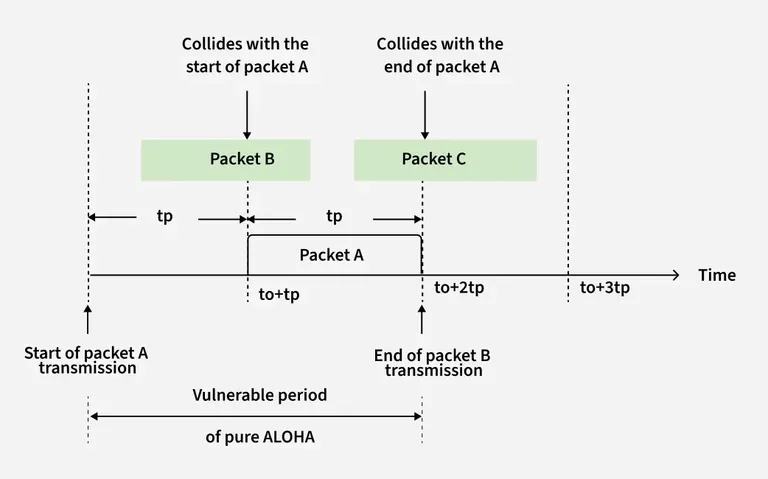
Collisions in Pure ALOHA occur if packets overlap at any point.
- Let each packet take 1 time unit (tp) to transmit.
- If a user starts sending a packet at time
t0, - Any packet generated in the interval (t0, t0 + tp) will collide with the beginning of the original packet.
- Any packet generated in (t0 + tp, t0 + 2tp) will collide with the end of the original packet.
Note: The vulnerable period for a packet in Pure ALOHA is
2 × t_p . If another transmission starts within this period, both packets will be destroyed.
Throughput Analysis of Pure ALOHA
The efficiency of Pure ALOHA can be calculated using probability.
Throughput (S):
where:
\text{S = } throughput (successful transmissions per packet time).\text{G = } average number of packets generated per packet time.
Maximum Throughput: Throughput is maximized when
Advantages
- Simple to design and implement.
- Suitable for low-traffic scenarios.
- Works well in environments with unpredictable transmission times.
Disadvantages
- Very low efficiency (maximum
18.4\% ). - High probability of collisions under heavy traffic.
- Unsuitable for real-time applications requiring guaranteed delivery.
