
Pointers are variables that store memory addresses instead of actual values. They provide an efficient way to access and manipulate memory, making them an essential feature of C and C++ programming.
- Provides direct access to memory locations through addresses.
- Enables efficient memory management and dynamic memory allocation.
- Widely used in data structures, function calls, and system-level programming.
#include <iostream>
using namespace std;
int main() {
int num = 10;
int* ptr = #
cout << "Value of num: " << *ptr << endl;
cout << "Address of num: " << ptr << endl;
return 0;
}
Output
Value of num: 10
Address of num: 0x7fffffffe9c4
Explanation: Here, ptr stores the address of num. Dereferencing the pointer using *ptr accesses the value stored at that memory location.
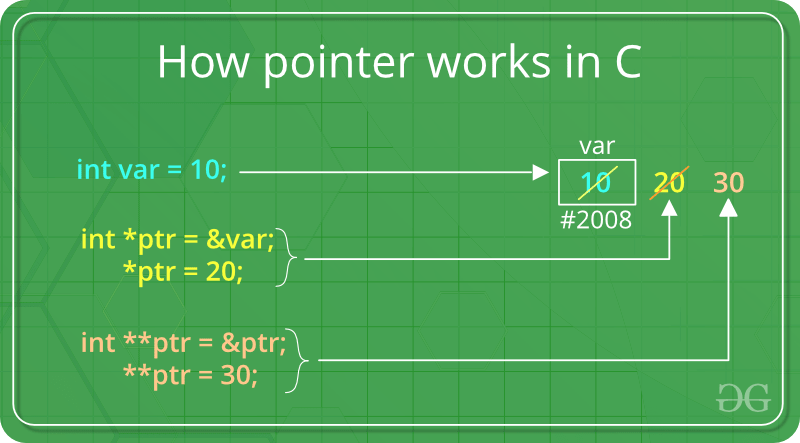
Syntax
data_type* pointer_name;
Here,
- data_type specifies the type of data whose address the pointer will store.
- * indicates that the variable being declared is a pointer.
- pointer_name is the name of the pointer variable.
Features of Pointers
Pointers provide several powerful features that make them an essential part of C and C++ programming.
- Direct Memory Access: Allows direct access to memory locations using addresses.
- Efficient Data Manipulation: Large objects can be accessed and modified without creating unnecessary copies.
- Dynamic Memory Management: Enables memory allocation and deallocation at runtime using new, delete, malloc(), and free().
- Support for Data Structures: Forms the basis of linked lists, trees, graphs, stacks, queues, and other dynamic data structures.
- Array Traversal: Arrays can be efficiently traversed and manipulated using pointer arithmetic.
- File Handling: Frequently used while working with files and buffers in low-level programming.
- Polymorphism in C++: A base class pointer can point to objects of derived classes, enabling runtime polymorphism.
Uses of pointers
Pointers are used in many programming scenarios to improve efficiency and provide greater control over memory.
- Passing function arguments by reference.
- Traversing and manipulating arrays and strings.
- Returning multiple values from a function using pointer parameters.
- Dynamic memory allocation at runtime.
- Implementing dynamic data structures such as linked lists, trees, and graphs.
- System-level programming where direct memory access is required.
- Working with callback functions and function pointers.
Drawbacks of Pointers
Although pointers are powerful, improper usage can lead to bugs and memory-related issues.
- Accessing an invalid or incorrect memory address can produce unpredictable results.
- Uninitialized or dangling pointers may cause segmentation faults.
- Forgetting to release dynamically allocated memory can result in memory leaks.
- Incorrect pointer arithmetic may lead to undefined behavior.
- Dereferencing a pointer adds a small amount of overhead compared to directly accessing a variable.
- Pointer-based code can be more difficult to read, debug, and maintain.
