
External CSS is a styling method where CSS rules are stored in a separate .css file and linked to HTML documents. It helps maintain a consistent and organized design across multiple web pages.
- A single CSS file can style multiple HTML pages efficiently.
- Improves code reusability and simplifies website maintenance.
- Keeps the HTML structure separate from presentation and design styles.
Link an External CSS to HTML
An external CSS file is connected to an HTML document using the <link> tag inside the <head> section. This allows the webpage to apply styles stored in a separate CSS file.
- The rel="stylesheet" attribute specifies the relationship as a stylesheet.
- The href attribute defines the path to the external CSS file.
- Linking external CSS helps maintain consistent styling across multiple pages.
Syntax:
<link rel="stylesheet" href="path/to/your/styles.css">Example 1: Here, we are using an external CSS style to provide styling to our div, h1, and p tags.
<!DOCTYPE html>
<html>

<head>
    <link rel="stylesheet" href="geeks.css" />
</head>

<body>
    <div class="main">
        <h1 class="GFG">
            GeeksForGeeks
        </h1>
        <p id="geeks">
            A computer science portal for geeks
        </p>
    </div>
</body>

</html>
/* Geeks.css */
.main {
    text-align: center;
}

.GFG {
    font-size: 60px;
    color: green;
}

#geeks {
    font-size: 25px;
    color: skyblue;
};
Output:

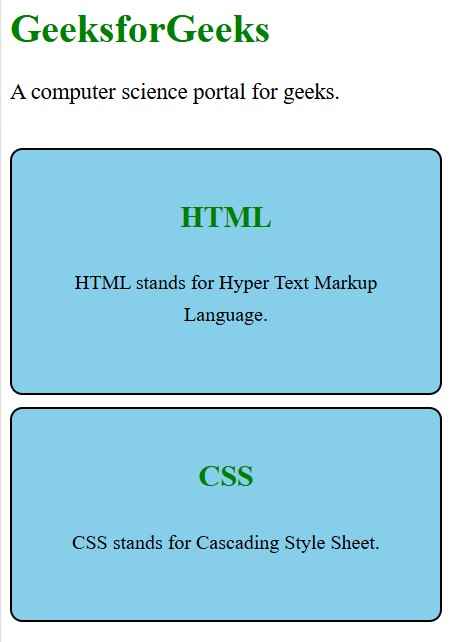
Example 2: Here’s another example demonstrating how to use external CSS to style multiple HTML elements, such as creating card-like sections.
<!DOCTYPE html>
<html lang="en">

<head>
    <meta charset="UTF-8">
    <meta name="viewport"
          content="width=device-width,
                   initial-scale=1.0">
    <title>External CSS Example</title>
    <link rel="stylesheet" href="geeks.css">
</head>

<body>
    <h1>GeeksforGeeks</h1>
    <p>
        A computer science portal for geeks.
    </p>
    <div class="geeks">

        <h2>HTML</h2>
        <p>
            HTML stands for Hyper Text Markup Language.
        </p>
    </div>
    <div class="geeks">

        <h2>CSS</h2>
        <p>
            CSS stands for Cascading Style Sheet.
        </p>
    </div>
</body>

</html>
/* Geeks.css */
h1 {
    color: green;
    margin-bottom: 10px;
}

p {
    font-size: 18px;
    line-height: 1.6;
    margin-bottom: 30px;
}

.geeks {
    display: flex;
    flex-direction: column;
    align-items: center;
    padding: 20px;
    border: 2px solid black;
    border-radius: 10px;
    background-color: skyblue;
    margin-bottom: 10px;
    width: 20%;

}

.geeks h2 {
    color: green;
    font-size: 24px;
    margin-bottom: 10px;
}

.geeks p {
    text-align: center;
    font-size: 16px;
    color: black;
}
Output:
Advantages of External CSS
- Improved Maintainability: Having styles in a separate file makes it easier to manage and update your styles without modifying each HTML document.
- Enhanced Reusability: The same CSS file can be linked to multiple HTML files, promoting consistent design across your site.
- Efficient Caching: Browsers cache external CSS files, leading to faster page load times on subsequent visits.
Disadvantages of External CSS
- Loading Time: Pages may not render correctly until the external CSS file is fully loaded, potentially causing a flash of unstyled content (FOUC).
- Performance Concerns: Linking multiple CSS files can increase download times, affecting overall site performance.
- Versioning and Caching Challenges: Large-scale projects may encounter difficulties in versioning and caching, leading to inconsistencies in styles.
