
Given two polynomials represented by linked lists, add them by summing the coefficients of terms with the same power. The lists are sorted in descending order of powers.
Structure of the linked list:
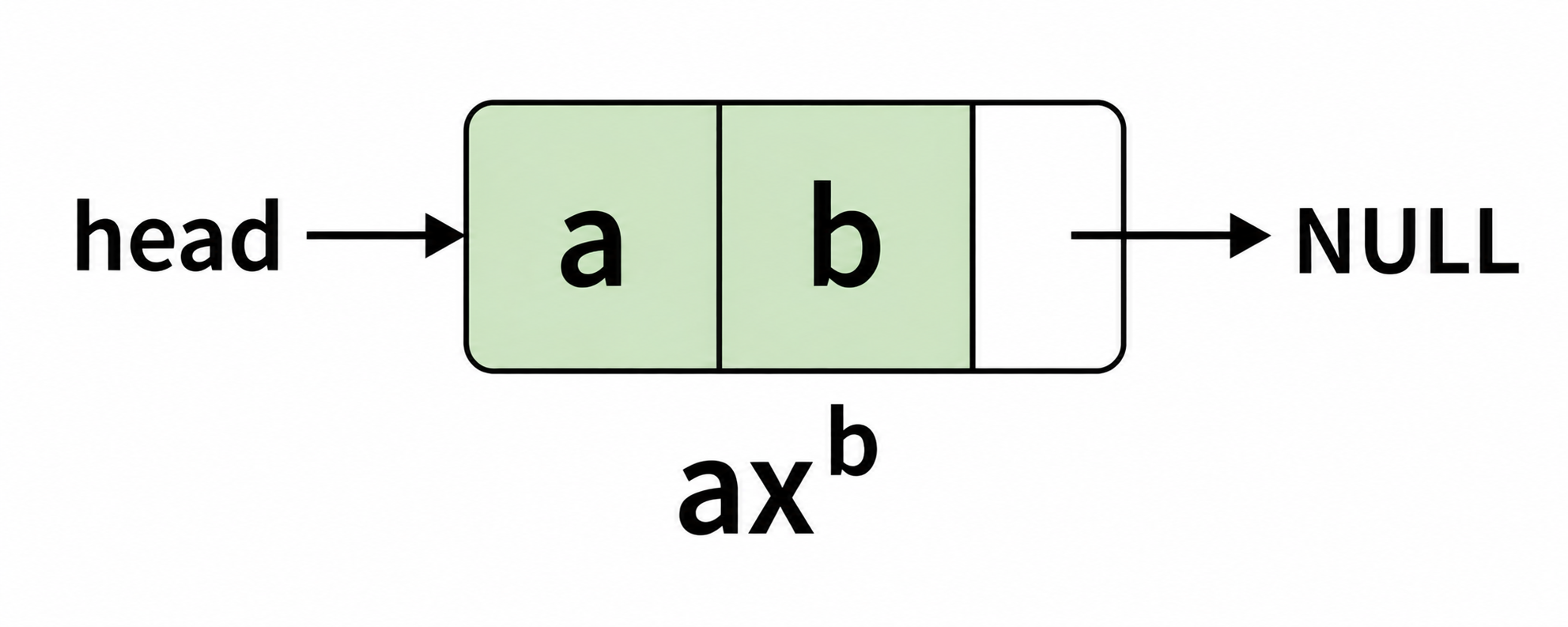
Note: If the sum of coefficients for a specific power becomes zero, that term should not be included in the resulting linked list.
Examples :
Input: head1 = [1, 3] , head2 = [1, 2]
Output: head = [1, 3] -> [1, 2]
Explanation: head1 represents x3, head2 represents x2, add both the polynomials to get x3 + x2.
Input: head1 = [1, 3] -> [2, 2], head2 = [3, 3] -> [4, 2]Output: head = [4, 3] -> [6, 2]
Explanation: head1 represents x3 + 2x2, head2 represents 3x3 + 4x2. Since, x3 has two different coefficients as 3 and 1. Adding them up will lead to 4x3. Also, x2 has two coefficients as 4 and 2. So, adding them up will give 6x2.



[Naive Approach] Using Hash Map to Store All Terms - O((n + m) log(n + m)) Time and O(n + m) Space
The idea is to traverse both linked lists and store the sum of coefficients corresponding to each power in a hash map. After processing both polynomials, traverse the map in descending order of powers and create the resultant polynomial. Terms whose coefficient becomes 0 are skipped.
#include <iostream>
using namespace std;

class Node
{
  public:
    int coeff;
    int pow;
    Node *next;

    Node(int c, int p)
    {
        coeff = c;
        pow = p;
        next = nullptr;
    }
};

Node *addPolynomial(Node *head1, Node *head2)
{

    map<int, int, greater<int>> mp;

    // Store terms of first polynomial
    while (head1)
    {
        mp[head1->pow] += head1->coeff;
        head1 = head1->next;
    }

    // Store terms of second polynomial
    while (head2)
    {
        mp[head2->pow] += head2->coeff;
        head2 = head2->next;
    }

    Node *head = nullptr;
    Node *tail = nullptr;

    // Create resultant polynomial
    for (auto &it : mp)
    {

        if (it.second == 0)
            continue;

        Node *newNode = new Node(it.second, it.first);

        if (head == nullptr)
        {
            head = tail = newNode;
        }
        else
        {
            tail->next = newNode;
            tail = newNode;
        }
    }

    return head;
}

// Driver code
void printList(Node *head)
{

    while (head)
    {
        cout << "[" << head->coeff << ", " << head->pow << "]";

        if (head->next)
            cout << " -> ";

        head = head->next;
    }

    cout << endl;
}

int main()
{

    Node *head1 = new Node(1, 3);
    head1->next = new Node(2, 2);

    Node *head2 = new Node(3, 3);
    head2->next = new Node(4, 2);

    Node *res = addPolynomial(head1, head2);

    printList(res);

    return 0;
}
import java.util.HashMap;
import java.util.Map;

class Node {
  public int coeff;
  public int pow;
  public Node next;

  public Node(int c, int p) {
      coeff = c;
      pow = p;
      next = null;
  }
}

public class Main {
  public static Node addPolynomial(Node head1, Node head2) {

      Map<Integer, Integer> mp = new HashMap<>();

      // Store terms of first polynomial
      while (head1!= null) {
          mp.put(head1.pow, mp.getOrDefault(head1.pow, 0) + head1.coeff);
          head1 = head1.next;
      }

      // Store terms of second polynomial
      while (head2!= null) {
          mp.put(head2.pow, mp.getOrDefault(head2.pow, 0) + head2.coeff);
          head2 = head2.next;
      }

      Node head = null;
      Node tail = null;

      // Create resultant polynomial
      for (Map.Entry<Integer, Integer> entry : mp.entrySet()) {

          if (entry.getValue() == 0)
              continue;

          Node newNode = new Node(entry.getValue(), entry.getKey());

          if (head == null) {
              head = tail = newNode;
          } else {
              tail.next = newNode;
              tail = newNode;
          }
      }

      return head;
  }

  // Driver code
  public static void printList(Node head) {

      while (head!= null) {
          System.out.print("[" + head.coeff + ", " + head.pow + "]");

          if (head.next!= null)
              System.out.print(" -> ");

          head = head.next;
      }

      System.out.println();
  }

  public static void main(String[] args) {

      Node head1 = new Node(1, 3);
      head1.next = new Node(2, 2);

      Node head2 = new Node(3, 3);
      head2.next = new Node(4, 2);

      Node res = addPolynomial(head1, head2);

      printList(res);
  }
}
from collections import OrderedDict

class Node:
    def __init__(self, c, p):
        self.coeff = c
        self.pow = p
        self.next = None

def addPolynomial(head1, head2):
    mp = OrderedDict()

    # Store terms of first polynomial
    while head1:
        if head1.pow in mp:
            mp[head1.pow] += head1.coeff
        else:
            mp[head1.pow] = head1.coeff
        head1 = head1.next

    # Store terms of second polynomial
    while head2:
        if head2.pow in mp:
            mp[head2.pow] += head2.coeff
        else:
            mp[head2.pow] = head2.coeff
        head2 = head2.next

    head = None
    tail = None

    # Create resultant polynomial
    for power, coeff in reversed(sorted(mp.items())):
        if coeff == 0:
            continue

        newNode = Node(coeff, power)

        if not head:
            head = tail = newNode
        else:
            tail.next = newNode
            tail = newNode

    return head

# Driver code
def printList(head):
    while head:
        print('[{}, {}]'.format(head.coeff, head.pow), end='')

        if head.next:
            print(' -> ', end='')

        head = head.next

    print()

if __name__ == '__main__':
    head1 = Node(1, 3)
    head1.next = Node(2, 2)

    head2 = Node(3, 3)
    head2.next = Node(4, 2)

    res = addPolynomial(head1, head2)

    printList(res)
using System;
using System.Collections.Generic;

public class Node
{
    public int coeff;
    public int pow;
    public Node next;

    public Node(int c, int p)
    {
        coeff = c;
        pow = p;
        next = null;
    }
}

public class Program
{
    public static Node addPolynomial(Node head1, Node head2)
    {
        Dictionary<int, int> mp = new Dictionary<int, int>();

        // Store terms of first polynomial
        while (head1!= null)
        {
            if (mp.ContainsKey(head1.pow))
                mp[head1.pow] += head1.coeff;
            else
                mp[head1.pow] = head1.coeff;

            head1 = head1.next;
        }

        // Store terms of second polynomial
        while (head2!= null)
        {
            if (mp.ContainsKey(head2.pow))
                mp[head2.pow] += head2.coeff;
            else
                mp[head2.pow] = head2.coeff;

            head2 = head2.next;
        }

        Node head = null;
        Node tail = null;

        // Create resultant polynomial
        foreach (var entry in mp)
        {
            if (entry.Value == 0)
                continue;

            Node newNode = new Node(entry.Value, entry.Key);

            if (head == null)
            {
                head = tail = newNode;
            }
            else
            {
                tail.next = newNode;
                tail = newNode;
            }
        }

        return head;
    }

    public static void printList(Node head)
    {
        while (head!= null)
        {
            Console.Write("[" + head.coeff + ", " + head.pow + "]");

            if (head.next!= null)
                Console.Write(" -> ");

            head = head.next;
        }

        Console.WriteLine();
    }

    public static void Main()
    {
        Node head1 = new Node(1, 3);
        head1.next = new Node(2, 2);

        Node head2 = new Node(3, 3);
        head2.next = new Node(4, 2);

        Node res = addPolynomial(head1, head2);

        printList(res);
    }
}
class Node {
    constructor(c, p) {
        this.coeff = c;
        this.pow = p;
        this.next = null;
    }
}

function addPolynomial(head1, head2) {
    const mp = new Map();

    // Store terms of first polynomial
    while (head1) {
        mp.set(head1.pow, (mp.get(head1.pow) || 0) + head1.coeff);
        head1 = head1.next;
    }

    // Store terms of second polynomial
    while (head2) {
        mp.set(head2.pow, (mp.get(head2.pow) || 0) + head2.coeff);
        head2 = head2.next;
    }

    let head = null;
    let tail = null;

    // Create resultant polynomial
    for (let [pow, coeff] of mp) {
        if (coeff === 0)
            continue;

        const newNode = new Node(coeff, pow);

        if (!head) {
            head = tail = newNode;
        } else {
            tail.next = newNode;
            tail = newNode;
        }
    }

    return head;
}

// Driver code
function printList(head) {
    while (head) {
        process.stdout.write(`[${head.coeff}, ${head.pow}]`);

        if (head.next)
            process.stdout.write(' -> ');

        head = head.next;
    }

    console.log();
}

(function main() {
    const head1 = new Node(1, 3);
    head1.next = new Node(2, 2);

    const head2 = new Node(3, 3);
    head2.next = new Node(4, 2);

    const res = addPolynomial(head1, head2);

    printList(res);
})();
Output
[4, 3] -> [6, 2]
[Expected Approach] Merge Two Sorted Polynomial Lists - O(n + m) Time and O(1) Space
The idea is to merge the two sorted polynomial linked lists. Compare the powers of the current terms:
- If powers are equal, add their coefficients and append the term.
- Otherwise, append the term with the higher power.
- Finally, attach the remaining terms of the non-empty list.
The existing nodes are reused to build the resultant polynomial.
Let us understand with example:
Input: head1 = [1, 3] -> [2, 2], head2 = [3, 3] -> [4, 2]
- Initially, curr1 points to [1, 3] and curr2 points to [3, 3]. Since both powers are equal (3), their coefficients are added (1 + 3 = 4), and node [4, 3] is appended to the result list.
- Next, curr1 moves to [2, 2] and curr2 moves to [4, 2]. Again, the powers are equal (2), so the coefficients are added (2 + 4 = 6), and node [6, 2] is appended to the result.
- Both lists are now exhausted, so the traversal stops and the merged polynomial is returned.
- The final polynomial becomes: [4, 3] -> [6, 2], representing 4x³ + 6x².
#include <iostream>
using namespace std;

class Node
{
  public:
    int coeff;
    int pow;
    Node *next;

    Node(int c, int p)
    {
        coeff = c;
        pow = p;
        next = nullptr;
    }
};

Node *addPolynomial(Node *head1, Node *head2)
{

    // if any list is empty, then return the other list.
    if (head1 == nullptr)
        return head2;
    if (head2 == nullptr)
        return head1;

    Node *dummy = new Node(0, 0);

    // node to append other nodes to the end of list
    Node *prev = dummy;

    Node *curr1 = head1, *curr2 = head2;

    while (curr1 != nullptr && curr2 != nullptr)
    {

        // if curr2.pow > curr1.pow, then append curr2 to list
        if (curr1->pow < curr2->pow)
        {
            prev->next = curr2;
            prev = curr2;
            curr2 = curr2->next;
        }

        // if curr1.pow > curr2.pow, then append curr2 to list
        else if (curr1->pow > curr2->pow)
        {
            prev->next = curr1;
            prev = curr1;
            curr1 = curr1->next;
        }

        // else, add curr2->coeff to curr1->coeff,
        // and append curr1 to the list
        else
        {
            curr1->coeff += curr2->coeff;
            prev->next = curr1;
            prev = curr1;
            curr1 = curr1->next;
            curr2 = curr2->next;
        }
    }

    // if there are leftover nodes in curr1, attach them
    if (curr1 != nullptr)
    {
        prev->next = curr1;
    }

    // if there are leftover nodes in curr2, attach them
    else if (curr2 != nullptr)
    {
        prev->next = curr2;
    }

    return dummy->next;
}

// Driver code
void printList(Node *head)
{

    while (head)
    {
        cout << "[" << head->coeff << ", " << head->pow << "]";

        if (head->next)
            cout << " -> ";

        head = head->next;
    }

    cout << endl;
}

int main()
{

    Node *head1 = new Node(1, 3);
    head1->next = new Node(2, 2);

    Node *head2 = new Node(3, 3);
    head2->next = new Node(4, 2);

    Node *res = addPolynomial(head1, head2);

    printList(res);

    return 0;
}
import java.util.LinkedList;
import java.util.List;

class Node {
  public int coeff;
  public int pow;
  public Node next;

  public Node(int c, int p) {
    coeff = c;
    pow = p;
    next = null;
  }
}

public class Main {
  public static Node addPolynomial(Node head1, Node head2) {

    // if any list is empty, then return the other list.
    if (head1 == null)
      return head2;
    if (head2 == null)
      return head1;

    Node dummy = new Node(0, 0);

    // node to append other nodes to the end of list
    Node prev = dummy;

    Node curr1 = head1, curr2 = head2;

    while (curr1!= null && curr2!= null) {

      // if curr2.pow > curr1.pow, then append curr2 to list
      if (curr1.pow < curr2.pow) {
        prev.next = curr2;
        prev = curr2;
        curr2 = curr2.next;
      }

      // if curr1.pow > curr2.pow, then append curr2 to list
      else if (curr1.pow > curr2.pow) {
        prev.next = curr1;
        prev = curr1;
        curr1 = curr1.next;
      }

      // else, add curr2->coeff to curr1->coeff,
      // and append curr1 to the list
      else {
        curr1.coeff += curr2.coeff;
        prev.next = curr1;
        prev = curr1;
        curr1 = curr1.next;
        curr2 = curr2.next;
      }
    }
    // if there are leftover nodes in curr1, attach them
    if (curr1!= null) {
      prev.next = curr1;
    }
    // if there are leftover nodes in curr2, attach them
    else if (curr2!= null) {
      prev.next = curr2;
    }

    return dummy.next;
  }

  // Driver code
  public static void printList(Node head) {

    while (head!= null) {
      System.out.print("[" + head.coeff + ", " + head.pow + "]");

      if (head.next!= null)
        System.out.print(" -> ");

      head = head.next;
    }

    System.out.println();
  }

  public static void main(String[] args) {

    Node head1 = new Node(1, 3);
    head1.next = new Node(2, 2);

    Node head2 = new Node(3, 3);
    head2.next = new Node(4, 2);

    Node res = addPolynomial(head1, head2);

    printList(res);
  }
}
class Node:
    def __init__(self, c, p):
        self.coeff = c
        self.pow = p
        self.next = None

def addPolynomial(head1, head2):

    # if any list is empty, then return the other list.
    if head1 is None:
        return head2
    if head2 is None:
        return head1

    dummy = Node(0, 0)
    # node to append other nodes to the end of list
    prev = dummy

    curr1 = head1
    curr2 = head2

    while curr1 is not None and curr2 is not None:
        # if curr2.pow > curr1.pow, then append curr2 to list
        if curr1.pow < curr2.pow:
            prev.next = curr2
            prev = curr2
            curr2 = curr2.next
        # if curr1.pow > curr2.pow, then append curr2 to list
        elif curr1.pow > curr2.pow:
            prev.next = curr1
            prev = curr1
            curr1 = curr1.next
        # else, add curr2->coeff to curr1->coeff,
        # and append curr1 to the list
        else:
            curr1.coeff += curr2.coeff
            prev.next = curr1
            prev = curr1
            curr1 = curr1.next
            curr2 = curr2.next

    # if there are leftover nodes in curr1, attach them
    if curr1 is not None:
        prev.next = curr1

    # if there are leftover nodes in curr2, attach them
    elif curr2 is not None:
        prev.next = curr2
    return dummy.next

# Driver code
def printList(head):
    while head:
        print('[' + str(head.coeff) + ','+ str(head.pow) + ']', end='')
        if head.next:
            print(' -> ', end='')
        head = head.next
    print()

if __name__ == "__main__":
    head1 = Node(1, 3)
    head1.next = Node(2, 2)
    head2 = Node(3, 3)
    head2.next = Node(4, 2)
    res = addPolynomial(head1, head2)
    printList(res)
using System;

public class Node
{
    public int coeff;
    public int pow;
    public Node next;

    public Node(int c, int p)
    {
        coeff = c;
        pow = p;
        next = null;
    }
}

public class Program
{
    public static Node addPolynomial(Node head1, Node head2)
    {
        // if any list is empty, then return the other list.
        if (head1 == null)
            return head2;
        if (head2 == null)
            return head1;

        Node dummy = new Node(0, 0);

        // node to append other nodes to the end of list
        Node prev = dummy;

        Node curr1 = head1, curr2 = head2;

        while (curr1!= null && curr2!= null)
        {
            // if curr2.pow > curr1.pow, then append curr2 to list
            if (curr1.pow < curr2.pow)
            {
                prev.next = curr2;
                prev = curr2;
                curr2 = curr2.next;
            }
            // if curr1.pow > curr2.pow, then append curr2 to list
            else if (curr1.pow > curr2.pow)
            {
                prev.next = curr1;
                prev = curr1;
                curr1 = curr1.next;
            }
            // else, add curr2->coeff to curr1->coeff,
            // and append curr1 to the list
            else
            {
                curr1.coeff += curr2.coeff;
                prev.next = curr1;
                prev = curr1;
                curr1 = curr1.next;
                curr2 = curr2.next;
            }
        }

        // if there are leftover nodes in curr1, attach them
        if (curr1!= null)
        {
            prev.next = curr1;
        }

        // if there are leftover nodes in curr2, attach them
        else if (curr2!= null)
        {
            prev.next = curr2;
        }

        return dummy.next;
    }

    // Driver code
    public static void printList(Node head)
    {
        while (head!= null)
        {
            Console.Write("[" + head.coeff + ", " + head.pow + "]");
            if (head.next!= null)
                Console.Write(" -> ");
            head = head.next;
        }
        Console.WriteLine();
    }

    public static void Main()
    {
        Node head1 = new Node(1, 3);
        head1.next = new Node(2, 2);

        Node head2 = new Node(3, 3);
        head2.next = new Node(4, 2);

        Node res = addPolynomial(head1, head2);

        printList(res);
    }
}
class Node {
    constructor(c, p) {
        this.coeff = c;
        this.pow = p;
        this.next = null;
    }
}

function addPolynomial(head1, head2) {

    // if any list is empty, then return the other list.
    if (head1 === null) {
        return head2;
    }
    if (head2 === null) {
        return head1;
    }

    const dummy = new Node(0, 0);

    // node to append other nodes to the end of list
    let prev = dummy;

    let curr1 = head1;
    let curr2 = head2;

    while (curr1!== null && curr2!== null) {

        // if curr2.pow > curr1.pow, then append curr2 to list
        if (curr1.pow < curr2.pow) {
            prev.next = curr2;
            prev = curr2;
            curr2 = curr2.next;
        }

        // if curr1.pow > curr2.pow, then append curr2 to list
        else if (curr1.pow > curr2.pow) {
            prev.next = curr1;
            prev = curr1;
            curr1 = curr1.next;
        }

        // else, add curr2->coeff to curr1->coeff,
        // and append curr1 to the list
        else {
            curr1.coeff += curr2.coeff;
            prev.next = curr1;
            prev = curr1;
            curr1 = curr1.next;
            curr2 = curr2.next;
        }
    }

    // if there are leftover nodes in curr1, attach them
    if (curr1!== null) {
        prev.next = curr1;
    }

    // if there are leftover nodes in curr2, attach them
    else if (curr2!== null) {
        prev.next = curr2;
    }
    return dummy.next;
}

// Driver code
function printList(head) {
    while (head) {
        process.stdout.write('[' + head.coeff + ',' + head.pow + ']');
        if (head.next) {
            process.stdout.write(' -> ');
        }
        head = head.next;
    }
    console.log();
}

if (typeof require!== 'undefined' && require!== null) {
    const head1 = new Node(1, 3);
    head1.next = new Node(2, 2);
    const head2 = new Node(3, 3);
    head2.next = new Node(4, 2);
    const res = addPolynomial(head1, head2);
    printList(res);
}
Output
[4, 3] -> [6, 2]
