
Given an expression string exp, write a program to examine whether the pairs and the orders of "{", "}", "(", ")", "[", "]" are correct in exp.
Example:
Input: exp = "[()]{}{[()()]()}"
Output: BalancedInput: exp = "[(])"
Output: Not Balanced
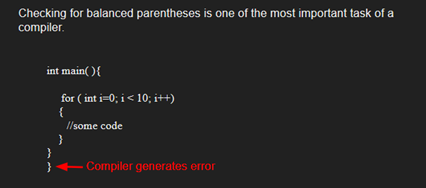
Algorithm:
- Declare a character stack S.
- Now traverse the expression string exp.
- If the current character is a starting bracket ('(' or '{' or '[') then push it to stack.
- If the current character is a closing bracket (')' or '}' or ']') then pop from stack and if the popped character is the matching starting bracket then fine else brackets are not balanced.
- After complete traversal, if there is some starting bracket left in stack then "not balanced"
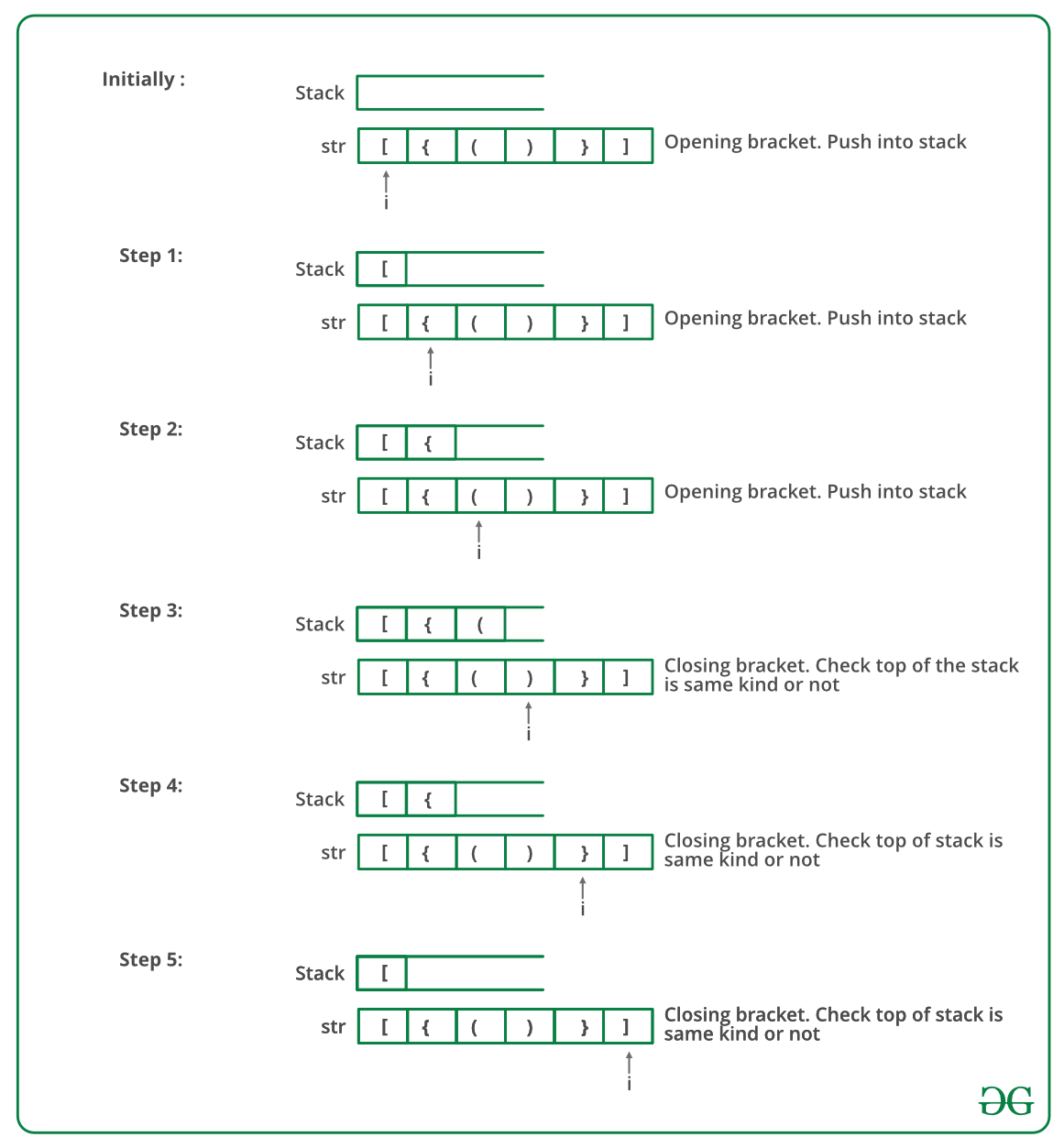
Below image is a dry run of the above approach:
Below is the implementation of the above approach:
#include <stdio.h>
#include <stdlib.h>
#define bool int

// structure of a stack node
struct sNode {
    char data;
    struct sNode* next;
};

// Function to push an item to stack
void push(struct sNode** top_ref, int new_data);

// Function to pop an item from stack
int pop(struct sNode** top_ref);

// Returns 1 if character1 and character2 are matching left
// and right Brackets
bool isMatchingPair(char character1, char character2)
{
    if (character1 == '(' && character2 == ')')
        return 1;
    else if (character1 == '{' && character2 == '}')
        return 1;
    else if (character1 == '[' && character2 == ']')
        return 1;
    else
        return 0;
}

// Return 1 if expression has balanced Brackets
bool areBracketsBalanced(char exp[])
{
    int i = 0;

    // Declare an empty character stack
    struct sNode* stack = NULL;

    // Traverse the given expression to check matching
    // brackets
    while (exp[i])
    {
        // If the exp[i] is a starting bracket then push
        // it
        if (exp[i] == '{' || exp[i] == '(' || exp[i] == '[')
            push(&stack, exp[i]);

        // If exp[i] is an ending bracket then pop from
        // stack and check if the popped bracket is a
        // matching pair*/
        if (exp[i] == '}' || exp[i] == ')'
            || exp[i] == ']') {

            // If we see an ending bracket without a pair
            // then return false
            if (stack == NULL)
                return 0;

            // Pop the top element from stack, if it is not
            // a pair bracket of character then there is a
            // mismatch.
            // his happens for expressions like {(})
            else if (!isMatchingPair(pop(&stack), exp[i]))
                return 0;
        }
        i++;
    }

    // If there is something left in expression then there
    // is a starting bracket without a closing
    // bracket
    if (stack == NULL)
        return 1; // balanced
    else
        return 0; // not balanced
}

// Driver code
int main()
{
    char exp[100] = "{()}[]";

    // Function call
    if (areBracketsBalanced(exp))
        printf("Balanced
");
    else
        printf("Not Balanced
");
    return 0;
}

// Function to push an item to stack
void push(struct sNode** top_ref, int new_data)
{
    // allocate node
    struct sNode* new_node
        = (struct sNode*)malloc(sizeof(struct sNode));

    if (new_node == NULL) {
        printf("Stack overflow n");
        getchar();
        exit(0);
    }

    // put in the data
    new_node->data = new_data;

    // link the old list of the new node
    new_node->next = (*top_ref);

    // move the head to point to the new node
    (*top_ref) = new_node;
}

// Function to pop an item from stack
int pop(struct sNode** top_ref)
{
    char res;
    struct sNode* top;

    // If stack is empty then error
    if (*top_ref == NULL) {
        printf("Stack overflow n");
        getchar();
        exit(0);
    }
    else {
        top = *top_ref;
        res = top->data;
        *top_ref = top->next;
        free(top);
        return res;
    }
}
Output
Balanced
Time Complexity: O(n)
Auxiliary Space: O(n) for stack.
Please refer complete article on Check for Balanced Brackets in an expression (well-formedness) using Stack for more details!
