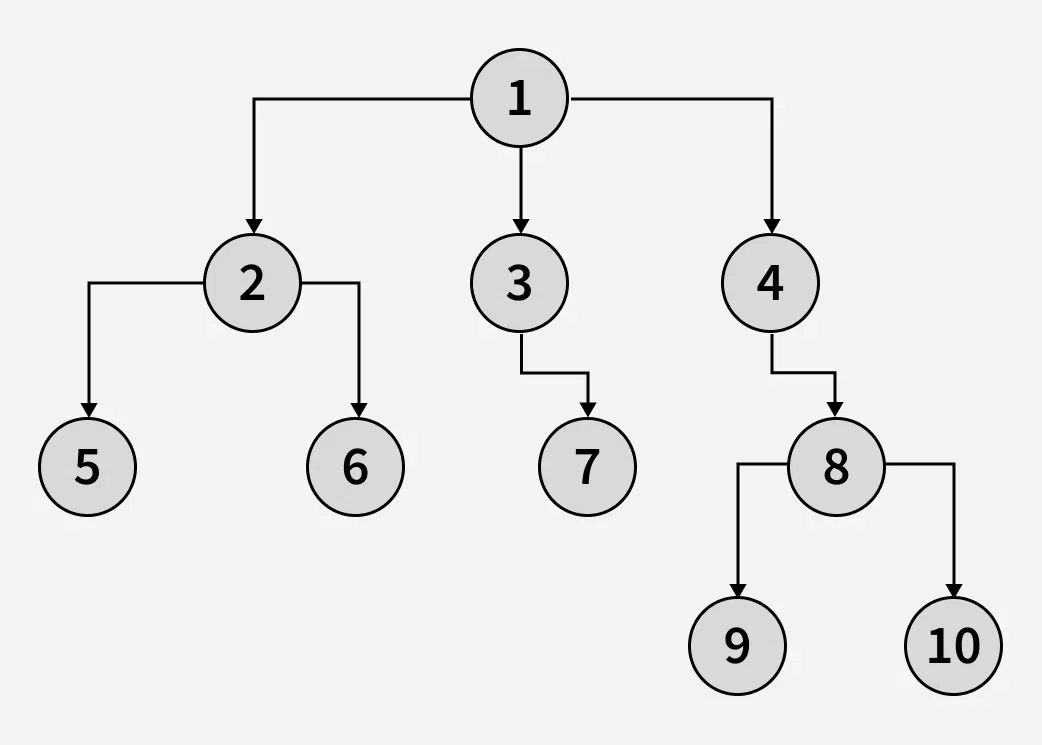
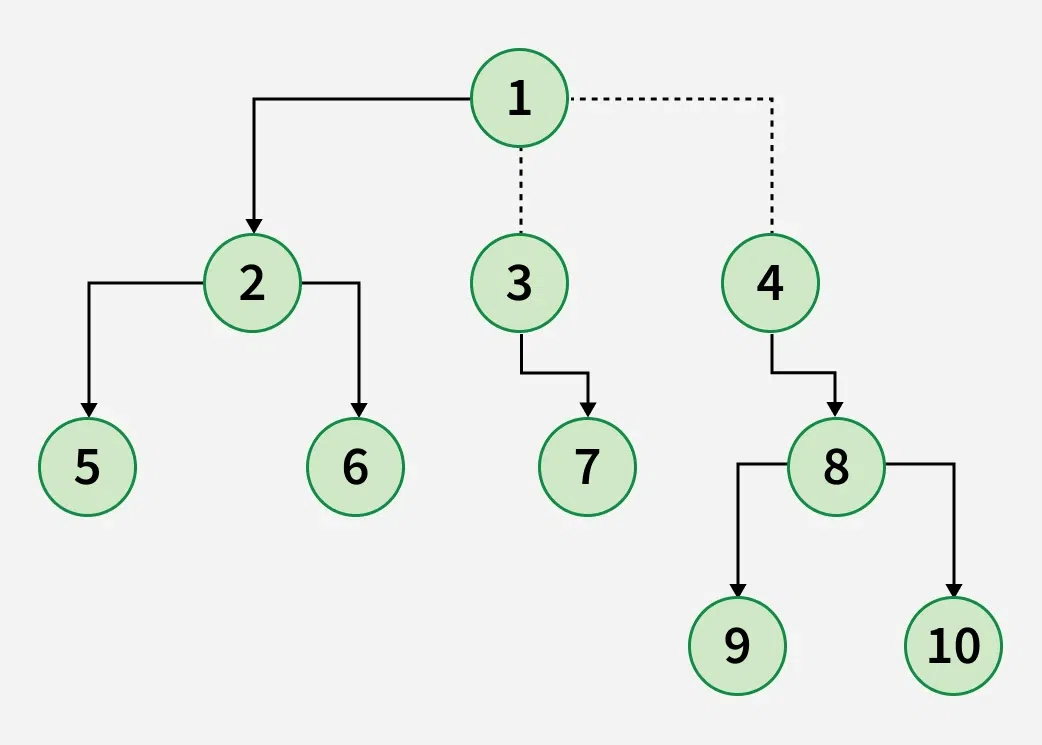
Given a tree of n even nodes. The task is to find the maximum number of edges to be removed from the given tree to obtain a forest of trees having an even number of nodes. This problem is always solvable as the given graph has even nodes.
Examples:
Input:
Output: 2 Explanation: By removing 2 edges shown below, we can obtain the forest with even node tree.
Approach:
The idea is to find a subtree with even number of nodes and remove it from rest of tree by removing the edge connecting it. After removal, we are left with tree with even node only because initially we have even number of nodes in the tree and removed subtree has also even node. Repeat the same procedure until we left with the tree that cannot be further decomposed in this manner.
To do this, the idea is to use Depth First Search to traverse the tree. Implement DFS function in such a manner that it will return number of nodes in the subtree whose root is node on which DFS is performed. If the number of nodes is even then remove the edge, else ignore.
C++
// C++ program to find maximum number to be removed// to convert a tree into a forest containing trees of// even number of nodes#include<bits/stdc++.h>usingnamespacestd;// Return the number of nodes of subtree having// node as a root.intdfs(vector<int>tree[],vector<int>&visit,int&ans,intnode){intnum=0,cnt=0;// Mark node as visited.visit[node]=1;// Traverse the adjacency list to find non-// visited node.for(inti=0;i<tree[node].size();i++){if(visit[tree[node][i]]==0){// Finding number of nodes of the subtree// of a subtree.cnt=dfs(tree,visit,ans,tree[node][i]);// If nodes are even, increment number of// edges to be removed.if(cnt%2==0){ans++;}else{// Else leave the node as// child of subtree.num+=cnt;}}}returnnum+1;}// Return the maximum number of edges to remove// to make the forest.intmaxEdge(vector<int>tree[],intn){vector<int>visit(n+2,0);intans=0;dfs(tree,visit,ans,1);returnans;}intmain(){intn=10;vector<int>tree[n+2];// Tree structure://// 1// / | \ // 2 3 4// / \ | |// 5 6 7 8// / \ // 9 10tree[1].push_back(2);tree[2].push_back(1);tree[1].push_back(3);tree[3].push_back(1);tree[1].push_back(4);tree[4].push_back(1);tree[2].push_back(5);tree[5].push_back(2);tree[2].push_back(6);tree[6].push_back(2);tree[3].push_back(7);tree[7].push_back(3);tree[4].push_back(8);tree[8].push_back(4);tree[8].push_back(9);tree[9].push_back(8);tree[8].push_back(10);tree[10].push_back(8);intresult=maxEdge(tree,n);cout<<result<<endl;return0;}
Java
// Java program to find maximum number to be removed// to convert a tree into a forest containing trees of// even number of nodesimportjava.util.ArrayList;importjava.util.Arrays;classGfG{// Return the number of nodes of subtree having node as a root.staticintdfs(ArrayList<Integer>[]tree,boolean[]visit,int[]ans,intnode){intnum=0,cnt;// Mark node as visited.visit[node]=true;// Traverse the adjacency list to find non-visited node.for(intneighbor:tree[node]){if(!visit[neighbor]){// Finding number of nodes of the subtree// of a subtree.cnt=dfs(tree,visit,ans,neighbor);// If nodes are even, increment number of edges to remove.if(cnt%2==0){ans[0]++;}else{// Else leave the node as child of subtree.num+=cnt;}}}returnnum+1;}// Return the maximum number of edges to remove// to make forest.staticintmaxEdge(ArrayList<Integer>[]tree,intn){boolean[]visit=newboolean[n+1];int[]ans={0};Arrays.fill(visit,false);// Perform DFS from node 1dfs(tree,visit,ans,1);returnans[0];}publicstaticvoidmain(String[]args){intn=10;// Tree structure://// 1// / | \// 2 3 4// / \ | |// 5 6 7 8// / \// 9 10ArrayList<Integer>[]tree=newArrayList[n+1];for(inti=0;i<n+1;i++){tree[i]=newArrayList<>();}tree[1].add(2);tree[2].add(1);tree[1].add(3);tree[3].add(1);tree[1].add(4);tree[4].add(1);tree[2].add(5);tree[5].add(2);tree[2].add(6);tree[6].add(2);tree[3].add(7);tree[7].add(3);tree[4].add(8);tree[8].add(4);tree[8].add(9);tree[9].add(8);tree[8].add(10);tree[10].add(8);System.out.println(maxEdge(tree,n));}}
Python
# Python program to find maximum number to be removed# to convert a tree into a forest containing trees of# even number of nodesdefdfs(tree,visit,ans,node):num=0# Mark node as visited.visit[node]=True# Traverse the adjacency list to find# non-visited node.forneighborintree[node]:ifnotvisit[neighbor]:# Finding number of nodes of the subtree.cnt=dfs(tree,visit,ans,neighbor)# If nodes are even, increment number of# edges to remove.ifcnt%2==0:ans[0]+=1else:# Else leave the node as child of subtree.num+=cntreturnnum+1# Return the maximum number of edge to remove# to make forest.defmaxEdge(tree,n):visit=[False]*(n+1)ans=[0]# Perform DFS from node 1dfs(tree,visit,ans,1)returnans[0]if__name__=='__main__':n=10# Tree structure:## 1# / | \# 2 3 4# / \ | |# 5 6 7 8# / \# 9 10tree=[[]for_inrange(n+1)]tree[1].append(2)tree[2].append(1)tree[1].append(3)tree[3].append(1)tree[1].append(4)tree[4].append(1)tree[2].append(5)tree[5].append(2)tree[2].append(6)tree[6].append(2)tree[3].append(7)tree[7].append(3)tree[4].append(8)tree[8].append(4)tree[8].append(9)tree[9].append(8)tree[8].append(10)tree[10].append(8)print(maxEdge(tree,n))
C#
// C# program to find maximum number to be removed// to convert a tree into a forest containing trees of// even number of nodesusingSystem;usingSystem.Collections.Generic;classGfG{// Return the number of nodes of subtree having node as a root.staticintdfs(List<int>[]tree,bool[]visit,refintans,intnode){intnum=0,cnt;// Mark node as visited.visit[node]=true;// Traverse the adjacency list to find non-visited node.foreach(intneighborintree[node]){if(!visit[neighbor]){// Finding number of nodes of the subtree.cnt=dfs(tree,visit,refans,neighbor);// If nodes are even, increment number// of edges to remove.if(cnt%2==0){ans++;}else{// Else leave the node as child of subtree.num+=cnt;}}}returnnum+1;}// Return the maximum number of edges to remove// to make forest.staticintmaxEdge(List<int>[]tree,intn){bool[]visit=newbool[n+1];intans=0;// Perform DFS from node 1dfs(tree,visit,refans,1);returnans;}staticvoidMain(string[]args){intn=10;// Tree structure://// 1// / | \// 2 3 4// / \ | |// 5 6 7 8// / \// 9 10List<int>[]tree=newList<int>[n+1];for(inti=0;i<n+1;i++){tree[i]=newList<int>();}tree[1].Add(2);tree[2].Add(1);tree[1].Add(3);tree[3].Add(1);tree[1].Add(4);tree[4].Add(1);tree[2].Add(5);tree[5].Add(2);tree[2].Add(6);tree[6].Add(2);tree[3].Add(7);tree[7].Add(3);tree[4].Add(8);tree[8].Add(4);tree[8].Add(9);tree[9].Add(8);tree[8].Add(10);tree[10].Add(8);Console.WriteLine(maxEdge(tree,n));}}
JavaScript
// JavaScript program to find maximum number to be removed// to convert a tree into a forest containing trees of// even number of nodesfunctiondfs(tree,visit,ans,node){letnum=0;// Mark node as visited.visit[node]=true;// Traverse the adjacency list to find non-visited node.for(letneighboroftree[node]){if(!visit[neighbor]){// Finding number of nodes of the subtree.letcnt=dfs(tree,visit,ans,neighbor);// If nodes are even, increment number// of edges to remove.if(cnt%2===0){ans.count++;}else{// Else leave the node as child of subtree.num+=cnt;}}}returnnum+1;}// Return the maximum number of edges to remove// to make forest.functionmaxEdge(tree,n){constvisit=newArray(n+1).fill(false);constans={count:0};// Perform DFS from node 1dfs(tree,visit,ans,1);returnans.count;}constn=10;// Tree structure://// 1// / | \// 2 3 4// / \ | |// 5 6 7 8// / \// 9 10consttree=Array.from({length:n+1},()=>[]);tree[1].push(2);tree[2].push(1);tree[1].push(3);tree[3].push(1);tree[1].push(4);tree[4].push(1);tree[2].push(5);tree[5].push(2);tree[2].push(6);tree[6].push(2);tree[3].push(7);tree[7].push(3);tree[4].push(8);tree[8].push(4);tree[8].push(9);tree[9].push(8);tree[8].push(10);tree[10].push(8);console.log(maxEdge(tree,n));
Output
2
Time Complexity: O(n), where n is the number of nodes in tree. Auxiliary Space: O(n) For taking visiting array.