
Given a directed graph of N vertices valued from 0 to N - 1 and array graph[] of size K represents the Adjacency List of the given graph, the task is to count all Hamiltonian Paths in it which start at the 0th vertex and end at the (N - 1)th vertex.
Note: Hamiltonian path is defined as the path which visits every vertex of the graph exactly once.
Examples:
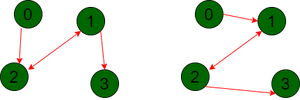
Input: N = 4, K = 6, graph[][] = {{1, 2}, {1, 3}, {2, 3}, {3, 2}, {2, 4}, {3, 4}}
Output: 2
Explanation:
The paths below shown are 1 -> 3 -> 2 -> 4 and 1 -> 2 -> 3 -> 4 starts at 1 and ends at 4 and are called Hamiltonian paths.
Input: N = 2, K = 1, graph[][] = {{1, 2}}
Output: 1
Approach: The given problem can be solved by using Bitmasking with Dynamic Programming, and iterate over all subsets of the given vertices represented by an N size mask and check if there exists a Hamiltonian Path that starts at the 0th vertex and ends at (N - 1)th vertex and count all such paths. Let's say for a graph having N vertices S represents a bitmask where S = 0 to S = (1 << N) -1 and dp[i][S] represents the number of paths that visits every vertex in the mask S and ends at i then the valid recurrence will be given as dp[i][S] = ∑ dp[j][S XOR 2i] where j ∈ S and there is an edge from j to i where S XOR 2i represents the subset which does not have the ith vertex in it and there must be an edge from j to i. Follow the steps below to solve the given problem:
- Initialize a 2-D array dp[N][2N] with 0 and set dp[0][1] as 1.
- Iterate over the range from [2, 2N - 1] using the variable i and check for the mask having all bits set in it.
- Iterate over the range from [0, N) using the variable end and traverse over all bits of the current mask and assume each bit as the ending bit.
- Initialize the variable prev as i - (1 << end).
- Iterate over the range [0, size) where size is the size of the array graph[end] using the variable it and traverse over the adjacent vertices of the current ending bit and update the dp[][] array like this dp[end][i] += dp[it][prev].
- Iterate over the range from [0, N) using the variable end and traverse over all bits of the current mask and assume each bit as the ending bit.
- After performing the above steps, print the value of dp[N-1][2N - 1] as the answer.
Below is the implementation of the above approach:
// C++ program for the above approach
#include <bits/stdc++.h>
using namespace std;

// Function to find all possible paths
void findAllPaths(
    int N, vector<vector<int> >& graph)
{

    // Initialize a dp array
    int dp[N][(1 << N)];

    // Initialize it with 0
    memset(dp, 0, sizeof dp);

    // Initialize for the first vertex
    dp[0][1] = 1;

    // Iterate over all the masks
    for (int i = 2; i < (1 << N); i++) {

        // If the first vertex is absent
        if ((i & (1 << 0)) == 0)
            continue;

        // Only consider the full subsets
        if ((i & (1 << (N - 1)))
            && i != ((1 << N) - 1))
            continue;

        // Choose the end city
        for (int end = 0; end < N; end++) {

            // If this city is not in the subset
            if (i & (1 << end) == 0)
                continue;

            // Set without the end city
            int prev = i - (1 << end);

            // Check for the adjacent cities
            for (int it : graph[end]) {
                if ((i & (1 << it))) {
                    dp[end][i] += dp[it][prev];
                }
            }
        }
    }

    // Print the answer
    cout << dp[N - 1][(1 << N) - 1];
}

// Driver Code
int main()
{
    int N = 4;
    vector<vector<int> > graph(N);
    graph[1].push_back(0);
    graph[2].push_back(0);
    graph[2].push_back(1);
    graph[1].push_back(2);
    graph[3].push_back(1);
    graph[3].push_back(2);

    findAllPaths(N, graph);

    return 0;
}
//Java program to count all Hamiltonian
//paths in a given directed graph

import java.io.*;
import java.util.*;

class GFG {

    // Function to find all possible paths
    static void findAllPaths(int N, List<List<Integer>> graph){

        // Initialize a dp array
        int dp[][] = new int[N][(1<<N)];

        // Initialize it with 0
        for(int i=0;i<N;i++){
            for(int j=0;j<(1<<N);j++){
                dp[i][j]=0;
            }
        }

        // Initialize for the first vertex
        dp[0][1] = 1;

        // Iterate over all the masks
        for (int i = 2; i < (1 << N); i++) {

            // If the first vertex is absent
            if ((i & (1 << 0)) == 0){
                continue;
            }

            // Only consider the full subsets
            if ((i & (1 << (N - 1)))==1 && (i != ((1 << N) - 1))){
                continue;
            }

            // Choose the end city
            for (int end = 0; end < N; end++) {

                // If this city is not in the subset
                if ((i & (1 << end)) == 0){
                    continue;
                }

                // Set without the end city
                int prev = i - (1 << end);

                // Check for the adjacent cities
                for (int it : graph.get(end)) {
                    if ((i & (1 << it))!=0) {
                        dp[end][i] += dp[it][prev];
                    }
                }
            }
        }
        System.out.print(dp[N - 1][(1 << N) - 1]);
    }

    //Driver Code
    public static void main (String[] args) {
        int N=4;
        List<List<Integer>> graph = new ArrayList<>();
        for(int i=0;i<N;i++){
            graph.add(new ArrayList<Integer>());
        }
        graph.get(1).add(0);
        graph.get(2).add(0);
        graph.get(2).add(1);
        graph.get(1).add(2);
        graph.get(3).add(1);
        graph.get(3).add(2);

        findAllPaths(N, graph);

    }
}

//This code is contributed by shruti456rawal
# python program for the above approach

# Function to find all possible paths
def findAllPaths(N, graph):

        # Initialize a dp array

        # Initialize it with 0
    dp = [[0 for _ in range(1 << N)] for _ in range(N)]

    # Initialize for the first vertex
    dp[0][1] = 1

    # Iterate over all the masks
    for i in range(2, (1 << N)):

        # If the first vertex is absent
        if ((i & (1 << 0)) == 0):
            continue

         # Only consider the full subsets
        if ((i & (1 << (N - 1)))and i != ((1 << N) - 1)):
            continue

        # Choose the end city
        for end in range(0, N):

             # If this city is not in the subset
            if (i & (1 << end) == 0):
                continue

                # Set without the end city
            prev = i - (1 << end)

            # Check for the adjacent cities

            for it in graph[end]:
                if ((i & (1 << it))):
                    dp[end][i] += dp[it][prev]

        # Print the answer
    print(dp[N - 1][(1 << N) - 1])

# Driver Code
if __name__ == "__main__":

    N = 4
    graph = [[] for _ in range(N)]
    graph[1].append(0)
    graph[2].append(0)
    graph[2].append(1)
    graph[1].append(2)
    graph[3].append(1)
    graph[3].append(2)

    findAllPaths(N, graph)

    # This code is contributed by rakeshsahni
<script>
// Javascript program for the above approach

// Function to find all possible paths
function findAllPaths(N, graph) {
  // Initialize a dp array
  let dp = new Array(N).fill(0).map(() => new Array(1 << N).fill(0));

  // Initialize for the first vertex
  dp[0][1] = 1;

  // Iterate over all the masks
  for (let i = 2; i < 1 << N; i++) {
    // If the first vertex is absent
    if ((i & (1 << 0)) == 0) continue;

    // Only consider the full subsets
    if (i & (1 << (N - 1)) && i != (1 << N) - 1) continue;

    // Choose the end city
    for (let end = 0; end < N; end++) {
      // If this city is not in the subset
      if (i & (1 << end == 0)) continue;

      // Set without the end city
      let prev = i - (1 << end);

      // Check for the adjacent cities
      for (let it of graph[end]) {
        if (i & (1 << it)) {
          dp[end][i] += dp[it][prev];
        }
      }
    }
  }

  // Print the answer
  document.write(dp[N - 1][(1 << N) - 1]);
}

// Driver Code

let N = 4;
let graph = new Array(N).fill(0).map(() => []);
graph[1].push(0);
graph[2].push(0);
graph[2].push(1);
graph[1].push(2);
graph[3].push(1);
graph[3].push(2);

findAllPaths(N, graph);

// This code is contributed by gfgking.
</script>
//C# program to count all Hamiltonian
//paths in a given directed graph

using System;
using System.Collections.Generic;

public class GFG
{
    // Function to find all possible paths
    static void findAllPaths(int N, List<List<int>> graph)
    {
        // Initialize a dp array
        int[][] dp = new int[N][];
        for (int i = 0; i < N; i++)
        {
            dp[i] = new int[1 << N];
        }

        // Initialize it with 0
        for (int i = 0; i < N; i++)
        {
            for (int j = 0; j < (1 << N); j++)
            {
                dp[i][j] = 0;
            }
        }

        // Initialize for the first vertex
        dp[0][1] = 1;

        // Iterate over all the masks
        for (int i = 2; i < (1 << N); i++)
        {
            // If the first vertex is absent
            if ((i & (1 << 0)) == 0)
            {
                continue;
            }

            // Only consider the full subsets
            if ((i & (1 << (N - 1))) == 1 && (i != ((1 << N) - 1)))
            {
                continue;
            }

            // Choose the end city
            for (int end = 0; end < N; end++)
            {
                // If this city is not in the subset
                if ((i & (1 << end)) == 0)
                {
                    continue;
                }

                // Set without the end city
                int prev = i - (1 << end);

                // Check for the adjacent cities
                foreach (int it in graph[end])
                {
                    if ((i & (1 << it)) != 0)
                    {
                        dp[end][i] += dp[it][prev];
                    }
                }
            }
        }
        Console.WriteLine(dp[N - 1][(1 << N) - 1]);
    }

    //Driver Code
    public static void Main(string[] args)
    {
        int N = 4;
        List<List<int>> graph = new List<List<int>>();
        for (int i = 0; i < N; i++)
        {
            graph.Add(new List<int>());
        }
        graph[1].Add(0);
        graph[2].Add(0);
        graph[2].Add(1);
        graph[1].Add(2);
        graph[3].Add(1);
        graph[3].Add(2);

        findAllPaths(N, graph);
    }
}
Output
2
Time Complexity: O(N*2N)
Auxiliary Space: O(1)
