
In mathematics, a Delannoy number D describes the number of paths from the southwest corner (0, 0) of a rectangular grid to the northeast corner (m, n), using only single steps north, northeast, or east.
For Example, D(3, 3) equals 63.
Delannoy Number can be calculated by:
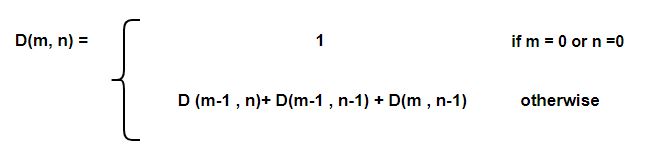
Delannoy number can be used to find:
- Counts the number of global alignments of two sequences of lengths m and n.
- Number of points in an m-dimensional integer lattice that are at most n steps from the origin.
- In cellular automata, the number of cells in an m-dimensional von Neumann neighborhood of radius n.
- Number of cells on a surface of an m-dimensional von Neumann neighborhood of radius n.
Examples :
Input : n = 3, m = 3
Output : 63
Input : n = 4, m = 5
Output : 681
Below is the implementation of finding Delannoy Number:
// CPP Program of finding nth Delannoy Number.
#include <bits/stdc++.h>
using namespace std;

// Return the nth Delannoy Number.
int Delannoy(int n, int m)
{
    // Base case
    if (m == 0 || n == 0)
        return 1;

    // Recursive step.
    return Delannoy(m - 1, n) +
          Delannoy(m - 1, n - 1) +
          Delannoy(m, n - 1);
}

// Driven Program
int main()
{
    int n = 3, m = 4;
    cout << Delannoy(n, m) << endl;
    return 0;
}
// Java Program for finding nth Delannoy Number.
import java.util.*;
import java.lang.*;

public class GfG{

    // Return the nth Delannoy Number.
    public static int Delannoy(int n, int m)
    {
        // Base case
        if (m == 0 || n == 0)
            return 1;

        // Recursive step.
        return Delannoy(m - 1, n) +
            Delannoy(m - 1, n - 1) +
            Delannoy(m, n - 1);
    }

    // driver function
    public static void main(String args[]){
        int n = 3, m = 4;
        System.out.println(Delannoy(n, m));
    }
}

/* This code is contributed by Sagar Shukla. */
# Python3 Program for finding
# nth Delannoy Number.

# Return the nth Delannoy Number.
def Delannoy(n, m):

    # Base case
    if (m == 0 or n == 0) :
        return 1

    # Recursive step.
    return Delannoy(m - 1, n) + Delannoy(m - 1, n - 1) + Delannoy(m, n - 1)

# Driven code
n = 3
m = 4;
print( Delannoy(n, m) )

# This code is contributed by "rishabh_jain".
// C# Program for finding nth Delannoy Number.
using System;

public class GfG {

    // Return the nth Delannoy Number.
    public static int Delannoy(int n, int m)
    {

        // Base case
        if (m == 0 || n == 0)
            return 1;

        // Recursive step.
        return dealnnoy(m - 1, n) +
               dealnnoy(m - 1, n - 1) +
                     dealnnoy(m, n - 1);
    }

    // driver function
    public static void Main()
    {
        int n = 3, m = 4;
        Console.WriteLine(dealnnoy(n, m));
    }
}

/* This code is contributed by vt_m. */
<script>
// javascript Program for finding nth Delannoy Number.

 // Return the nth Delannoy Number.
   function Delannoy(n, m)
    {
        // Base case
        if (m == 0 || n == 0)
            return 1;

        // Recursive step.
        return Delannoy(m - 1, n) +
            Delannoy(m - 1, n - 1) +
            Delannoy(m, n - 1);
    }

// Driver code

         let n = 3, m = 4;
        document.write(Delannoy(n, m));

       // This code is contributed by susmitakundugoaldanga.
</script>
<?php
// PHP Program of finding nth
// Delannoy Number.

// Return the nth Delannoy Number.
function Delannoy( $n, $m)
{

    // Base case
    if ($m == 0 or $n == 0)
        return 1;

    // Recursive step.
    return Delannoy($m - 1, $n) +
           Delannoy($m - 1, $n - 1) +
           Delannoy($m, $n - 1);
}

    // Driver Code
    $n = 3;
    $m = 4;
    echo Delannoy($n, $m);

// This code is contributed by anuj_67.
?>
Output
129
Below is the Dynamic Programming program to find nth Delannoy Number:
// CPP Program of finding nth Delannoy Number.
#include <bits/stdc++.h>
using namespace std;

// Return the nth Delannoy Number.
int Delannoy(int n, int m)
{
    int dp[m + 1][n + 1];

    // Base cases
    for (int i = 0; i <= m; i++)
        dp[i][0] = 1;
    for (int i = 0; i <= m; i++)
        dp[0][i] = 1;

    for (int i = 1; i <= m; i++)
        for (int j = 1; j <= n; j++)
            dp[i][j] = dp[i - 1][j] +
                       dp[i - 1][j - 1] +
                       dp[i][j - 1];

    return dp[m][n];
}

// Driven Program
int main()
{
    int n = 3, m = 4;
    cout << Delannoy(n, m) << endl;
    return 0;
}
// Java Program of finding nth Delannoy Number.

import java.io.*;

class GFG {

    // Return the nth Delannoy Number.
    static int Delannoy(int n, int m)
    {
        int dp[][]=new int[m + 1][n + 1];

        // Base cases
        for (int i = 0; i <= m; i++)
            dp[i][0] = 1;
        for (int i = 0; i < m; i++)
            dp[0][i] = 1;

        for (int i = 1; i <= m; i++)
            for (int j = 1; j <= n; j++)
                dp[i][j] = dp[i - 1][j] +
                           dp[i - 1][j - 1] +
                           dp[i][j - 1];

        return dp[m][n];
    }

    // Driven Program
    public static void main(String args[])
    {
        int n = 3, m = 4;
        System.out.println(Delannoy(n, m));

    }
}

// This code is contributed by Nikita Tiwari.
# Python3 Program for finding nth
# Delannoy Number.

# Return the nth Delannoy Number.
def Delannoy (n, m):
    dp = [[0 for x in range(n+1)] for x in range(m+1)]

    # Base cases
    for i in range(m):
        dp[0][i] = 1

    for i in range(1, m + 1):
        dp[i][0] = 1

    for i in range(1, m + 1):
        for j in range(1, n + 1):
            dp[i][j] = dp[i - 1][j] + dp[i - 1][j - 1] + dp[i][j - 1];

    return dp[m][n]

# Driven code
n = 3
m = 4
print(Delannoy(n, m))

# This code is contributed by "rishabh_jain".
// C# Program of finding nth Delannoy Number.
using System;

class GFG {

    // Return the nth Delannoy Number.
    static int Delannoy(int n, int m)
    {

        int[, ] dp = new int[m + 1, n + 1];

        // Base cases
        for (int i = 0; i <= m; i++)
            dp[i, 0] = 1;
        for (int i = 0; i < m; i++)
            dp[0, i] = 1;

        for (int i = 1; i <= m; i++)
            for (int j = 1; j <= n; j++)
                dp[i, j] = dp[i - 1, j]
                     + dp[i - 1, j - 1]
                         + dp[i, j - 1];

        return dp[m, n];
    }

    // Driven Program
    public static void Main()
    {
        int n = 3, m = 4;

        Console.WriteLine(Delannoy(n, m));
    }
}

// This code is contributed by vt_m.
<script>

// Javascript Program of finding
// nth Delannoy Number.

// Return the nth Delannoy Number.
function Delannoy(n, m)
{
    var dp = Array.from(Array(m+1),
        () => Array(n+1));

    // Base cases
    for (var i = 0; i <= m; i++)
        dp[i][0] = 1;
    for (var i = 0; i <= m; i++)
        dp[0][i] = 1;

    for (var i = 1; i <= m; i++)
        for (var j = 1; j <= n; j++)
            dp[i][j] = dp[i - 1][j] +
                       dp[i - 1][j - 1] +
                       dp[i][j - 1];

    return dp[m][n];
}

// Driven Program
var n = 3, m = 4;
document.write( Delannoy(n, m));


</script>
<?php
// PHP Program of finding
// nth Delannoy Number.

// Return the nth Delannoy Number.
function Delannoy($n, $m)
{
    $dp[$m + 1][$n + 1] = 0;

    // Base cases
    for ($i = 0; $i <= $m; $i++)
        $dp[$i][0] = 1;
    for ( $i = 0; $i <= $m; $i++)
        $dp[0][$i] = 1;

    for ($i = 1; $i <= $m; $i++)
        for ($j = 1; $j <= $n; $j++)
            $dp[$i][$j] = $dp[$i - 1][$j] +
                      $dp[$i - 1][$j - 1] +
                           $dp[$i][$j - 1];

    return $dp[$m][$n];
}

// Driven Code
$n = 3; $m = 4;
echo Delannoy($n, $m) ;

// This code is contributed by SanjuTomar
?>
Output
129
Time complexity: O(m*n)
space complexity: O(n*m)
Efficient approach: Space optimization
In previous approach the current value dp[i][j] is only depend upon the current and previous row values of DP. So to optimize the space complexity we use a single 1D array to store the computations.
Implementation steps:
- Create a 1D vector dp of size n+1 and initialize it with 1.
- Now iterate over subproblems by the help of nested loop and get the current value from previous computations.
- Now Create a temporary variable prev used to store the previous computations and temp to update prev after every iteration.
- After every iteration assign the value of temp to prev for further iteration.
- At last return and print the final answer stored in dp[n].
Implementation:
// C++ code for above approach
#include <bits/stdc++.h>
using namespace std;

// Return the nth Delannoy Number.
int Delannoy(int n, int m)
{
    // initialize dp
    vector<int> dp(n + 1, 1);

    // iterate over subproblems
    for (int i = 1; i <= m; i++) {

        // to keep track of previous element
        int prev = 1;
        for (int j = 1; j <= n; j++) {
            int temp = dp[j];
            dp[j] = prev + dp[j] + dp[j - 1];

            // assigning value to iterate further
            prev = temp;
        }
    }

    // return answer
    return dp[n];
}

// Driven Program
int main()
{
    int n = 3, m = 4;
    cout << Delannoy(n, m) << endl;
    return 0;
}
import java.util.*;

public class Main {
  public static int Delannoy(int n, int m)
  {
    // initialize dp
    int[] dp = new int[n + 1];
    Arrays.fill(dp, 1);

    // iterate over subproblems
    for (int i = 1; i <= m; i++) {
      // to keep track of previous element
      int prev = 1;
      for (int j = 1; j <= n; j++) {
        int temp = dp[j];
        dp[j] = prev + dp[j] + dp[j - 1];

        // assigning value to iterate further
        prev = temp;
      }
    }

    // return answer
    return dp[n];
  }

  public static void main(String[] args)
  {
    int n = 3, m = 4;
    System.out.println(Delannoy(n, m));
  }
}
# Python code for above approach

# Return the nth Delannoy Number.


def Delannoy(n, m):
    # initialize dp
    dp = [1] * (n+1)

    # iterate over subproblems
    for i in range(1, m+1):
        # to keep track of previous element
        prev = 1
        for j in range(1, n+1):
            temp = dp[j]
            dp[j] = prev + dp[j] + dp[j-1]

            # assigning value to iterate further
            prev = temp

    # return answer
    return dp[n]


# Driven Program
n = 3
m = 4
print(Delannoy(n, m))
using System;

namespace DelannoyNumber
{
    class Program
    {
        // Return the nth Delannoy Number.
        static int Delannoy(int n, int m)
        {
            // Initialize dp
            int[] dp = new int[n + 1];
            for (int i = 0; i <= n; i++)
            {
                dp[i] = 1;
            }

            // Iterate over subproblems
            for (int i = 1; i <= m; i++)
            {
                // To keep track of the previous element
                int prev = 1;
                for (int j = 1; j <= n; j++)
                {
                    int temp = dp[j];
                    dp[j] = prev + dp[j] + dp[j - 1];

                    // Assigning value to iterate further
                    prev = temp;
                }
            }

            // Return answer
            return dp[n];
        }

        // Driven Program
        static void Main(string[] args)
        {
            int n = 3, m = 4;
            Console.WriteLine(Delannoy(n, m));
        }
    }
}
// Javascript code addition

// Return the nth Delannoy Number.
function Delannoy(n, m) {
  // initialize dp
  let dp = new Array(n + 1).fill(1);

  // iterate over subproblems
  for (let i = 1; i <= m; i++) {
    // to keep track of previous element
    let prev = 1;
    for (let j = 1; j <= n; j++) {
      let temp = dp[j];
      dp[j] = prev + dp[j] + dp[j - 1];

      // assigning value to iterate further
      prev = temp;
    }
  }

  // return answer
  return dp[n];
}

// Driven Program
let n = 3, m = 4;
console.log(Delannoy(n, m));

// The code is contributed by Anjali goel.
Output
129
Time complexity: O(m*n)
Auxiliary space: O(n)
