
Given two polynomial A(x) and B(x), find the product C(x) = A(x)*B(x). There is already an O(
A coefficient representation of a polynomial
Example-
Coefficient representation of A(x) = (9, -10, 7, 6)
Coefficient representation of B(x) = (-5, 4, 0, -2)
Input :
 A[] = {9, -10, 7, 6}
 B[] = {-5, 4, 0, -2}
Output :
-12x^6 - 14x^5 + 44x^4 - 20x^3 -75x^2 + 86x - 45
We can do better, if we represent the polynomial in another form.
Idea is to represent polynomial in point-value form and then compute the product. A point-value representation of a polynomial A(x) of degree-bound n is a set of n point-value pairs is{ (x0, y0), (x1, y1), ..., (xn-1, yn-1)} such that all of the xi are distinct and yi = A(xi) for i = 0, 1, ..., n-1.
Example
A(x) = x^3 - 2x + 1 xi -- 0, 1, 2, 3 A(xi) -- 1, 0, 5, 22
Point-value representation of above polynomial is { (0, 1), (1, 0), (2, 5), (3, 22) }. Using Horner’s method, (discussed here), n-point evaluation takes time O(
So far we discussed,
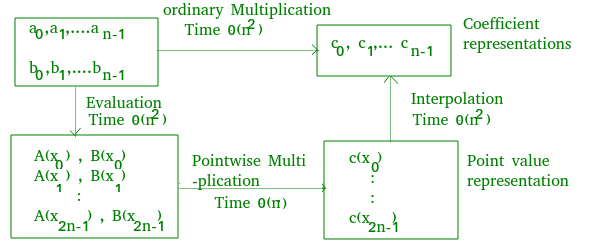
.
This idea still solves the problem in O(
DFT
DFT is evaluating values of polynomial at n complex nth roots of unity
The product of two polynomials of degree-bound n is a polynomial of degree-bound 2n. Before evaluating the input polynomials A and B, therefore, we first double their degree-bounds to 2n by adding n high-order coefficients of 0. Because the vectors have 2n elements, we use “complex 2nth roots of unity, ” which are denoted by the W2n (omega 2n). We assume that n is a power of 2; we can always meet this requirement by adding high-order zero coefficients.
FFT
Here is the Divide-and-conquer strategy to solve this problem.
Define two new polynomials of degree-bound n/2, using even-index and odd-index coefficients of A(x) separately
The problem of evaluating A(x) at
Now combining the results by
The list
Algorithm
1. Add n higher-order zero coefficients to A(x) and B(x)
2. Evaluate A(x) and B(x) using FFT for 2n points
3. Pointwise multiplication of point-value forms
4. Interpolate C(x) using FFT to compute inverse DFT
Pseudo code of recursive FFT
Recursive_FFT(a){
n = length(a) // a is the input coefficient vector
if n = 1
  then return a

// wn is principle complex nth root of unity.
wn = e^(2*pi*i/n)
w = 1

// even indexed coefficients
A0 = (a0, a2, ..., an-2 )

// odd indexed coefficients
A1 = (a1, a3, ..., an-1 )

y0 = Recursive_FFT(A0) // local array
y1 = Recursive-FFT(A1) // local array

for k = 0 to n/2 - 1

  // y array stores values of the DFT
  // of given polynomial.
  do y[k] = y0[k] + w*y1[k]
     y[k+(n/2)] = y0[k] - w*y1[k]
     w = w*wn
return y
}
Recursion Tree of Above Execution-
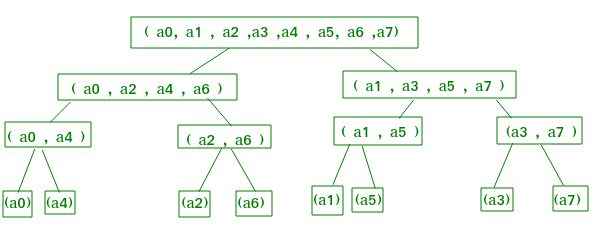
Why does this work?
since,
Thus, the vector y returned by Recursive-FFT is indeed the DFT of the input
vector a.
#include <bits/stdc++.h>
using namespace std;

// For storing complex values of nth roots
// of unity we use complex<double>
typedef complex<double> cd;

// Recursive function of FFT
vector<cd> fft(vector<cd>& a)
{
    int n = a.size();

    // if input contains just one element
    if (n == 1)
        return vector<cd>(1, a[0]);

    // For storing n complex nth roots of unity
    vector<cd> w(n);
    for (int i = 0; i < n; i++) {
        double alpha = -2 * M_PI * i / n;
        w[i] = cd(cos(alpha), sin(alpha));
    }

    vector<cd> A0(n / 2), A1(n / 2);
    for (int i = 0; i < n / 2; i++) {

        // even indexed coefficients
        A0[i] = a[i * 2];

        // odd indexed coefficients
        A1[i] = a[i * 2 + 1];
    }

    // Recursive call for even indexed coefficients
    vector<cd> y0 = fft(A0);

    // Recursive call for odd indexed coefficients
    vector<cd> y1 = fft(A1);

    // for storing values of y0, y1, y2, ..., yn-1.
    vector<cd> y(n);

    for (int k = 0; k < n / 2; k++) {
        y[k] = y0[k] + w[k] * y1[k];
        y[k + n / 2] = y0[k] - w[k] * y1[k];
    }
    return y;
}

// Driver code
int main()
{
    vector<cd> a{1, 2, 3, 4};
    vector<cd> b = fft(a);
    for (int i = 0; i < 4; i++)
        cout << b[i] << endl;

    return 0;
}
from math import sin,cos,pi

# Recursive function of FFT
def fft(a):

    n = len(a)

    # if input contains just one element
    if n == 1:
        return [a[0]]

    # For storing n complex nth roots of unity
    theta = -2*pi/n
    w = list( complex(cos(theta*i), sin(theta*i)) for i in range(n) )

    # Separe coefficients
    Aeven = a[0::2]
    Aodd  = a[1::2]

    # Recursive call for even indexed coefficients
    Yeven = fft(Aeven)

    # Recursive call for odd indexed coefficients
    Yodd = fft(Aodd)

    # for storing values of y0, y1, y2, ..., yn-1.
    Y = [0]*n

    middle = n//2
    for k in range(n//2):
        w_yodd_k  = w[k] * Yodd[k]
        yeven_k   =  Yeven[k]

        Y[k]          =  yeven_k  +  w_yodd_k
        Y[k + middle] =  yeven_k  -  w_yodd_k

    return Y


# Driver code
if __name__ == '__main__':

    a = [1, 2, 3, 4]
    b = fft(a)
    for B in b:
        print(B)
// JavaScript program to implement
// the approach

// For storing complex values of nth roots
// of unity we use complex
class complex
{
    constructor(a, b = 0)
    {
        this.x = a;
        this.y = b;
    }

}

function product(c1, c2)
{
    let c =new complex(0, 0);
    c.x = c1.x * c2.x - c1.y * c2.y
    c.y = c1.x * c2.y + c2.x * c1.y
    return c
}

function sum(c1, c2)
{
    let c = new complex(0, 0);
    c.x = c1.x + c2.x
    c.y = c1.y + c2.y
    return c
}

function difference(c1, c2)
{
    let c =new complex(0, 0);
    c.x = c1.x - c2.x
    c.y = c1.y - c2.y
    return c
}


// Recursive function of FFT
function fft(a)
{
    let n = a.length;

    // if input contains just one element
    if (n == 1)
        return [a[0]]

    // For storing n complex nth roots of unity
    let w = new Array(n);
    let alpha = -2 * Math.PI / n;
    for (var i = 0; i < n; i++) {
        w[i] = new complex(Math.cos(alpha * i), Math.sin(alpha * i));
    }

    let A0 = new Array(Math.floor(n / 2));
    let A1 = new Array(Math.floor(n / 2));
    for (var i = 0; i < Math.floor(n / 2); i++) {

        // even indexed coefficients
        A0[i] = a[i * 2];

        // odd indexed coefficients
        A1[i] = a[i * 2 + 1];
    }

    // Recursive call for even indexed coefficients
    let y0 = fft(A0);

    // Recursive call for odd indexed coefficients
    let y1 = fft(A1);

    // for storing values of y0, y1, y2, ..., yn-1.
    let y = new Array(n);

    for (var k = 0; k < Math.floor(n / 2); k++) {

        y[k] =  sum(y0[k], product(w[k], y1[k]));
        y[k + Math.floor(n / 2)] = difference(y0[k], product(w[k], y1[k]));
    }
    return y;
}

// Driver code

let a = [ new complex(1, 0), new complex(2, 0), new complex(3, 0), new complex(4, 0)];
let b = fft(a);
for (var b0 of b)
    console.log("(", b0.x, ",", b0.y, ")")


// This code is contributed by phasing17
import java.util.*;

// For storing complex values of nth roots
// of unity we use complex<double>
class cd {
    double re;
    double im;

    cd(double r, double i) {
        re = r;
        im = i;
    }

    cd add(cd b) {
        return new cd(re + b.re, im + b.im);
    }

    cd sub(cd b) {
        return new cd(re - b.re, im - b.im);
    }

    cd mul(cd b) {
        return new cd(re * b.re - im * b.im, re * b.im + im * b.re);
    }
}

// Recursive function of FFT
class FFT {
    int n;
    cd[] a, w;

    FFT(int n) {
        this.n = n;
        a = new cd[n];
        w = new cd[n];
    }

    void fft() {
        // if input contains just one element
        if (n == 1)
            return;

        for (int i = 0; i < n; i++) {
            double alpha = -2 * Math.PI * i / n;
            w[i] = new cd(Math.cos(alpha), Math.sin(alpha));
        }

        cd[] A0 = new cd[n / 2];
        cd[] A1 = new cd[n / 2];
        for (int i = 0; i < n / 2; i++) {
            // even indexed coefficients
            A0[i] = a[i * 2];
            // odd indexed coefficients
            A1[i] = a[i * 2 + 1];
        }

        // Recursive call for even indexed coefficients
        FFT y0 = new FFT(n / 2);
        y0.a = A0;
        y0.fft();

        // Recursive call for odd indexed coefficients
        FFT y1 = new FFT(n / 2);
        y1.a = A1;
        y1.fft();

        // for storing values of y0, y1, y2, ..., yn-1.
        cd[] y = new cd[n];
        for (int k = 0; k < n / 2; k++) {
            y[k] = y0.a[k].add(w[k].mul(y1.a[k]));
            y[k + n / 2] = y0.a[k].sub(w[k].mul(y1.a[k]));
        }
        System.arraycopy(y, 0, a, 0, n);
    }
// }

// Driver code
// public class Main {
    public static void main(String[] args) {
        FFT fft = new FFT(4);
        fft.a[0] = new cd(1, 0);
        fft.a[1] = new cd(2, 0);
        fft.a[2] = new cd(3, 0);
        fft.a[3] = new cd(4, 0);
        fft.fft();

        for (int i = 0; i < 4; i++)
            System.out.println(fft.a[i].re + " + " + fft.a[i].im + "i");
    }
}
using System;

// For storing complex values of nth roots
// of unity we use a struct named Complex
struct Complex
{
    public double Re;
    public double Im;

    public Complex(double r, double i)
    {
        Re = r;
        Im = i;
    }

    public Complex Add(Complex b)
    {
        return new Complex(Re + b.Re, Im + b.Im);
    }

    public Complex Sub(Complex b)
    {
        return new Complex(Re - b.Re, Im - b.Im);
    }

    public Complex Mul(Complex b)
    {
        return new Complex(Re * b.Re - Im * b.Im,
                           Re * b.Im + Im * b.Re);
    }
}

// Recursive function of FFT
class FFT {
    int n;
    Complex[] a, w;

    public FFT(int n)
    {
        this.n = n;
        a = new Complex[n];
        w = new Complex[n];
    }

    public void Fft()
    {
        // if input contains just one element
        if (n == 1)
            return;

        for (int i = 0; i < n; i++) {
            double alpha = -2 * Math.PI * i / n;
            w[i] = new Complex(Math.Cos(alpha),
                               Math.Sin(alpha));
        }

        Complex[] A0 = new Complex[n / 2];
        Complex[] A1 = new Complex[n / 2];
        for (int i = 0; i < n / 2; i++) {
            // even indexed coefficients
            A0[i] = a[i * 2];
            // odd indexed coefficients
            A1[i] = a[i * 2 + 1];
        }

        // Recursive call for even indexed coefficients
        FFT y0 = new FFT(n / 2);
        y0.a = A0;
        y0.Fft();

        // Recursive call for odd indexed coefficients
        FFT y1 = new FFT(n / 2);
        y1.a = A1;
        y1.Fft();

        // for storing values of y0, y1, y2, ..., yn-1.
        Complex[] y = new Complex[n];
        for (int k = 0; k < n / 2; k++) {
            y[k] = y0.a[k].Add(w[k].Mul(y1.a[k]));
            y[k + n / 2] = y0.a[k].Sub(w[k].Mul(y1.a[k]));
        }
        Array.Copy(y, a, n);
    }

    public static void Main()
    {
        FFT fft = new FFT(4);
        fft.a[0] = new Complex(1, 0);
        fft.a[1] = new Complex(2, 0);
        fft.a[2] = new Complex(3, 0);
        fft.a[3] = new Complex(4, 0);
        fft.Fft();

        // css
        // Copy code
        for (int i = 0; i < 4; i++)
            Console.WriteLine(fft.a[i].Re + " + "
                              + fft.a[i].Im + "i");
    }
}
Input:  1 2 3 4
Output:
(10, 0)
(-2, 2)
(-2, 0)
(-2,-2)
Interpolation
Switch the roles of a and y.
Replace wn by wn^-1.
Divide each element of the result by n.
Time Complexity: O(nlogn).
