
Given an array A[], the task is to find the circulant matrix made by this array.
A circulant matrix is a square matrix of order N x N, where each column is composed of the same elements, but each column is rotated one element to the bottom relative to the preceding column. It is a particular kind of Toeplitz matrix.
Here is the general form of a circulant matrix.
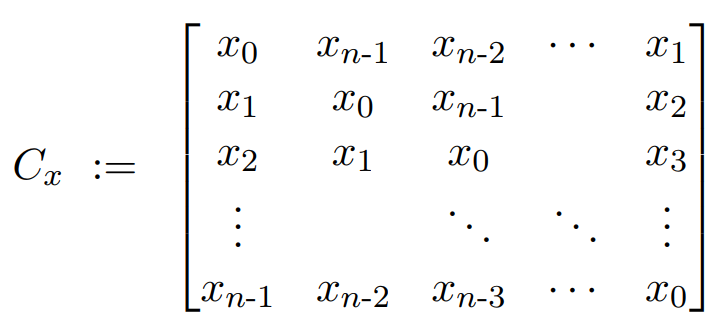
Examples:
Input: a[] = {2, 3, 4, 5}.
Output: Then the resultant circulant matrix should be:
2 3 4 5
3 4 5 2
4 5 2 3
5 2 3 4Input: a[] = {0, 4, 0, 7, 9, 12, 17}.
Output: The resultant circulant matrix should be:
0 4 0 7 9 12 17
4 0 7 9 12 17 0
0 7 9 12 17 0 4
7 9 12 17 0 4 0
9 12 17 0 4 0 7
12 17 0 4 0 7 9
17 0 4 0 7 9 12
Approach: This is a simple implementation based problem based on the following idea:
For each ith column, insert the first element of the array at ith row and insert all the other elements iterating through the column in a circular manner.
Follow the below steps to solve the problem:
- Initialize an empty matrix (say c[][])of order N.
- Iterate through the columns from i = 0 to N-1:
- Iterate through the rows using a nested loop from j = 0 to N-1.
- if (i > 0), then assign c[j][i] = c[j - 1][i - 1].
- else, assign c[j][i] = c[N - 1][i - 1].
- Iterate through the rows using a nested loop from j = 0 to N-1.
- At last, display the circulant matrix.
Below is the implementation of the above approach:
// C++ code to implement the approach
#include <iostream>
using namespace std;

// Circulant function defined here
void circulant(int arr[], int n)
{
    // Initializing an empty
    // 2D matrix of order n
    int c[n][n];
    for (int k = 0; k <= n - 1; k++)
        c[k][0] = arr[k];

    // Forming the circulant matrix
    for (int i = 1; i <= n - 1; i++) {
        for (int j = 0; j <= n - 1; j++) {
            if (j - 1 >= 0)
                c[j][i] = c[j - 1][i - 1];
            else
                c[j][i] = c[n - 1][i - 1];
        }
    }

    // Displaying the circulant matrix
    for (int i = 0; i <= n - 1; i++) {
        for (int j = 0; j <= n - 1; j++) {
            cout << c[i][j] << "\t";
        }
        cout << "\n";
    }
}

// Driver Code
int main()
{
    int N = 4;
    int A[] = { 2, 3, 4, 5 };
    // Function call
    circulant(A, N);
    return 0;
}

// This code is contributed by Rohit Pradhan
// Java code to implement the approach

import java.io.*;

class GFG {

    // Circulant function defined here
    public static void circulant(int arr[], int n)
    {
        // Initializing an empty
        // 2D matrix of order n
        int c[][] = new int[n][n];
        for (int k = 0; k <= n - 1; k++)
            c[k][0] = arr[k];

        // Forming the circulant matrix
        for (int i = 1; i <= n - 1; i++) {
            for (int j = 0; j <= n - 1; j++) {
                if (j - 1 >= 0)
                    c[j][i] = c[j - 1][i - 1];
                else
                    c[j][i] = c[n - 1][i - 1];
            }
        }

        // Displaying the circulant matrix
        for (int i = 0; i <= n - 1; i++) {
            for (int j = 0; j <= n - 1; j++) {
                System.out.print(c[i][j] + "\t");
            }
            System.out.println();
        }
    }

    // Driver code
    public static void main(String[] args)
    {
        int N = 4;
        int A[] = { 2, 3, 4, 5 };
        circulant(A, N);
    }
}
# Python code to implement the approach
# Circulant function defined here
def circulant( arr,  n):

    # Initializing an empty
    # 2D matrix of order n
    c = [[0 for i in range(n)] for j in range(n)]
    for k in range(n):
        c[k][0] = arr[k]

    # Forming the circulant matrix
    for  i in range(1,n):
        for j in range(n):
            if (j - 1 >= 0):
                c[j][i] = c[j - 1][i - 1]
            else:
                c[j][i] = c[n - 1][i - 1]


    # Displaying the circulant matrix
    for  i in range(n):
        for j in range(n):
            print(c[i][j] ,end="\t")
        print()


# Driver code
N = 4
A =  [2, 3, 4, 5 ]
circulant(A, N)

# This code is contributed by rohitsingh07052
// C# program to implement
// the above approach
using System;

class GFG
{
    // Circulant function defined here
    public static void circulant(int[] arr, int n)
    {
        // Initializing an empty
        // 2D matrix of order n
        int[,] c = new int[n, n];
        for (int k = 0; k <= n - 1; k++)
            c[k, 0] = arr[k];

        // Forming the circulant matrix
        for (int i = 1; i <= n - 1; i++) {
            for (int j = 0; j <= n - 1; j++) {
                if (j - 1 >= 0)
                    c[j, i] = c[j - 1, i - 1];
                else
                    c[j, i] = c[n - 1, i - 1];
            }
        }

        // Displaying the circulant matrix
        for (int i = 0; i <= n - 1; i++) {
            for (int j = 0; j <= n - 1; j++) {
                Console.Write(c[i, j] + "\t");
            }
            Console.WriteLine();
        }
    }

// Driver Code
public static void Main()
{
    int N = 4;
    int[] A = { 2, 3, 4, 5 };
    circulant(A, N);
}
}

// This code is contributed by sanjoy_62.
<script>

// JavaScript code to implement the approach

// Circulant function defined here
function circulant(arr, n)
{
    // Initializing an empty
    // 2D matrix of order n
    let c = new Array(n).fill(0).map(()=>new Array(n));
    for (let k = 0; k <= n - 1; k++)
        c[k][0] = arr[k];

    // Forming the circulant matrix
    for (let i = 1; i <= n - 1; i++) {
        for (let j = 0; j <= n - 1; j++) {
            if (j - 1 >= 0)
                c[j][i] = c[j - 1][i - 1];
            else
                c[j][i] = c[n - 1][i - 1];
        }
    }

    // Displaying the circulant matrix
    for (let i = 0; i <= n - 1; i++) {
        for (let j = 0; j <= n - 1; j++) {
            document.write(`${c[i][j]} \t`)
        }
        document.write("</br>")
    }
}

// Driver Code

let N = 4
let A = [ 2, 3, 4, 5 ]
// Function call
circulant(A, N)

// This code is contributed by shinjanpatra

</script>
Output
2    5    4    3
3    2    5    4
4    3    2    5
5    4    3    2
Time Complexity: O(N2)
Auxiliary Space: O(1)
