
Given an array arr of lowercase strings, find if the strings can be chained together to form a circle.
- A string x can be chained together with another string y if the last character of x is the same as the first character of y.
- If every string of the array can be chained with exactly two strings of the array(one with the first character and the second with the last character of the string), it will form a circle.
Examples:
Input: arr = ["for", "geek", "rig", "kaf"]
Output: true
Explanation: These strings can be chained as "for" -> "rig" -> "geek" -> "kaf" to form a circle.Input: arr = ["abc", "bcd", "cdf"]
Output: false
Explanation: These strings can't form a circle.

Table of Content
[Approach-1] Using Eulerian Circuit (Two DFS) - O(n) Time and O(n) Space
The idea is to model the problem as a directed graph where each character (
a-z) is a vertex, and every string forms an edge from its first character to its last character. Since every string must be used exactly once while forming a circular chain, the problem becomes checking whether the graph contains an Eulerian circuit.A directed graph has an Eulerian circuit if every vertex has equal in-degree and out-degree, and all vertices with non-zero degree belong to a single strongly connected component.
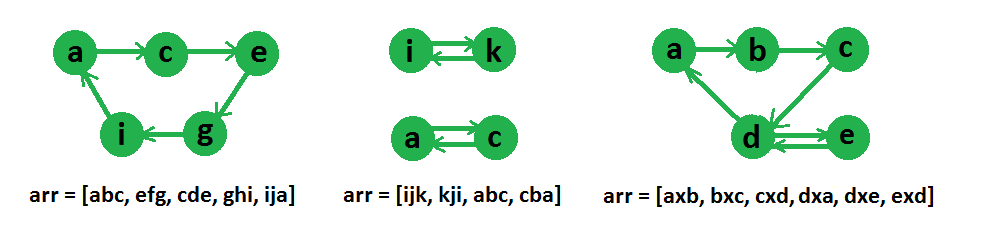
Algorithm:
- Create a directed graph with 26 vertices (a-z) and maintain indegree and outdegree arrays.
- For every string, add an edge from its first character to its last character and update the corresponding degrees.
- Check if indegree == outdegree for every vertex; if not, return false.
- Find a starting vertex having a non-zero degree. If none exists, return true.
- Perform DFS on the original graph and verify that all vertices with non-zero degree are reachable.
- Perform DFS on the reversed graph and again verify reachability; if all such vertices are visited, return true, otherwise return false.
#include <algorithm>
#include <iostream>
#include <string>
#include <vector>

using namespace std;

void dfs(int node, vector<int> graph[], vector<int> &visited)
{
    visited[node] = 1;

    for (int neighbor : graph[node])
    {
        if (!visited[neighbor])
        {
            dfs(neighbor, graph, visited);
        }
    }
}

bool isCircle(vector<string> &arr)
{
    // Graph contains 26 vertices corresponding to 'a' to 'z'
    vector<int> graph[26];
    vector<int> reverseGraph[26];

    int indegree[26] = {0};
    int outdegree[26] = {0};

    // Build graph:
    // first character -> last character
    for (string &word : arr)
    {
        int from = word.front() - 'a';
        int to = word.back() - 'a';

        graph[from].push_back(to);
        reverseGraph[to].push_back(from);

        outdegree[from]++;
        indegree[to]++;
    }

    // Euler Circuit Condition #1:
    // indegree must equal outdegree
    for (int vertex = 0; vertex < 26; vertex++)
    {
        if (indegree[vertex] != outdegree[vertex])
        {
            return false;
        }
    }

    // Find any node with non-zero degree
    int startNode = -1;

    for (int vertex = 0; vertex < 26; vertex++)
    {
        if (outdegree[vertex] > 0)
        {
            startNode = vertex;
            break;
        }
    }

    // Empty input case
    if (startNode == -1)
    {
        return true;
    }

    // Euler Circuit Condition #2:
    // All used vertices should be strongly connected

    vector<int> visited(26, 0);

    dfs(startNode, graph, visited);

    for (int vertex = 0; vertex < 26; vertex++)
    {
        if (outdegree[vertex] > 0 && !visited[vertex])
        {
            return false;
        }
    }

    fill(visited.begin(), visited.end(), 0);
    dfs(startNode, reverseGraph, visited);

    for (int vertex = 0; vertex < 26; vertex++)
    {
        if (outdegree[vertex] > 0 && !visited[vertex])
        {
            return false;
        }
    }

    return true;
}

int main()
{
    vector<string> arr = {"for", "geek", "rig", "kaf"};

    if (isCircle(arr))
    {
        cout << "true" << endl;
    }
    else
    {
        cout << "false" << endl;
    }

    return 0;
}
import java.util.*;

class GFG {

    static void dfs(int node, ArrayList<Integer>[] graph,
                    boolean[] visited)
    {
        visited[node] = true;

        for (int neighbor : graph[node]) {
            if (!visited[neighbor]) {
                dfs(neighbor, graph, visited);
            }
        }
    }

    static boolean isCircle(String[] arr)
    {
        // Graph contains 26 vertices corresponding to 'a'
        // to 'z'
        ArrayList<Integer>[] graph = new ArrayList[26];
        ArrayList<Integer>[] reverseGraph
            = new ArrayList[26];

        for (int i = 0; i < 26; i++) {
            graph[i] = new ArrayList<>();
            reverseGraph[i] = new ArrayList<>();
        }

        int[] indegree = new int[26];
        int[] outdegree = new int[26];

        // Build graph:
        // first character -> last character
        for (String word : arr) {

            int from = word.charAt(0) - 'a';
            int to = word.charAt(word.length() - 1) - 'a';

            graph[from].add(to);
            reverseGraph[to].add(from);

            outdegree[from]++;
            indegree[to]++;
        }

        // Euler Circuit Condition #1:
        // indegree must equal outdegree
        for (int vertex = 0; vertex < 26; vertex++) {
            if (indegree[vertex] != outdegree[vertex]) {
                return false;
            }
        }

        // Find any node with non-zero degree
        int startNode = -1;

        for (int vertex = 0; vertex < 26; vertex++) {
            if (outdegree[vertex] > 0) {
                startNode = vertex;
                break;
            }
        }

        // Empty input case
        if (startNode == -1) {
            return true;
        }

        // Euler Circuit Condition #2:
        // All used vertices should be strongly connected

        boolean[] visited = new boolean[26];

        dfs(startNode, graph, visited);

        for (int vertex = 0; vertex < 26; vertex++) {
            if (outdegree[vertex] > 0 && !visited[vertex]) {
                return false;
            }
        }

        Arrays.fill(visited, false);

        dfs(startNode, reverseGraph, visited);

        for (int vertex = 0; vertex < 26; vertex++) {
            if (outdegree[vertex] > 0 && !visited[vertex]) {
                return false;
            }
        }

        return true;
    }

    public static void main(String[] args)
    {
        String[] arr = { "for", "geek", "rig", "kaf" };
        System.out.println(isCircle(arr));
    }
}
def dfs(node, graph, visited):
    visited[node] = True
    for neighbor in graph[node]:
        if not visited[neighbor]:
            dfs(neighbor, graph, visited)


def isCircle(arr):

    # Graph contains 26 vertices corresponding to 'a' to 'z'
    graph = [[] for _ in range(26)]
    reverseGraph = [[] for _ in range(26)]

    indegree = [0] * 26
    outdegree = [0] * 26

    # Build graph:
    # first character -> last character
    for word in arr:

        from_node = ord(word[0]) - ord('a')
        to = ord(word[-1]) - ord('a')

        graph[from_node].append(to)
        reverseGraph[to].append(from_node)

        outdegree[from_node] += 1
        indegree[to] += 1

    # Euler Circuit Condition #1:
    # indegree must equal outdegree
    for vertex in range(26):

        if indegree[vertex] != outdegree[vertex]:
            return False

    # Find any node with non-zero degree
    startNode = -1

    for vertex in range(26):

        if outdegree[vertex] > 0:
            startNode = vertex
            break

    # Empty input case
    if startNode == -1:
        return True

    # Euler Circuit Condition #2:
    # All used vertices should be strongly connected

    visited = [False] * 26

    dfs(startNode, graph, visited)

    for vertex in range(26):

        if outdegree[vertex] > 0 and not visited[vertex]:
            return False

    visited = [False] * 26

    dfs(startNode, reverseGraph, visited)

    for vertex in range(26):

        if outdegree[vertex] > 0 and not visited[vertex]:
            return False

    return True


# Driver Code
if __name__ == "__main__":
    arr = ["for", "geek", "rig", "kaf"]

    if isCircle(arr) == True:
        print("true")
    else:
        print("false")
using System;
using System.Collections.Generic;

class GFG {
    static void DFS(int node, List<int>[] graph,
                    bool[] visited)
    {
        visited[node] = true;

        foreach(int neighbor in graph[node])
        {
            if (!visited[neighbor]) {
                DFS(neighbor, graph, visited);
            }
        }
    }

    static bool isCircle(string[] arr)
    {
        // Graph contains 26 vertices corresponding to 'a'
        // to 'z'
        List<int>[] graph = new List<int>[ 26 ];
        List<int>[] reverseGraph = new List<int>[ 26 ];

        for (int i = 0; i < 26; i++) {
            graph[i] = new List<int>();
            reverseGraph[i] = new List<int>();
        }

        int[] indegree = new int[26];
        int[] outdegree = new int[26];

        // Build graph:
        // first character -> last character
        foreach(string word in arr)
        {
            int from = word[0] - 'a';
            int to = word[word.Length - 1] - 'a';

            graph[from].Add(to);
            reverseGraph[to].Add(from);

            outdegree[from]++;
            indegree[to]++;
        }

        // Euler Circuit Condition #1:
        // indegree must equal outdegree
        for (int vertex = 0; vertex < 26; vertex++) {
            if (indegree[vertex] != outdegree[vertex]) {
                return false;
            }
        }

        // Find any node with non-zero degree
        int startNode = -1;

        for (int vertex = 0; vertex < 26; vertex++) {
            if (outdegree[vertex] > 0) {
                startNode = vertex;
                break;
            }
        }

        // Empty input case
        if (startNode == -1) {
            return true;
        }

        // Euler Circuit Condition #2:
        // All used vertices should be strongly connected

        bool[] visited = new bool[26];

        DFS(startNode, graph, visited);

        for (int vertex = 0; vertex < 26; vertex++) {
            if (outdegree[vertex] > 0 && !visited[vertex]) {
                return false;
            }
        }

        Array.Fill(visited, false);

        DFS(startNode, reverseGraph, visited);

        for (int vertex = 0; vertex < 26; vertex++) {
            if (outdegree[vertex] > 0 && !visited[vertex]) {
                return false;
            }
        }

        return true;
    }

    public static void Main()
    {
        string[] arr = { "for", "geek", "rig", "kaf" };

        if (isCircle(arr) == true) {
            Console.WriteLine("true");
        }
        else {
            Console.WriteLine("false");
        }
    }
}
function dfs(node, graph, visited)
{
    visited[node] = true;

    for (let neighbor of graph[node]) {
        if (!visited[neighbor]) {
            dfs(neighbor, graph, visited);
        }
    }
}

function isCircle(arr)
{
    // Graph contains 26 vertices corresponding to 'a' to
    // 'z'
    let graph = Array.from({length : 26}, () => []);
    let reverseGraph = Array.from({length : 26}, () => []);

    let indegree = Array(26).fill(0);
    let outdegree = Array(26).fill(0);

    // Build graph:
    // first character -> last character
    for (let word of arr) {

        let from = word.charCodeAt(0) - "a".charCodeAt(0);
        let to = word.charCodeAt(word.length - 1)
                 - "a".charCodeAt(0);

        graph[from].push(to);
        reverseGraph[to].push(from);

        outdegree[from]++;
        indegree[to]++;
    }

    // Euler Circuit Condition #1:
    // indegree must equal outdegree
    for (let vertex = 0; vertex < 26; vertex++) {

        if (indegree[vertex] !== outdegree[vertex]) {
            return false;
        }
    }

    // Find any node with non-zero degree
    let startNode = -1;

    for (let vertex = 0; vertex < 26; vertex++) {

        if (outdegree[vertex] > 0) {
            startNode = vertex;
            break;
        }
    }

    // Empty input case
    if (startNode === -1) {
        return true;
    }

    // Euler Circuit Condition #2:
    // All used vertices should be strongly connected

    let visited = Array(26).fill(false);

    dfs(startNode, graph, visited);

    for (let vertex = 0; vertex < 26; vertex++) {

        if (outdegree[vertex] > 0 && !visited[vertex]) {
            return false;
        }
    }

    visited.fill(false);

    dfs(startNode, reverseGraph, visited);

    for (let vertex = 0; vertex < 26; vertex++) {

        if (outdegree[vertex] > 0 && !visited[vertex]) {
            return false;
        }
    }

    return true;
}

// Driver Code
const arr = [ "for", "geek", "rig", "kaf" ];

if (isCircle(arr) == true) {
    console.log("true");
}
else {
    console.log("false");
}
Output
true
[Approach-2] Using Single DFS - O(n) Time and O(n) Space
Instead of explicitly checking strong connectivity using both original and reverse graph traversals like in above approach, we use indegrees and outdegrees: if every vertex has equal indegree and outdegree, then performing a single DFS traversal is sufficient.
If all participating vertices are reachable and every vertex has equal indegree and outdegree, then a loop among them is automatically guaranteed, making a circular ordering of strings possible.
Algorithm:
- Create a directed graph with 26 vertices (a-z) and maintain indegree, outdegree, and a usedCharacter array.
- For each string, add an edge from its first character to its last character and update degree counts.
- Check whether indegree == outdegree for every vertex; if not, return false.
- Find any participating character (non-zero degree) and use it as the starting node.
- Perform one DFS traversal and verify that all characters involved in the strings are visited.
- If all participating vertices are visited, return true; otherwise return false.
#include <bits/stdc++.h>
using namespace std;

// Perform DFS and mark all reachable vertices
void dfs(vector<int> graph[], int node, vector<bool> &visited)
{
    visited[node] = true;

    for (int neighbor : graph[node])
    {
        if (!visited[neighbor])
        {
            dfs(graph, neighbor, visited);
        }
    }
}

// Check whether all participating vertices
// are reachable from the starting node
bool isConnected(vector<int> graph[], vector<bool> &usedCharacter, int startNode)
{
    // Mark all vertices as unvisited
    vector<bool> visited(26, false);

    // Start DFS traversal
    dfs(graph, startNode, visited);

    // Every character that appeared in the strings
    // should be visited after DFS
    for (int vertex = 0; vertex < 26; vertex++)
    {
        if (usedCharacter[vertex] && !visited[vertex])
        {
            return false;
        }
    }

    return true;
}

// Returns true if all strings can be arranged
// in a circular chain
bool isCircle(vector<string> &arr)
{
    int n = arr.size();

    // Graph with 26 vertices (a-z)
    vector<int> graph[26];

    // Track whether a character participates
    // in any string
    vector<bool> usedCharacter(26, false);

    // Store indegree and outdegree
    vector<int> indegree(26, 0);
    vector<int> outdegree(26, 0);

    // Build graph using strings
    for (int i = 0; i < n; i++)
    {
        // Get first and last character
        int from = arr[i].front() - 'a';
        int to = arr[i].back() - 'a';

        // Mark both characters as used
        usedCharacter[from] = true;
        usedCharacter[to] = true;

        // Add edge:
        // first character -> last character
        graph[from].push_back(to);

        // Update degree counts
        outdegree[from]++;
        indegree[to]++;
    }

    // Euler Circuit Condition #1:
    // Indegree must equal outdegree
    for (int vertex = 0; vertex < 26; vertex++)
    {
        if (indegree[vertex] != outdegree[vertex])
        {
            return false;
        }
    }

    // Find a starting vertex
    int startNode = -1;

    for (int vertex = 0; vertex < 26; vertex++)
    {
        if (usedCharacter[vertex])
        {
            startNode = vertex;
            break;
        }
    }

    // No strings present
    if (startNode == -1)
    {
        return true;
    }

    // Euler Circuit Condition #2:
    // All participating vertices should be connected
    return isConnected(graph, usedCharacter, startNode);
}

int main()
{
    vector<string> arr = {"for", "geek", "rig", "kaf"};

    if (isCircle(arr) == true)
    {
        cout << "true" << endl;
    }
    else
    {
        cout << "false" << endl;
    }

    return 0;
}
import java.util.*;

class Solution {

    // Perform DFS and mark all reachable vertices
    static void dfs(ArrayList<Integer>[] graph, int node,
                    boolean[] visited)
    {
        visited[node] = true;

        for (int neighbor : graph[node]) {
            if (!visited[neighbor]) {
                dfs(graph, neighbor, visited);
            }
        }
    }

    // Check whether all participating vertices
    // are reachable from the starting node
    static boolean isConnected(ArrayList<Integer>[] graph,
                               boolean[] usedCharacter,
                               int startNode)
    {
        // Mark all vertices as unvisited
        boolean[] visited = new boolean[26];

        // Start DFS traversal
        dfs(graph, startNode, visited);

        // Every character that appeared in the strings
        // should be visited after DFS
        for (int vertex = 0; vertex < 26; vertex++) {
            if (usedCharacter[vertex] && !visited[vertex]) {
                return false;
            }
        }

        return true;
    }

    // Returns true if all strings can be arranged
    // in a circular chain
    static boolean isCircle(String[] arr)
    {
        int n = arr.length;

        // Graph with 26 vertices (a-z)
        ArrayList<Integer>[] graph = new ArrayList[26];

        for (int i = 0; i < 26; i++) {
            graph[i] = new ArrayList<>();
        }

        // Track whether a character participates
        // in any string
        boolean[] usedCharacter = new boolean[26];

        // Store indegree and outdegree
        int[] indegree = new int[26];
        int[] outdegree = new int[26];

        // Build graph using strings
        for (int i = 0; i < n; i++) {
            // Get first and last character
            int from = arr[i].charAt(0) - 'a';
            int to
                = arr[i].charAt(arr[i].length() - 1) - 'a';

            // Mark both characters as used
            usedCharacter[from] = true;
            usedCharacter[to] = true;

            // Add edge:
            // first character -> last character
            graph[from].add(to);

            // Update degree counts
            outdegree[from]++;
            indegree[to]++;
        }

        // Euler Circuit Condition #1:
        // Indegree must equal outdegree
        for (int vertex = 0; vertex < 26; vertex++) {
            if (indegree[vertex] != outdegree[vertex]) {
                return false;
            }
        }

        // Find a starting vertex
        int startNode = -1;

        for (int vertex = 0; vertex < 26; vertex++) {
            if (usedCharacter[vertex]) {
                startNode = vertex;
                break;
            }
        }

        // No strings present
        if (startNode == -1) {
            return true;
        }

        // Euler Circuit Condition #2:
        // All participating vertices
        // should be connected
        return isConnected(graph, usedCharacter, startNode);
    }

    public static void main(String[] args)
    {
        String[] arr = { "for", "geek", "rig", "kaf" };
        System.out.println(isCircle(arr));
    }
}
# Perform DFS and mark all reachable vertices
def dfs(graph, node, visited):

    visited[node] = True

    for neighbor in graph[node]:
        if not visited[neighbor]:
            dfs(graph, neighbor, visited)


# Check whether all participating vertices
# are reachable from the starting node
def isConnected(graph,
                usedCharacter,
                startNode):

    # Mark all vertices as unvisited
    visited = [False] * 26

    # Start DFS traversal
    dfs(graph, startNode, visited)

    # Every character that appeared in
    # the strings should be visited
    for vertex in range(26):

        if usedCharacter[vertex] and \
           not visited[vertex]:
            return False

    return True


# Returns true if all strings can be arranged
# in a circular chain
def isCircle(arr):

    n = len(arr)

    # Graph with 26 vertices (a-z)
    graph = [[] for _ in range(26)]

    # Track whether a character participates
    # in any string
    usedCharacter = [False] * 26

    # Store indegree and outdegree
    indegree = [0] * 26
    outdegree = [0] * 26

    # Build graph using strings
    for word in arr:

        # Get first and last character
        from_node = ord(word[0]) - ord('a')
        to = ord(word[-1]) - ord('a')

        # Mark both characters as used
        usedCharacter[from_node] = True
        usedCharacter[to] = True

        # Add edge:
        # first character -> last character
        graph[from_node].append(to)

        # Update degree counts
        outdegree[from_node] += 1
        indegree[to] += 1

    # Euler Circuit Condition #1:
    # Indegree must equal outdegree
    for vertex in range(26):

        if indegree[vertex] != outdegree[vertex]:
            return False

    # Find a starting vertex
    startNode = -1

    for vertex in range(26):

        if usedCharacter[vertex]:
            startNode = vertex
            break

    # No strings present
    if startNode == -1:
        return True

    # Euler Circuit Condition #2:
    # All participating vertices
    # should be connected
    return isConnected(graph,
                       usedCharacter,
                       startNode)


# Driver Code
if __name__ == "__main__":
    arr = ["for", "geek", "rig", "kaf"]

    if isCircle(arr) == True:
        print("true")
    else:
        print("false")
using System;
using System.Collections.Generic;

class Solution {
    // Perform DFS and mark all reachable vertices
    static void DFS(List<int>[] graph, int node,
                    bool[] visited)
    {
        visited[node] = true;

        foreach(int neighbor in graph[node])
        {
            if (!visited[neighbor]) {
                DFS(graph, neighbor, visited);
            }
        }
    }

    // Check whether all participating vertices
    // are reachable from the starting node
    static bool IsConnected(List<int>[] graph,
                            bool[] usedCharacter,
                            int startNode)
    {
        // Mark all vertices as unvisited
        bool[] visited = new bool[26];

        // Start DFS traversal
        DFS(graph, startNode, visited);

        // Every character that appeared
        // in the strings should be visited
        for (int vertex = 0; vertex < 26; vertex++) {
            if (usedCharacter[vertex] && !visited[vertex]) {
                return false;
            }
        }

        return true;
    }

    // Returns true if all strings can be arranged
    // in a circular chain
    static bool isCircle(string[] arr)
    {
        int n = arr.Length;

        // Graph with 26 vertices (a-z)
        List<int>[] graph = new List<int>[ 26 ];

        for (int i = 0; i < 26; i++) {
            graph[i] = new List<int>();
        }

        // Track whether a character participates
        // in any string
        bool[] usedCharacter = new bool[26];

        // Store indegree and outdegree
        int[] indegree = new int[26];
        int[] outdegree = new int[26];

        // Build graph using strings
        foreach(string word in arr)
        {
            // Get first and last character
            int from = word[0] - 'a';
            int to = word[word.Length - 1] - 'a';

            // Mark both characters as used
            usedCharacter[from] = true;
            usedCharacter[to] = true;

            // Add edge:
            // first character -> last character
            graph[from].Add(to);

            // Update degree counts
            outdegree[from]++;
            indegree[to]++;
        }

        // Euler Circuit Condition #1:
        // Indegree must equal outdegree
        for (int vertex = 0; vertex < 26; vertex++) {
            if (indegree[vertex] != outdegree[vertex]) {
                return false;
            }
        }

        // Find a starting vertex
        int startNode = -1;

        for (int vertex = 0; vertex < 26; vertex++) {
            if (usedCharacter[vertex]) {
                startNode = vertex;
                break;
            }
        }

        // No strings present
        if (startNode == -1) {
            return true;
        }

        // Euler Circuit Condition #2:
        // All participating vertices
        // should be connected
        return IsConnected(graph, usedCharacter, startNode);
    }

    static void Main()
    {
        string[] arr = { "for", "geek", "rig", "kaf" };

        if (isCircle(arr) == true) {
            Console.WriteLine("true");
        }
        else {
            Console.WriteLine("false");
        }
    }
}
// Perform DFS and mark all reachable vertices
function dfs(graph, node, visited)
{
    visited[node] = true;

    for (let neighbor of graph[node]) {
        if (!visited[neighbor]) {
            dfs(graph, neighbor, visited);
        }
    }
}

// Check whether all participating vertices
// are reachable from the starting node
function isConnected(graph, usedCharacter, startNode)
{
    // Mark all vertices as unvisited
    let visited = Array(26).fill(false);

    // Start DFS traversal
    dfs(graph, startNode, visited);

    // Every character that appeared
    // in the strings should be visited
    for (let vertex = 0; vertex < 26; vertex++) {
        if (usedCharacter[vertex] && !visited[vertex]) {
            return false;
        }
    }

    return true;
}

// Returns true if all strings can be arranged
// in a circular chain
function isCircle(arr)
{
    let n = arr.length;

    // Graph with 26 vertices (a-z)
    let graph = Array.from({length : 26}, () => []);

    // Track whether a character participates
    // in any string
    let usedCharacter = Array(26).fill(false);

    // Store indegree and outdegree
    let indegree = Array(26).fill(0);
    let outdegree = Array(26).fill(0);

    // Build graph using strings
    for (let word of arr) {
        // Get first and last character
        let from = word.charCodeAt(0) - "a".charCodeAt(0);

        let to = word.charCodeAt(word.length - 1)
                 - "a".charCodeAt(0);

        // Mark both characters as used
        usedCharacter[from] = true;
        usedCharacter[to] = true;

        // Add edge:
        // first character -> last character
        graph[from].push(to);

        // Update degree counts
        outdegree[from]++;
        indegree[to]++;
    }

    // Euler Circuit Condition #1:
    // Indegree must equal outdegree
    for (let vertex = 0; vertex < 26; vertex++) {
        if (indegree[vertex] !== outdegree[vertex]) {
            return false;
        }
    }

    // Find a starting vertex
    let startNode = -1;

    for (let vertex = 0; vertex < 26; vertex++) {
        if (usedCharacter[vertex]) {
            startNode = vertex;
            break;
        }
    }

    // No strings present
    if (startNode === -1) {
        return true;
    }

    // Euler Circuit Condition #2:
    // All participating vertices
    // should be connected
    return isConnected(graph, usedCharacter, startNode);
}

// Driver Code
let arr = [ "for", "geek", "rig", "kaf" ];
if (isCircle(arr) == true) {
    console.log("true");
}
else {
    console.log("false");
}
Output
true
