
Given a Doubly Linked List, insert a new node at the end of the linked list.
Examples:
Input: Linked List = 1 <-> 2 <-> 3, NewNode = 4
Output: 1 <-> 2 <-> 3 <-> 4Input: Linked List = NULL, NewNode = 1
Output: 1
Try It Yourself
Approach:
Inserting at the end involves traversing the entire list until we reach the last node. We then set the last node’s next reference to point to the new node and new node's previous reference to point to the last node. Thus, making the new node the last element in the list.
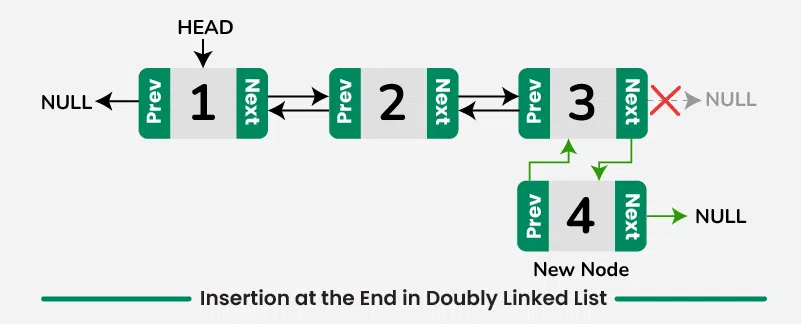
Steps to insert a new node at the end:
- If the linked list is empty, we set the new node as the head of linked list and return it as the new head of the linked list.
- Otherwise, traverse the entire list until we reach the last node, say curr.
- Then, set the last node’s next to new node and new node’s prev to last node, making the new node the last element in the list.
#include <iostream>
using namespace std;

class Node
{
  public:
    int data;
    Node *next, *prev;

    Node(int new_data)
    {
        data = new_data;
        next = prev = nullptr;
    }
};

// Function to insert a new node at
// the end of doubly linked list
Node *insertEnd(Node *head, int new_data)
{

    // Create a new node
    Node *new_node = new Node(new_data);

    // If the linked list is empty, set the new
    // node as the head of linked list
    if (head == nullptr)
    {
        head = new_node;
    }
    else
    {
        Node *curr = head;
        while (curr->next != nullptr)
        {
            curr = curr->next;
        }

        // Set the next of last node to new node
        curr->next = new_node;

        // Set prev of new node to last node
        new_node->prev = curr;
    }

    // Return the head of the doubly linked list
    return head;
}

// Function to print the list in required format
void printList(Node *head)
{
    Node *curr = head;
    while (curr != nullptr)
    {
        cout << curr->data;
        if (curr->next != nullptr)
        {
            cout << " <-> ";
        }
        curr = curr->next;
    }
    cout << endl;
}

int main()
{

    // Create a hardcoded doubly linked list:
    // 1 <-> 2 <-> 3
    Node *head = new Node(1);
    head->next = new Node(2);
    head->next->prev = head;
    head->next->next = new Node(3);
    head->next->next->prev = head->next;

    // Insert a new node with data 4 at the end
    int data = 4;
    head = insertEnd(head, data);

    // Print the updated list
    printList(head);

    return 0;
}
#include <stdio.h>
#include <stdlib.h>

// Define the Node structure
struct Node
{
    int data;
    struct Node *next;
    struct Node *prev;
};

// Function to create a new node
struct Node *createNode(int new_data)
{
    struct Node *new_node = (struct Node *)malloc(sizeof(struct Node));
    new_node->data = new_data;
    new_node->next = NULL;
    new_node->prev = NULL;
    return new_node;
}

// Function to insert a new node at the end of doubly linked list
struct Node *insertEnd(struct Node *head, int new_data)
{
    struct Node *new_node = createNode(new_data);

    if (head == NULL)
    {
        head = new_node;
    }
    else
    {
        struct Node *curr = head;
        while (curr->next != NULL)
        {
            curr = curr->next;
        }
        curr->next = new_node;
        new_node->prev = curr;
    }

    return head;
}

// Function to print the list in required format
void printList(struct Node *head)
{
    struct Node *curr = head;
    while (curr != NULL)
    {
        printf("%d", curr->data);
        if (curr->next != NULL)
        {
            printf(" <-> ");
        }
        curr = curr->next;
    }
    printf("\n");
}

int main()
{
    // Create a hardcoded doubly linked list: 1 <-> 2 <-> 3
    struct Node *head = createNode(1);
    head->next = createNode(2);
    head->next->prev = head;
    head->next->next = createNode(3);
    head->next->next->prev = head->next;

    // Insert a new node with data 4 at the end
    int data = 4;
    head = insertEnd(head, data);

    // Print the updated list
    printList(head);

    // Free allocated memory
    struct Node *temp;
    while (head != NULL)
    {
        temp = head;
        head = head->next;
        free(temp);
    }

    return 0;
}
class Node {
    int data;
    Node next, prev;

    Node(int newData) {
        data = newData;
        next = prev = null;
    }
}

class GfG {

    // Function to insert a new node at the end of the
    // doubly linked list
    public static Node insertEnd(Node head, int newData) {

        // Create a new node
        Node newNode = new Node(newData);

        // If the linked list is empty, set the new node as
        // the head
        if (head == null) {
            head = newNode;
        } else {
            Node curr = head;
            while (curr.next != null) {
                curr = curr.next;
            }

            // Set the next of last node to the new node
            curr.next = newNode;

            // Set the prev of new node to the last node
            newNode.prev = curr;
        }

        return head;
    }

    // Function to print the doubly
    // linked list in required format
    public static void printList(Node head) {
        Node curr = head;
        while (curr != null) {
            System.out.print(curr.data);
            if (curr.next != null) {
                System.out.print(" <-> ");
            }
            curr = curr.next;
        }
        System.out.println();
    }

    public static void main(String[] args) {

        // Create a hardcoded doubly linked list:
        // 1 <-> 2 <-> 3
        Node head = new Node(1);
        head.next = new Node(2);
        head.next.prev = head;
        head.next.next = new Node(3);
        head.next.next.prev = head.next;

        // Insert a new node with data 4 at the end
        head = insertEnd(head, 4);

        printList(head);
    }
}
class Node:
    def __init__(self, data):
        self.data = data
        self.next = None
        self.prev = None

# Function to insert a new node at the
# end of the doubly linked list
def insertEnd(head, new_data):
    # Create a new node
    new_node = Node(new_data)

    # If the linked list is empty, set
    # the new node as the head
    if head is None:
        head = new_node
    else:
        curr = head
        while curr.next is not None:
            curr = curr.next

        # Set the next of the last node to the new node
        curr.next = new_node

        # Set the prev of the new node to the last node
        new_node.prev = curr

    return head

# Function to print the list in required format
def printList(head):
    curr = head
    while curr is not None:
        print(curr.data, end="")
        if curr.next is not None:
            print(" <-> ", end="")
        curr = curr.next
    print()

if __name__ == "__main__":
    # Create a hardcoded doubly linked list:
    # 1 <-> 2 <-> 3
    head = Node(1)
    head.next = Node(2)
    head.next.prev = head
    head.next.next = Node(3)
    head.next.next.prev = head.next

    # Insert a new node with data 4 at the end
    head = insertEnd(head, 4)

    # Print only the final list
    printList(head)
using System;

class Node {
    public int Data;
    public Node Next;
    public Node Prev;

    public Node(int data) {
        Data = data;
        Next = null;
        Prev = null;
    }
}

class GfG {

    // Function to insert a new node at the
    // end of the doubly linked list
    public static Node insertEnd(Node head, int newData) {

        // Create a new node
        Node newNode = new Node(newData);

        // If the linked list is empty,
        // set the new node as the head
        if (head == null) {
            head = newNode;
        }
        else {
            Node curr = head;
            while (curr.Next != null) {
                curr = curr.Next;
            }

            // Set the next of the last
            // node to the new node
            curr.Next = newNode;

            // Set the prev of the new
            // node to the last node
            newNode.Prev = curr;
        }

        return head;
    }

    // Function to print the list in required format
    public static void printList(Node head) {
        Node curr = head;
        while (curr != null) {
            Console.Write(curr.Data);
            if (curr.Next != null) {
                Console.Write(" <-> ");
            }
            curr = curr.Next;
        }
        Console.WriteLine();
    }

    static void Main() {
        // Create a hardcoded doubly linked list:
        // 1 <-> 2 <-> 3
        Node head = new Node(1);
        head.Next = new Node(2);
        head.Next.Prev = head;
        head.Next.Next = new Node(3);
        head.Next.Next.Prev = head.Next;

        // Insert a new node with data 4 at the end
        int data = 4;
        head = insertEnd(head, data);

        printList(head);
    }
}
class Node {
    constructor(data) {
        this.data = data;
        this.next = null;
        this.prev = null;
    }
}

// Function to insert a new node at
// the end of doubly linked list
function insertEnd(head, newData) {

    // Create a new node
    const newNode = new Node(newData);

    // If the linked list is empty,
    // set the new node as the head
    if (head === null) {
        head = newNode;
    }
    else {
        let curr = head;
        while (curr.next !== null) {
            curr = curr.next;
        }

        // Set the next of the last node to the new node
        curr.next = newNode;

        // Set the prev of the new node to the last node
        newNode.prev = curr;
    }

    return head;
}

// Function to print the list in required format
function printList(head) {
    let curr = head;
    let result = "";
    while (curr !== null) {
        result += curr.data;
        if (curr.next !== null) {
            result += " <-> ";
        }
        curr = curr.next;
    }
    console.log(result);
}

// Driver Code
// Create a hardcoded doubly linked list:
// 1 <-> 2 <-> 3
let head = new Node(1);
head.next = new Node(2);
head.next.prev = head;
head.next.next = new Node(3);
head.next.next.prev = head.next;

// Insert a new node with data 4 at the end
const data = 4;
head = insertEnd(head, data);

printList(head);
Output
1 <-> 2 <-> 3 <-> 4
Time Complexity: O(n), where n is the number of nodes in the linked list.
Auxiliary Space: O(1)
