
Suppose you are given a string Str of length N and a set of Pairs ( i, j such that 0 <= i < j < N, 0 based indexing). Pair “i, j” means that you can swap the ith and jth characters in the string any number of times. You have to output the lexicographically smallest string that can be produced by doing any number of swaps on the input string.
Examples:
Input: Str = zcxfbe Pairs = (0, 1), (0, 2), (3, 5)
Output: cxzebf
Explanation: First we will swap 0 and 2 char (new Str=xczfbe) then we will swap 0 and 1 char (new Str=cxzfbe) then we will swap 3 and 5 char (new Str=cxzebf).Input: Str = dcab Pairs = (0, 3), (1, 2)
Output: bacd
Explanation: First we will swap 0 and 3 char (new Str=bcad) then we will swap 2 and 1 char (new Str=bacd).
Source: Directi Interview | Set 6 (On-Campus for Internship)
Efficient Approach: The approach is to find groups of characters that can be swapped together. We'll use a graph to connect characters that can be swapped within each group. Here are the steps to follow this approach::
- Begin by creating N nodes to represent the string indexes.
- Connect these nodes based on the given pairs of characters.
- Group the connected nodes into disjoint sets, referred to as "Groups."
- For each group, extract the characters from the input string corresponding to the group's indices.
- Sort these extracted characters in lexicographical order.
- Reconstruct the final rearranged string by placing the sorted characters back into their original positions according to the indices.
Illustrations:
Below, you can find the representation of the string and the pairs of characters that can be swapped.
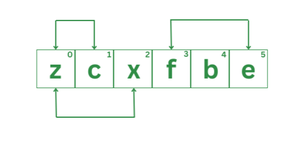
Next, we will construct a graph based on the relationships between pairs, which is depicted below.
-300.png)
Now, we will arrange each disconnected subgraph in lexicographically sorted order, as shown above.
Subsequently, we will reconstruct the string using the lexicographically sorted graph.

Below is the implementation of the above approach.
#include <iostream>
#include <vector>
#include <algorithm>

using namespace std;

class Graph {
private:
    int V;
    vector<vector<int>> adj;

public:
    // Constructor to initialize the graph with 'V' vertices
    Graph(int V) : V(V), adj(V) {}

    // Function to add a relationship (edge) between vertices 'v' and 'w'
    void addPair(int v, int w) {
        // Check if the indices are within bounds
        if (v >= 0 && v < V && w >= 0 && w < V) {
            // Adjust indices to be 0-based
            adj[v].push_back(w);
            adj[w].push_back(v);
        }
        else {
            cerr << "Invalid vertex indices: " << v << " or " << w << endl;
        }
    }

    // Utility function to perform depth-first traversal to find connected groups
    void countAll(int v, vector<int>& group, vector<bool>& visited) {
        visited[v] = true;
        // Add the vertex to the current group (adjust index)
        group.push_back(v + 1);

        // Recursively explore neighbors of the current vertex
        for (int neighbor : adj[v]) {
            if (!visited[neighbor]) {
                countAll(neighbor, group, visited);
            }
        }
    }

    // Function to find disjoint sets formed by the relations
    vector<vector<int>> disjointSets() {
        vector<bool> visited(V, false);
        vector<vector<int>> all_sets;

        for (int i = 0; i < V; ++i) {
            // If the vertex hasn't been visited, it's the start of a new group
            if (!visited[i]) {
                // Create a new group
                vector<int> group;
                // Find all vertices connected to this one
                countAll(i, group, visited);
                // Add the group to the list of all groups
                all_sets.push_back(group);
            }
        }

        return all_sets;
    }
};

// Driver Code
int main() {
    // Input string
    string Str = "zcxfbe";
    // Number of elements
    int N = 6;
    // Pairs of indices indicating relationships
    vector<vector<int>> Pairs = {{0, 1}, {0, 2}, {3, 5}};

    // Create a graph with N vertices
    Graph g(N);

    // Add relations based on pairs
    for (const auto& pair : Pairs) {
        g.addPair(pair[0], pair[1]);
    }

    // Find disjoint sets formed by the relations
    vector<vector<int>> disjoint_sets = g.disjointSets();
    vector<int> key;
    vector<char> value;

    for (size_t i = 0; i < disjoint_sets.size(); ++i) {
        // Temporary list to store characters within a group
        vector<char> semians;
        for (int j : disjoint_sets[i]) {
            // Extract characters from the input string
            semians.push_back(Str[j - 1]);
        }
        // Sort the characters lexicographically
        sort(semians.begin(), semians.end());
        // Sort the indices
        sort(disjoint_sets[i].begin(), disjoint_sets[i].end());

        // Add sorted characters to the value list
        value.insert(value.end(), semians.begin(), semians.end());
        // Add sorted indices to the key list
        key.insert(key.end(), disjoint_sets[i].begin(), disjoint_sets[i].end());
    }

    // Initialize a list to reconstruct the final string
    vector<char> ans(N, ' ');

    // Reconstruct the final string based on sorted characters and indices
    for (size_t i = 0; i < N; ++i) {
        ans[key[i] - 1] = value[i];
    }

    // Print the rearranged string
    cout << string(ans.begin(), ans.end()) << endl;

    return 0;
}
import java.util.ArrayList;
import java.util.Collections;
import java.util.List;

class Graph {
    private int V;
    private List<List<Integer>> adj;

    public Graph(int V) {
        this.V = V;
        adj = new ArrayList<>(V);
        for (int i = 0; i < V; i++) {
            adj.add(new ArrayList<>());
        }
    }

    public void addPair(int v, int w) {
        // Check if the indices are within bounds
        if (v >= 0 && v < V && w >= 0 && w < V) {
            adj.get(v).add(w);
            adj.get(w).add(v);
        } else {
            System.err.println("Invalid vertex indices: " + v + " or " + w);
        }
    }

    public void countAll(int v, List<Integer> group, boolean[] visited) {
        visited[v] = true;
        group.add(v + 1);

        for (int neighbor : adj.get(v)) {
            if (!visited[neighbor]) {
                countAll(neighbor, group, visited);
            }
        }
    }

    public List<List<Integer>> disjointSets() {
        boolean[] visited = new boolean[V];
        List<List<Integer>> allSets = new ArrayList<>();

        for (int i = 0; i < V; ++i) {
            if (!visited[i]) {
                List<Integer> group = new ArrayList<>();
                countAll(i, group, visited);
                allSets.add(group);
            }
        }

        return allSets;
    }
}

public class Main {
    public static void main(String[] args) {
        String str = "zcxfbe";
        int N = 6;
        int[][] pairs = {{0, 1}, {0, 2}, {3, 5}};

        Graph g = new Graph(N);

        // Add relations based on pairs
        for (int[] pair : pairs) {
            g.addPair(pair[0], pair[1]);
        }

        List<List<Integer>> disjointSets = g.disjointSets();
        List<Integer> key = new ArrayList<>();
        List<Character> value = new ArrayList<>();

        for (int i = 0; i < disjointSets.size(); ++i) {
            List<Character> semians = new ArrayList<>();
            for (int j : disjointSets.get(i)) {
                semians.add(str.charAt(j - 1));
            }
            Collections.sort(semians);
            Collections.sort(disjointSets.get(i));

            // Add sorted characters to the value list
            value.addAll(semians);
            // Add sorted indices to the key list
            key.addAll(disjointSets.get(i));
        }

        char[] ans = new char[N];
        for (int i = 0; i < N; ++i) {
            ans[key.get(i) - 1] = value.get(i);
        }

        // Print the rearranged string
        System.out.println(new String(ans));
    }
}
// This Code is contributed by Vikram_Shirsat
class Graph:
    def __init__(self, V):
          # Number of vertices in the graph
        self.V = V
         # Adjacency list to represent the graph
        self.adj = [[] for i in range(V)]

    def addPair(self, v, w):
          # Adjust indices to be 0-based
        v -= 1
        w -= 1
         # Add a relation (edge) between v and w
        self.adj[v].append(w)
        # Also add the reverse relation (undirected graph)
        self.adj[w].append(v)

    def disjointSets(self):
          # Create a list to track visited vertices
        visited = [False] * self.V
        # List to store groups of connected vertices
        all_sets = []

        def countAll(v, group):
               # Mark the current vertex as visited
            visited[v] = True
            # Add the vertex to the current group (adjust index)
            group.append(v + 1)

            # Recursively explore neighbors of the current vertex
            for neighbor in self.adj[v]:
                if not visited[neighbor]:
                    countAll(neighbor, group)

        for i in range(self.V):
              # If the vertex hasn't been visited,
            # it's the start of a new group
            if not visited[i]:
                  # Create a new group
                group = []
                # Find all vertices connected to this one
                countAll(i, group)
                 # Add the group to the list of all groups
                all_sets.append(group)

        return all_sets

# Driver Code

# Input string
Str = 'zcxfbe'
# Number of elements
N = 6
# Pairs of indices indicating relationships
Pairs = [[0, 1], [0, 2], [3, 5]]

# Create a graph with N vertices
g = Graph(N)

# Add relations based on pairs
for i in Pairs:
    g.addPair(i[0], i[1])

# Find groups formed by the relations
groups = g.disjointSets()

key = []  # List to store indices of characters
value = []  # List to store characters

# Sort characters within each group and store the results
for i in range(len(groups)):
      # Temporary list to store characters within a group
    semians = []
    for j in groups[i]:
          # Extract characters from the input string
        semians.append(Str[j])
    # Sort the characters lexicographically
    semians.sort()
    # Sort the indices
    groups[i].sort()

    # Add sorted characters to the value list
    value.extend(semians)
    # Add sorted indices to the key list
    key.extend(groups[i])

# Initialize a list to reconstruct the final string
ans = [""] * N

# Reconstruct the final string
# based on sorted characters and indices
for i in range(N):
    ans[key[i]] = value[i]

# Print the rearranged string
print(''.join(ans))

# This code is contributed by the Author
// C# IMplementation
using System;
using System.Collections.Generic;
using System.Linq;

class Graph
{
    private int V;
    private List<List<int>> adj;

    public Graph(int V)
    {
        this.V = V;
        adj = new List<List<int>>(V);
        for (int i = 0; i < V; i++)
        {
            adj.Add(new List<int>());
        }
    }

    public void AddPair(int v, int w)
    {
        // Check if the indices are within bounds
        if (v >= 0 && v < V && w >= 0 && w < V)
        {
            adj[v].Add(w);
            adj[w].Add(v);
        }
        else
        {
            Console.WriteLine("Invalid vertex indices: " + v + " or " + w);
        }
    }

    public void CountAll(int v, List<int> group, bool[] visited)
    {
        visited[v] = true;
        group.Add(v + 1);

        foreach (int neighbor in adj[v])
        {
            if (!visited[neighbor])
            {
                CountAll(neighbor, group, visited);
            }
        }
    }

    public List<List<int>> DisjointSets()
    {
        bool[] visited = new bool[V];
        List<List<int>> allSets = new List<List<int>>();

        for (int i = 0; i < V; ++i)
        {
            if (!visited[i])
            {
                List<int> group = new List<int>();
                CountAll(i, group, visited);
                allSets.Add(group);
            }
        }

        return allSets;
    }
}

public class MainClass
{
    public static void Main(string[] args)
    {
        string str = "zcxfbe";
        int N = 6;
        int[][] pairs = { new int[] { 0, 1 }, new int[] { 0, 2 }, new int[] { 3, 5 } };

        Graph g = new Graph(N);

        // Add relations based on pairs
        foreach (int[] pair in pairs)
        {
            g.AddPair(pair[0], pair[1]);
        }

        List<List<int>> disjointSets = g.DisjointSets();
        List<int> key = new List<int>();
        List<char> value = new List<char>();

        for (int i = 0; i < disjointSets.Count; ++i)
        {
            List<char> semians = new List<char>();
            foreach (int j in disjointSets[i])
            {
                semians.Add(str[j - 1]);
            }
            semians.Sort();
            disjointSets[i].Sort();

            // Add sorted characters to the value list
            value.AddRange(semians);
            // Add sorted indices to the key list
            key.AddRange(disjointSets[i]);
        }

        char[] ans = new char[N];
        for (int i = 0; i < N; ++i)
        {
            ans[key[i] - 1] = value[i];
        }

        // Print the rearranged string
        Console.WriteLine(new string(ans));
    }
}

// THis code is contributed by Sakshi
class GFG {
    constructor(V) {
        this.V = V;
        this.adj = new Array(V);
        for (let i = 0; i < V; i++) {
            this.adj[i] = [];
        }
    }
    addPair(v, w) {
        // Check if the indices are within bounds
        if (v >= 0 && v < this.V && w >= 0 && w < this.V) {
            this.adj[v].push(w);
            this.adj[w].push(v);
        } else {
            console.error("Invalid vertex indices: " + v + " or " + w);
        }
    }
    countAll(v, group, visited) {
        visited[v] = true;
        group.push(v + 1);
        for (let neighbor of this.adj[v]) {
            if (!visited[neighbor]) {
                this.countAll(neighbor, group, visited);
            }
        }
    }
    disjointSets() {
        const visited = new Array(this.V).fill(false);
        const allSets = [];
        for (let i = 0; i < this.V; ++i) {
            if (!visited[i]) {
                const group = [];
                this.countAll(i, group, visited);
                allSets.push(group);
            }
        }
        return allSets;
    }
}
// Main function
function main() {
    const str = "zcxfbe";
    const N = 6;
    const pairs = [[0, 1], [0, 2], [3, 5]];
    const g = new GFG(N);
    // Add relations based on pairs
    for (const pair of pairs) {
        g.addPair(pair[0], pair[1]);
    }
    const disjointSets = g.disjointSets();
    const key = [];
    const value = [];
    for (let i = 0; i < disjointSets.length; ++i) {
        const semians = [];
        for (const j of disjointSets[i]) {
            semians.push(str.charAt(j - 1));
        }
        semians.sort();
        disjointSets[i].sort();
        // Add sorted characters to value list
        value.push(...semians);
        // Add sorted indices to  key list
        key.push(...disjointSets[i]);
    }
    const ans = new Array(N);
    for (let i = 0; i < N; ++i) {
        ans[key[i] - 1] = value[i];
    }
    // Print the rearranged string
    console.log(ans.join(''));
}
main();
Output
cxzebf
Time Complexity: O(N log N),
Auxiliary Space: O(N), where N is the length of the input String.
