
Given a string, the task is to return the length of its longest possible chunked palindrome. It means a palindrome formed by substring in the case when it is not formed by characters of the string. For a better understanding look at the example
Examples:
Input : ghiabcdefhelloadamhelloabcdefghi
Output : 7
(ghi)(abcdef)(hello)(adam)(hello)(abcdef)(ghi)

Input : merchant
Output : 1
(merchant)

Input : antaprezatepzapreanta
Output : 11
(a)(nt)(a)(pre)(za)(tpe)(za)(pre)(a)(nt)(a)

Input : geeksforgeeks
Output : 3
(geeks)(for)(geeks)
The entire idea is to create chunks from left and right and recursively.
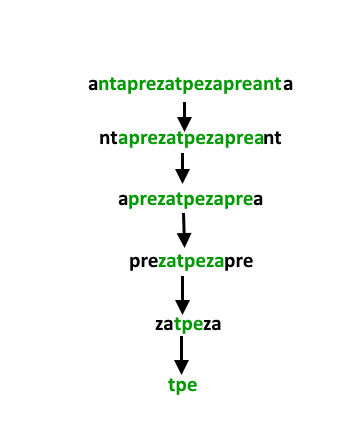
As you can see, we can match substring from the left side chunk and match it with the exact right side chunk. Once we get a match, we recursively count the length of the longest possible chunked palindrome in the remaining string. We end the recursion once no string is left or when no more valid chunked parts can be found.
Implementation:
// C++ program to find the length of longest palindromic chunk
#include <bits/stdc++.h>
using namespace std;

// Here curr_str is the string whose LCP is needed
// len is length of string evaluated till now
// and str is original string
int LPCRec(string curr_str, int count, int len, string str)
    {
        // if there is noting at all!!
        if (curr_str.size()==0)
            return (0);

        // if a single letter is left out
        if (curr_str.size() <= 1)
        {
            if (count != 0 && (str.size() - len )<= 1)
                return (count + 1);
            else
                return (1);
        }

        // for each length of substring chunk in string
        int n = curr_str.size();
        for (int i = 0; i < n/2; i++)
        {
            // if left side chunk and right side chunk
            // are same
            if (curr_str.substr(0, i+1) == curr_str.substr(n-1-i,i+1))
            {
                // Call LCP for the part between the
                // chunks and add 2 to the result.
                // Length of string evaluated till
                // now is increased by (i+1)*2
                return LPCRec(curr_str.substr(i+1, n-2-2*i), //
                        count + 2,
                        len + (i+1)*2, str);
            }
        }

        return count + 1;
    }


// Wrapper over LPCRec()
int LPC(string str)
{
    return LPCRec(str, 0, 0, str);
}


// driver function
int main()
{
    cout<<"V : "<<LPC("V")<<endl;
    cout<<"VOLVO : " << LPC("VOLVO")<<endl;
    cout<<"VOLVOV : " << LPC("VOLVOV")<<endl;
    cout<<"ghiabcdefhelloadamhelloabcdefghi : "<<
        LPC("ghiabcdefhelloadamhelloabcdefghi")<<endl;

    cout<<"ghiabcdefhelloadamhelloabcdefghik : "<<
                    LPC("ghiabcdefhelloadamhelloabcdefghik")<<endl;

    cout<<"antaprezatepzapreanta : " <<
                    LPC("antaprezatepzapreanta");
}

// This code is contributed by Pushpesh Raj
 /* Java program to find the length of longest palindromic
   chunk */
import java.util.*;
import java.lang.*;
import java.io.*;

class LongestPalindromicChunk
{
    // Here s is the string whose LCP is needed
    // ln is length of string evaluated till now
    // and str is original string
    private static int LPCRec(String curr_str, int count,
                             int len, String str)
    {
        // if there is noting at all!!
        if (curr_str == null || curr_str.isEmpty())
            return (0);

        // if a single letter is left out
        if (curr_str.length() <= 1)
        {
            if (count != 0 && str.length() - len <= 1)
                return (count + 1);
            else
                return (1);
        }

        // for each length of substring chunk in string
        int n = curr_str.length();
        for (int i = 0; i < n/2; i++)
        {
            // if left side chunk and right side chunk
            // are same
            if (curr_str.substring(0, i + 1).
                equals(curr_str.substring(n-1-i, n)))
            {
                // Call LCP for the part between the
                // chunks and add 2 to the result.
                // Length of string evaluated till
                // now is increased by (i+1)*2
                return LPCRec(curr_str.substring(i+1, n-1-i),
                           count + 2,
                           len + (i+1)*2, str);
            }
        }

        return count + 1;
    }

    // Wrapper over LPCRec()
    public static int LPC(String str)
    {
        return LPCRec(str, 0, 0, str);
    }

    // driver function
    public static void main(String[] args)
    {
        System.out.println("V : " + LPC("V"));
        System.out.println("VOLVO : " + LPC("VOLVO"));
        System.out.println("VOLVOV : " + LPC("VOLVOV"));
        System.out.println("ghiabcdefhelloadamhelloabcdefghi : " +
                        LPC("ghiabcdefhelloadamhelloabcdefghi"));

        System.out.println("ghiabcdefhelloadamhelloabcdefghik : " +
                        LPC("ghiabcdefhelloadamhelloabcdefghik"));

        System.out.println("antaprezatepzapreanta : " +
                        LPC("antaprezatepzapreanta"));
    }
}
# Python3 program to find length of
# longest palindromic chunk

# Here curr_str is the string whose
# LCP is needed leng is length of
# string evaluated till now and s
# is original string
def LPCRec(curr_str, count, leng, s):

    # If there is nothing at all!!
    if not curr_str:
        return 0

    # If a single letter is left out
    if len(curr_str) <= 1:
        if count != 0 and len(s) - leng <= 1:
            return (count + 1)
        else:
            return 1

    # For each length of substring
    # chunk in string
    n = len(curr_str)
    for i in range(n // 2):

        # If left side chunk and right
        # side chunk are same
        if (curr_str[0 : i + 1] ==
            curr_str[n - 1 - i : n]):

            # Call LCP for the part between the
            # chunks and add 2 to the result.
            # Length of string evaluated till
            # now is increased by (i+1)*2
            return LPCRec(curr_str[i + 1 : n - 1 - i],
                          count + 2, leng + (i + 1) * 2, s)

    return count + 1

# Wrapper over LPCRec()
def LPC(s):

    return LPCRec(s, 0, 0, s)

# Driver code
print("V :", LPC("V"))
print("VOLVO :", LPC("VOLVO"))
print("VOLVOV :", LPC("VOLVOV"))
print("ghiabcdefhelloadamhelloabcdefghi :",
  LPC("ghiabcdefhelloadamhelloabcdefghi"))

print("ghiabcdefhelloadamhelloabcdefghik :",
  LPC("ghiabcdefhelloadamhelloabcdefghik"))

print("antaprezatepzapreanta :",
  LPC("antaprezatepzapreanta"))

# This code is contributed by Prateek Gupta
// C# program to find length of
// longest palindromic chunk
using System;

class GFG
{
// Here s is the string whose LCP
// is needed ln is length of string
// evaluated till now and str is
// original string
private static int LPCRec(string curr_str, int count,
                          int len, string str)
{
    // if there is noting at all!!
    if (string.ReferenceEquals(curr_str, null) ||
                               curr_str.Length == 0)
    {
        return (0);
    }

    // if a single letter is left out
    if (curr_str.Length <= 1)
    {
        if (count != 0 && str.Length - len <= 1)
        {
            return (count + 1);
        }
        else
        {
            return (1);
        }
    }

    // for each length of substring
    // chunk in string
    int n = curr_str.Length;
    for (int i = 0; i < n / 2; i++)
    {
        // if left side chunk and right side chunk
        // are same
        if (curr_str.Substring(0, i + 1).Equals(
            curr_str.Substring(n - 1 - i, n - (n - 1 - i))))
        {
            // Call LCP for the part between the
            // chunks and add 2 to the result.
            // Length of string evaluated till
            // now is increased by (i+1)*2
            return LPCRec(curr_str.Substring(i + 1, (n - 1 - i) -
                         (i + 1)), count + 2, len + (i + 1) * 2, str);
        }
    }

    return count + 1;
}

// Wrapper over LPCRec()
public static int LPC(string str)
{
    return LPCRec(str, 0, 0, str);
}

// Driver Code
public static void Main(string[] args)
{
    Console.WriteLine("V : " + LPC("V"));
    Console.WriteLine("VOLVO : " + LPC("VOLVO"));
    Console.WriteLine("VOLVOV : " + LPC("VOLVOV"));
    Console.WriteLine("ghiabcdefhelloadamhelloabcdefghi : " +
                    LPC("ghiabcdefhelloadamhelloabcdefghi"));

    Console.WriteLine("ghiabcdefhelloadamhelloabcdefghik : " +
                    LPC("ghiabcdefhelloadamhelloabcdefghik"));

    Console.WriteLine("antaprezatepzapreanta : " +
                    LPC("antaprezatepzapreanta"));
}
}

// This code is contributed by Shrikant13
<script>

// JavaScript program to find length of
// longest palindromic chunk

// Here curr_str is the string whose
// LCP is needed leng is length of
// string evaluated till now and s
// is original string
function LPCRec(curr_str, count, leng, s){

    // If there is nothing at all!!
    if(!curr_str)
        return 0

    // If a single letter is left out
    if(curr_str.length <= 1){
        if (count != 0 && s.length - leng <= 1)
            return (count + 1)
        else
            return 1
    }

    // For each length of substring
    // chunk in string
    let n = curr_str.length
    for(let i=0;i<Math.floor(n/2);i++){

        // If left side chunk and right
        // side chunk are same
        if (curr_str.substring(0,i+1) == curr_str.substring(n-1-i,n))

            // Call LCP for the part between the
            // chunks and add 2 to the result.
            // Length of string evaluated till
            // now is increased by (i+1)*2
            return LPCRec(curr_str.substring(i + 1,n - 1 - i), count + 2, leng + (i + 1) * 2, s)
    }

    return count + 1
}

// Wrapper over LPCRec()
function LPC(s){

    return LPCRec(s, 0, 0, s)
}

// Driver code
document.write("V :", LPC("V"),"</br>")
document.write("VOLVO :", LPC("VOLVO"),"</br>")
document.write("VOLVOV :", LPC("VOLVOV"),"</br>")
document.write("ghiabcdefhelloadamhelloabcdefghi :",
  LPC("ghiabcdefhelloadamhelloabcdefghi"),"</br>")

document.write("ghiabcdefhelloadamhelloabcdefghik :",
  LPC("ghiabcdefhelloadamhelloabcdefghik"),"</br>")

document.write("antaprezatepzapreanta :",
  LPC("antaprezatepzapreanta"),"</br>")

// This code is contributed by shinjanpatra

</script>
Output
V : 1
VOLVO : 3
VOLVOV : 5
ghiabcdefhelloadamhelloabcdefghi : 7
ghiabcdefhelloadamhelloabcdefghik : 1
antaprezatepzapreanta : 11
Following is the C++ implementation with memoization for above problem.
Implementation:
#include <climits>
#include <iostream>
#include <unordered_map>
using namespace std;

unordered_map<string, int> mem;

int process(string& s, int l, int r)
{
    int ans = 1;
    if (l > r)
        return 0;
    // check if we've already solved this
    if (mem.find(s.substr(l, r - l + 1)) != mem.end())
        return mem[s.substr(l, r - l + 1)];
    for (int len = 1; len <= (r - l + 1) / 2; len++) {
        if (s.substr(l, len) == s.substr(r - len + 1, len))
            ans = max(ans,
                      2 + process(s, l + len, r - len));
    }
    // remember result for future
    mem[s.substr(l, r - l + 1)] = ans;
    return ans;
}

int LPC(string s) { return process(s, 0, s.length() - 1); }

int main()
{
    cout << LPC("aaaaabaababbaabaaababababababababbbbaaaaa")
         << endl;
    return 0;
}
import java.util.HashMap;

public class Main {

  static HashMap<String, Integer> mem = new HashMap<>();

  public static int process(String s, int l, int r) {
    int ans = 1;
    if (l > r) {
      return 0;
    }

    // check if we've already solved this
    if (mem.containsKey(s.substring(l, r + 1))) {
      return mem.get(s.substring(l, r + 1));
    }
    for (int len = 1; len <= (r - l + 1) / 2; len++) {
      if (s.substring(l, l + len).equals(s.substring(r - len + 1, r + 1))) {
        ans = Math.max(ans, 2 + process(s, l + len, r - len));
      }
    }
    // remember result for future
    mem.put(s.substring(l, r + 1), ans);
    return ans;
  }

  public static int LPC(String s) {
    return process(s, 0, s.length() - 1);
  }

  public static void main(String[] args) {
    System.out.println(LPC("aaaaabaababbaabaaababababababababbbbaaaaa"));
  }
}

// This code is contributed by Aman Kumar
# Python code for the approach

mem = {}

def process(s,l,r):
    global mem
    ans = 1
    if (l > r):
        return 0
    # check if we've already solved this
    if (s[l: r+1] in mem):
        return mem[s[l: r+1]]
    for Len in range(1,(r-l+1)//2 + 1,1):
        if (s[l: Len+l] == s[r-Len+1:r+1]):
            ans = max(ans, 2 + process(s, l+Len, r-Len))
    # remember result for future
    mem[s[l: r+1]] = ans
    return ans

def LPC(s):
    return process(s, 0, len(s)-1)

# driver code

print(LPC("aaaaabaababbaabaaababababababababbbbaaaaa"))

# This code is contributed by shinjanpatra.
let mem = {};

function process(s, l, r) {
    let ans = 1;
    if (l > r) {
        return 0;
    }

    // check if we've already solved this
    if (s.slice(l, r + 1) in mem) {
        return mem[s.slice(l, r + 1)];
    }
    for (let Len = 1; Len <= Math.floor((r - l + 1) / 2); Len++) {
        if (s.slice(l, Len + l) === s.slice(r - Len + 1, r + 1)) {
            ans = Math.max(ans, 2 + process(s, l + Len, r - Len));
        }
    }

    // remember result for future
    mem[s.slice(l, r + 1)] = ans;
    return ans;
}

function LPC(s) {
    return process(s, 0, s.length - 1);
}

// driver code
console.log(LPC("aaaaabaababbaabaaababababababababbbbaaaaa"));

// This code is contributed by adityashatmfh
// C# program for the above approach

using System;
using System.Collections.Generic;

class Program
{
    static Dictionary<string, int> mem = new Dictionary<string, int>();

    static int Process(string s, int l, int r)
    {
        int ans = 1;
        if (l > r)
            return 0;
        // check if we've already solved this
        if (mem.ContainsKey(s.Substring(l, r - l + 1)))
            return mem[s.Substring(l, r - l + 1)];
        for (int len = 1; len <= (r - l + 1) / 2; len++)
        {
            if (s.Substring(l, len) == s.Substring(r - len + 1, len))
                ans = Math.Max(ans, 2 + Process(s, l + len, r - len));
        }
        // remember result for future
        mem[s.Substring(l, r - l + 1)] = ans;
        return ans;
    }

    static int LPC(string s)
    {
        return Process(s, 0, s.Length - 1);
    }

    static void Main(string[] args)
    {
        Console.WriteLine(LPC("aaaaabaababbaabaaababababababababbbbaaaaa"));
    }
}


// This code is contributed by prince
Output
13
Time Complexity: O(N^3), where N is the length of the input string.
Auxiliary Space: O(N^2)
