
Given an undirected graph consisting of N nodes and M edges, the task is to find the minimum length of the path from Node 1 to Node N passing from every possible node of the given graph. If there doesn't exist any such path, then print -1.
Note: The path can pass through a node any number of times.
Examples:
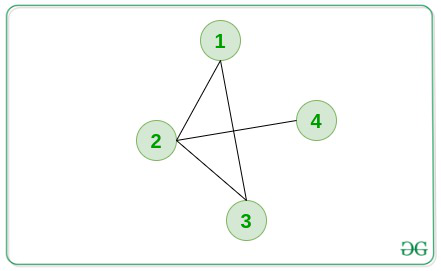
Input: N = 4, M = 4, edges[][] = {{1, 2}, {2, 3}, {1, 3}, {2, 4}}
Output: 2 2 3 2
Explanation:
Minimum path length from 1 to 4, passing from 1 is 2.
Minimum path length from 1 to 4, passing from 2 is 2.
Minimum path length from 1 to 4, passing from 3 is 3.
Minimum path length from 1 to 4, passing from 4 is 2.Input: N = 5, M = 7, edges[][] = {{1, 2}, {1, 4}, {2, 3}, {2, 5}, {4, 3}, {4, 5}, {1, 5}}
Output: 1 2 4 2 1
Approach: The idea is to run two BFS, one from node 1 excluding node N and another from node N excluding node 1 to find the minimum distance of all the nodes from 1 and N. The sum of both the minimum distances will be the minimum length of the path from 1 to N including the node. Follow the steps below to solve the problem:
- Initialize a queue, say queue1 to perform BFS from node 1 and a queue queue2 to perform BFS from node N.
- Initialize two arrays, say dist1[] and dist2[] that store the shortest distance by performing BFS1 and BFS2.
- Perform two BFS and perform the following steps in each case:
- Pop from the queue and store node in x and its distance in dis.
- If dist[x] is smaller than dis then continue.
- Traverse the adjacency list of x and for each child y, if dist[y] is greater than dis + 1 then update dist[y] equals dis + 1.
- After populating the two arrays dist1[] and dist2[] in the above steps, iterate over the range [0, N] and if the sum of (dist1[i] + dist2[i]) is greater than 109 then print "-1" as their exists no such path. Otherwise, print the value of (dist1[i] + dist2[i]) as the result.
Below is the implementation of the above approach:
// C++ program for the above approach

#include <bits/stdc++.h>
using namespace std;
#define ll long long int

// Function to calculate the distances
// from node 1 to N
void minDisIncludingNode(int n, int m,
                         int edges[][2])
{
    // Vector to store our edges
    vector<ll> g[10005];

    // Storing the edgees in the Vector
    for (int i = 0; i < m; i++) {
        int a = edges[i][0] - 1;
        int b = edges[i][1] - 1;
        g[a].push_back(b);
        g[b].push_back(a);
    }

    // Initialize queue
    queue<pair<ll, ll> > q;
    q.push({ 0, 0 });
    vector<int> dist(n, 1e9);
    dist[0] = 0;

    // BFS from first node using queue
    while (!q.empty()) {
        auto up = q.front();

        // Pop from queue
        q.pop();
        int x = up.first;
        int lev = up.second;
        if (lev > dist[x])
            continue;
        if (x == n - 1)
            continue;

        // Traversing its adjacency list
        for (ll y : g[x]) {
            if (dist[y] > lev + 1) {
                dist[y] = lev + 1;
                q.push({ y, lev + 1 });
            }
        }
    }
    // Initialize queue
    queue<pair<ll, ll> > q1;
    q1.push({ n - 1, 0 });
    vector<int> dist1(n, 1e9);
    dist1[n - 1] = 0;

    // BFS from last node using queue
    while (!q1.empty()) {
        auto up = q1.front();

        // Pop from queue
        q1.pop();
        int x = up.first;
        int lev = up.second;
        if (lev > dist1[x])
            continue;
        if (x == 0)
            continue;

        // Traversing its adjacency list
        for (ll y : g[x]) {
            if (dist1[y] > lev + 1) {
                dist1[y] = lev + 1;
                q1.push({ y, lev + 1 });
            }
        }
    }

    // Printing the minimum distance
    // including node i
    for (int i = 0; i < n; i++) {
        // If not reachable
        if (dist[i] + dist1[i] > 1e9)
            cout << -1 << " ";

        // Path exists
        else
            cout << dist[i] + dist1[i] << " ";
    }
}

// Driver Code
int main()
{
    // Given Input
    int n = 5;
    int m = 7;
    int edges[m][2]
        = { { 1, 2 }, { 1, 4 },
            { 2, 3 }, { 2, 5 },
            { 4, 3 }, { 4, 5 },
            { 1, 5 } };

    // Function Call
    minDisIncludingNode(n, m, edges);

    return 0;
}
import java.util.*;

public class Main {

    public static void minDisIncludingNode(int n, int m, int[][] edges) {
        // List to store our edges
        List<Integer>[] g = new ArrayList[10005];
        for (int i = 0; i < 10005; i++) {
            g[i] = new ArrayList<Integer>();
        }

        // Storing the edges in the List
        for (int i = 0; i < m; i++) {
            int a = edges[i][0] - 1;
            int b = edges[i][1] - 1;
            g[a].add(b);
            g[b].add(a);
        }

        // Initialize queue
        Queue<Integer> q = new LinkedList<>();
        q.add(0);
        int[] dist = new int[n];
        Arrays.fill(dist, Integer.MAX_VALUE);
        dist[0] = 0;

        // BFS from first node using queue
        while (!q.isEmpty()) {
            int x = q.poll();
            if (x == n - 1)
                continue;

            // Traversing its adjacency list
            for (int y : g[x]) {
                if (dist[y] > dist[x] + 1) {
                    dist[y] = dist[x] + 1;
                    q.add(y);
                }
            }
        }
        // Initialize queue
        Queue<Integer> q1 = new LinkedList<>();
        q1.add(n - 1);
        int[] dist1 = new int[n];
        Arrays.fill(dist1, Integer.MAX_VALUE);
        dist1[n - 1] = 0;

        // BFS from last node using queue
        while (!q1.isEmpty()) {
            int x = q1.poll();
            if (x == 0)
                continue;

            // Traversing its adjacency list
            for (int y : g[x]) {
                if (dist1[y] > dist1[x] + 1) {
                    dist1[y] = dist1[x] + 1;
                    q1.add(y);
                }
            }
        }

        // Printing the minimum distance
        // including node i
        for (int i = 0; i < n; i++) {
            // If not reachable
            if (dist[i] + dist1[i] > Integer.MAX_VALUE)
                System.out.print(-1 + " ");

            // Path exists
            else
                System.out.print(dist[i] + dist1[i] + " ");
        }
    }

    public static void main(String[] args) {
        // Given Input
        int n = 5;
        int m = 7;
        int[][] edges = { { 1, 2 }, { 1, 4 }, { 2, 3 },
                          { 2, 5 }, { 4, 3 }, { 4, 5 }, { 1, 5 } };

        // Function Call
        minDisIncludingNode(n, m, edges);
    }
}
# Python 3 program for the above approach

# Function to calculate the distances
# from node 1 to N
def minDisIncludingNode(n, m, edges):
    # Vector to store our edges
    g = [[] for i in range(10005)]

    # Storing the edgees in the Vector
    for i in range(m):
        a = edges[i][0] - 1
        b = edges[i][1] - 1
        g[a].append(b)
        g[b].append(a)

    # Initialize queue
    q = []
    q.append([0, 0])
    dist = [1e9 for i in range(n)]
    dist[0] = 0

    # BFS from first node using queue
    while(len(q)>0):
        up = q[0]

        # Pop from queue
        q = q[1:]
        x = up[0]
        lev = up[1]
        if (lev > dist[x]):
            continue
        if (x == n - 1):
            continue

        # Traversing its adjacency list
        for y in g[x]:
            if (dist[y] > lev + 1):
                dist[y] = lev + 1
                q.append([y, lev + 1])

    # Initialize queue
    q1 = []
    q1.append([n - 1, 0])
    dist1 = [1e9 for i in range(n)]
    dist1[n - 1] = 0

    # BFS from last node using queue
    while (len(q1) > 0):
        up = q1[0]

        # Pop from queue
        q1 = q1[1:]
        x = up[0]
        lev = up[1]
        if (lev > dist1[x]):
            continue
        if (x == 0):
            continue

        # Traversing its adjacency list
        for y in g[x]:
            if (dist1[y] > lev + 1):
                dist1[y] = lev + 1
                q1.append([y, lev + 1])

    # Printing the minimum distance
    # including node i
    for i in range(n):
        # If not reachable
        if (dist[i] + dist1[i] > 1e9):
            print(-1,end = " ")

        # Path exists
        else:
            print(dist[i] + dist1[i],end = " ")

# Driver Code
if __name__ == '__main__':
    # Given Input
    n = 5
    m = 7
    edges = [[1, 2],[1, 4],[2, 3],[2, 5],[4, 3],[4, 5],[1, 5]]

    # Function Call
    minDisIncludingNode(n, m, edges)

    # This code is contributed by SURENDRA_GANGWAR.
using System;
using System.Collections.Generic;

class MainClass {
    public static void MinDisIncludingNode(int n, int m, int[][] edges) {
        // List to store our edges
        List<int>[] g = new List<int>[10005];
        for (int i = 0; i < 10005; i++) {
            g[i] = new List<int>();
        }

        // Storing the edges in the List
        for (int i = 0; i < m; i++) {
            int a = edges[i][0] - 1;
            int b = edges[i][1] - 1;
            g[a].Add(b);
            g[b].Add(a);
        }

        // Initialize queue
        Queue<int> q = new Queue<int>();
        q.Enqueue(0);
        int[] dist = new int[n];
        for (int i = 0; i < n; i++) {
            dist[i] = int.MaxValue;
        }
        dist[0] = 0;

        // BFS from first node using queue
        while (q.Count != 0) {
            int x = q.Dequeue();
            if (x == n - 1)
                continue;

            // Traversing its adjacency list
            foreach (int y in g[x]) {
                if (dist[y] > dist[x] + 1) {
                    dist[y] = dist[x] + 1;
                    q.Enqueue(y);
                }
            }
        }
        // Initialize queue
        Queue<int> q1 = new Queue<int>();
        q1.Enqueue(n - 1);
        int[] dist1 = new int[n];
        for (int i = 0; i < n; i++) {
            dist1[i] = int.MaxValue;
        }
        dist1[n - 1] = 0;

        // BFS from last node using queue
        while (q1.Count != 0) {
            int x = q1.Dequeue();
            if (x == 0)
                continue;

            // Traversing its adjacency list
            foreach (int y in g[x]) {
                if (dist1[y] > dist1[x] + 1) {
                    dist1[y] = dist1[x] + 1;
                    q1.Enqueue(y);
                }
            }
        }

        // Printing the minimum distance
        // including node i
        for (int i = 0; i < n; i++) {
            // If not reachable
            if (dist[i] + dist1[i] > int.MaxValue)
                Console.Write(-1 + " ");

            // Path exists
            else
                Console.Write(dist[i] + dist1[i] + " ");
        }
    }

    public static void Main(string[] args) {

       // Given Input
            int n = 5;
            int m = 7;
            int[][] edges = { new int[] { 1, 2 }, new int[] { 1, 4 }, new int[] { 2, 3 },
                          new int[] { 2, 5 }, new int[] { 4, 3 }, new int[] { 4, 5 }, new int[] { 1, 5 } };

            // Function Call
            MinDisIncludingNode(n, m, edges);
        }

}
<script>
// Javascript program for the above approach

// Function to calculate the distances
// from node 1 to N
function minDisIncludingNode(n, m, edges) {
  // Vector to store our edges

  let g = new Array(10005).fill(0).map(() => []);
  // Storing the edgees in the Vector
  for (let i = 0; i < m; i++) {
    let a = edges[i][0] - 1;
    let b = edges[i][1] - 1;
    g[a].push(b);
    g[b].push(a);
  }

  // Initialize queue
  let q = [];
  q.push([0, 0]);
  dist = new Array(n).fill(1e9);
  dist[0] = 0;

  // BFS from first node using queue
  while (q.length > 0) {
    let up = q[0];

    // Pop from queue
    q.pop();
    let x = up[0];
    let lev = up[1];
    if (lev > dist[x]) continue;
    if (x == n - 1) continue;

    // Traversing its adjacency list
    for (let y of g[x]) {
      if (dist[y] > lev + 1) {
        dist[y] = lev + 1;
        q.push([y, lev + 1]);
      }
    }
  }

  // Initialize queue
  let q1 = [];
  q1.push([n - 1, 0]);
  let dist1 = new Array(n).fill(1e9);
  dist1[n - 1] = 0;

  // BFS from last node using queue
  while (q1.length > 0) {
    let up = q1[0];

    // Pop from queue
    q1.pop();
    let x = up[0];
    let lev = up[1];
    if (lev > dist1[x]) continue;
    if (x == 0) continue;

    // Traversing its adjacency list
    for (let y of g[x]) {
      if (dist1[y] > lev + 1) {
        dist1[y] = lev + 1;
        q1.push([y, lev + 1]);
      }
    }
  }

  // Printing the minimum distance
  // including node i
  for (let i = 0; i < n; i++) {
    // If not reachable
    if (dist[i] + dist1[i] > 1e9) document.write(-1 + " ");
    // Path exists
    else document.write(dist[i] + dist1[i] + " ");
  }
}

// Driver Code
// Given Input
let n = 5;
let m = 7;
let edges = [
  [1, 2],
  [1, 4],
  [2, 3],
  [2, 5],
  [4, 3],
  [4, 5],
  [1, 5],
];

// Function Call
minDisIncludingNode(n, m, edges);

// This code is contributed by gfgking
</script>
Output:
1 2 4 2 1
Time Complexity: O(N + M)
Auxiliary Space: O(N)
