
Given a set of cities and distance between every pair of cities, the problem is to find the shortest possible tour that visits every city exactly once and returns to the starting point.
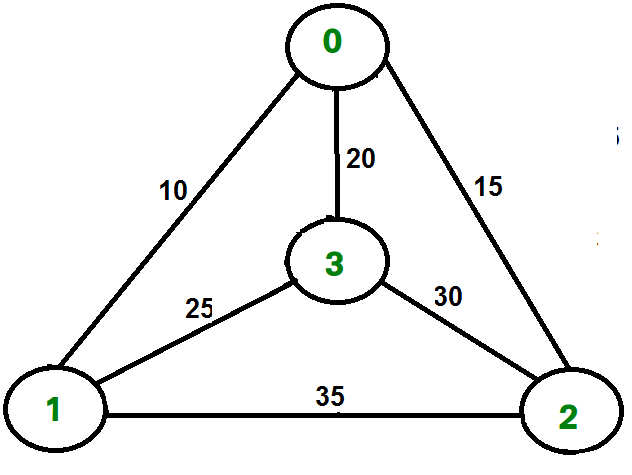
For example, consider the graph shown in figure on right side. A TSP tour in the graph is 0-1-3-2-0. The cost of the tour is 10+25+30+15 which is 80.
We have discussed following solutions
1) Naive and Dynamic Programming
2) Approximate solution using MST
Branch and Bound Solution for TSP
In the Branch and Bound method, we explore the solution space as a state space tree where each node represents a partial tour. For every node, we compute a bound on the best possible solution that can be obtained from that node. If this bound is greater than the best solution found so far, the subtree rooted at that node is ignored (pruned) because it cannot produce a better solution.
Cost Components of a Node
The total cost associated with a node consists of two parts
- Cost of reaching the node from the root, This is the cost of the edges already included in the partial tour.
- Estimated cost to complete the tour from the current node, This is computed using a lower bound on the remaining edges.
For a minimization problem like the Travelling Salesman Problem, we compute a lower bound.
This lower bound represents the minimum possible cost of completing the tour from the current node.
Lower Bound Calculation using Cost Matrix Reduction
To compute the lower bound efficiently, we use matrix reduction.
Row Reduction
For each row of the cost matrix
- Find the minimum value in that row.
- Subtract it from all elements of that row.
- Add the subtracted value to the reduction cost.
Column Reduction
For each column
- Find the minimum value in that column.
- Subtract it from all elements of that column.
- Add the subtracted value to the reduction cost.
The sum of all reductions gives a lower bound on the cost of completing the tour.
State Space Tree Expansion
The algorithm constructs a state space tree where
- Each level represents a city added to the partial tour.
- Each node stores the reduced cost matrix, the current cost (lower bound), the current city, and the path taken so far.
A priority queue (min-heap) is used so that the node with the smallest lower bound is expanded first.
Creating Child Nodes
When moving from city i → j:
- The row of city i is set to ∞ (cannot leave again).
- The column of city j is set to ∞ (cannot revisit).
- The edge j → start may also be restricted until the last level.
- The matrix is reduced again to compute a new lower bound.
The new node cost becomes:
New Cost = Parent Cost + Edge Cost(i, j) + Reduction Cost of new matrix
Pruning Condition
If Node Cost ≥ Best Tour Cost Found, then the node (subtree) is pruned, because it cannot produce a better solution.
Note: When a node reaches level n-1 (all cities visited), the algorithm adds the edge back to the starting city to complete the tour.
The tour with the minimum cost among all possible tours explored is returned as the optimal solution.
//Driver Code Starts
#include <iostream>
#include <vector>
#include <queue>
#include <algorithm>
using namespace std;

//Driver Code Ends

// large value used to represent no edge
const int inf = 1e9;


// structure representing a node in the state space tree
struct node {

    // reduced cost matrix
    vector<vector<int>> matrix;

    // lower bound cost of this node
    int cost;

    // current city
    int vertex;

    // number of cities visited so far
    int level;

    // path taken to reach this node
    vector<int> path;

    node(int n = 0) {
        matrix.assign(n, vector<int>(n, inf));
        cost = 0;
        vertex = 0;
        level = 0;
    }
};


// reduce rows and columns of matrix, return total reduction cost
int reducematrix(vector<vector<int>> &mat) {

    int n = mat.size();
    int reduction = 0;

    // row reduction
    for (int i = 0; i < n; i++) {

        int rowmin = inf;

        // find minimum value in the row
        for (int j = 0; j < n; j++)
            rowmin = min(rowmin, mat[i][j]);

        // subtract row minimum from all elements of that row
        if (rowmin != inf && rowmin > 0) {

            reduction += rowmin;

            for (int j = 0; j < n; j++)
                if (mat[i][j] != inf)
                    mat[i][j] -= rowmin;
        }
    }

    // column reduction
    for (int j = 0; j < n; j++) {

        int colmin = inf;

        // find minimum value in the column
        for (int i = 0; i < n; i++)
            colmin = min(colmin, mat[i][j]);

        // subtract column minimum from all elements of that column
        if (colmin != inf && colmin > 0) {

            reduction += colmin;

            for (int i = 0; i < n; i++)
                if (mat[i][j] != inf)
                    mat[i][j] -= colmin;
        }
    }

    // return total reduction cost which contributes to lower bound
    return reduction;
}


// create a child node after moving from one city to another
node createchild(const node &parent, int from, int to) {

    int n = parent.matrix.size();
    node child(n);

    // copy parent reduced matrix
    child.matrix = parent.matrix;

    // disable all outgoing edges from current city
    for (int j = 0; j < n; j++)
        child.matrix[from][j] = inf;

    // disable all incoming edges to the next city
    for (int i = 0; i < n; i++)
        child.matrix[i][to] = inf;

    // cost of edge used for transition
    int edgecost = parent.matrix[from][to];

    // new cost includes parent cost and edge cost
    child.cost = parent.cost + edgecost;

    // perform reduction on the new matrix
    int reduction = reducematrix(child.matrix);

    // add reduction cost to obtain lower bound
    child.cost += reduction;

    // update node information
    child.vertex = to;
    child.level = parent.level + 1;

    // copy path and append new city
    child.path = parent.path;
    child.path.push_back(to);

    return child;
};


// comparison for selecting minimum cost node
struct comparenode {

    // priority queue selects node with minimum cost
    bool operator()(const node &a, const node &b) const {
        return a.cost > b.cost;
    }
};


// solve tsp using branch and bound
pair<int, vector<int>> solvetsp(const vector<vector<int>> &costmatrix) {

    int n = costmatrix.size();

    // create root node
    node root(n);
    root.matrix = costmatrix;
    root.vertex = 0;
    root.level = 0;

    // starting city
    root.path.push_back(0);

    // compute initial reduction
    root.cost = reducematrix(root.matrix);

    // priority queue to select node with smallest bound
    priority_queue<node, vector<node>, comparenode> pq;
    pq.push(root);

    int bestcost = inf;
    vector<int> bestpath;

    // explore nodes until queue becomes empty
    while (!pq.empty()) {

        node cur = pq.top();
        pq.pop();

        // prune nodes whose bound is already worse
        if (cur.cost >= bestcost)
            continue;

        // if all cities are visited
        if (cur.level == n - 1) {

            // cost to return to starting city
            int finaledge = cur.matrix[cur.vertex][0];

            if (finaledge == inf)
                continue;

            int totalcost = cur.cost + finaledge;

            // update best solution
            if (totalcost < bestcost) {

                bestcost = totalcost;
                bestpath = cur.path;
                bestpath.push_back(0);
            }

            continue;
        }

        // expand current node to all possible next cities
        for (int j = 0; j < n; j++) {

            if (cur.matrix[cur.vertex][j] != inf) {

                bool visited = false;

                // check if city already visited
                for (int v : cur.path)
                    if (v == j)
                        visited = true;

                if (visited)
                    continue;

                // create child node
                node child = createchild(cur, cur.vertex, j);

                // push only promising nodes
                if (child.cost < bestcost)
                    pq.push(child);
            }
        }
    }

    return {bestcost, bestpath};
}

//Driver Code Starts


// driver code
int main() {

    // example cost matrix for 5 cities
    vector<vector<int>> costmatrix = {
        {0, 72, 184, 136, 115},
        {72, 0, 143, 180, 58},
        {184, 143, 0, 23, 182},
        {136, 180, 23, 0, 156},
        {115, 58, 182, 156, 0}
    };

    auto result = solvetsp(costmatrix);

    int bestcost = result.first;
    vector<int> path = result.second;

    if (bestcost >= inf) {

        cout << "No Hamiltonian cycle found
";

    } else {

        cout << "Minimum cost: " << bestcost << "
";
        cout << "Path: ";

        for (int i = 0; i < path.size(); i++) {

            cout << path[i];

            if (i + 1 < path.size())
                cout << " ";
        }

        cout << "
";
    }

    return 0;
}
//Driver Code Ends
//Driver Code Starts
import java.util.ArrayList;
import java.util.PriorityQueue;
import java.util.Comparator;


class GfG {

//Driver Code Ends

    // large value used to represent no edge
    static final int inf = (int)1e9;


    // structure representing a node in the state space tree
    static class node {

        // reduced cost matrix
        ArrayList<ArrayList<Integer>> matrix;

        // lower bound cost of this node
        int cost;

        // current city
        int vertex;

        // number of cities visited so far
        int level;

        // path taken to reach this node
        ArrayList<Integer> path;

        node(int n) {

            matrix = new ArrayList<>();

            for (int i = 0; i < n; i++) {

                ArrayList<Integer> row = new ArrayList<>();

                for (int j = 0; j < n; j++)
                    row.add(inf);

                matrix.add(row);
            }

            cost = 0;
            vertex = 0;
            level = 0;
            path = new ArrayList<>();
        }
    }


    // reduce rows and columns of matrix, return total reduction cost
    static int reducematrix(ArrayList<ArrayList<Integer>> mat) {

        int n = mat.size();
        int reduction = 0;

        // row reduction
        for (int i = 0; i < n; i++) {

            int rowmin = inf;

            // find minimum value in the row
            for (int j = 0; j < n; j++)
                rowmin = Math.min(rowmin, mat.get(i).get(j));

            // subtract row minimum from all elements of that row
            if (rowmin != inf && rowmin > 0) {

                reduction += rowmin;

                for (int j = 0; j < n; j++)
                    if (mat.get(i).get(j) != inf)
                        mat.get(i).set(j, mat.get(i).get(j) - rowmin);
            }
        }

        // column reduction
        for (int j = 0; j < n; j++) {

            int colmin = inf;

            // find minimum value in the column
            for (int i = 0; i < n; i++)
                colmin = Math.min(colmin, mat.get(i).get(j));

            // subtract column minimum from all elements of that column
            if (colmin != inf && colmin > 0) {

                reduction += colmin;

                for (int i = 0; i < n; i++)
                    if (mat.get(i).get(j) != inf)
                        mat.get(i).set(j, mat.get(i).get(j) - colmin);
            }
        }

        // return total reduction cost which contributes to lower bound
        return reduction;
    }


    // create a child node after moving from one city to another
    static node createchild(node parent, int from, int to) {

        int n = parent.matrix.size();
        node child = new node(n);

        // copy parent reduced matrix
        for (int i = 0; i < n; i++)
            child.matrix.set(i, new ArrayList<>(parent.matrix.get(i)));

        // disable all outgoing edges from current city
        for (int j = 0; j < n; j++)
            child.matrix.get(from).set(j, inf);

        // disable all incoming edges to the next city
        for (int i = 0; i < n; i++)
            child.matrix.get(i).set(to, inf);

        // cost of edge used for transition
        int edgecost = parent.matrix.get(from).get(to);

        // new cost includes parent cost and edge cost
        child.cost = parent.cost + edgecost;

        // perform reduction on the new matrix
        int reduction = reducematrix(child.matrix);

        // add reduction cost to obtain lower bound
        child.cost += reduction;

        // update node information
        child.vertex = to;
        child.level = parent.level + 1;

        // copy path and append new city
        child.path = new ArrayList<>(parent.path);
        child.path.add(to);

        return child;
    }


    // comparison for selecting minimum cost node
    static class comparenode implements Comparator<node> {

        // priority queue selects node with minimum cost
        public int compare(node a, node b) {
            return a.cost - b.cost;
        }
    }


    // solve tsp using branch and bound
    static Pair solvetsp(int[][] costmatrix) {

        int n = costmatrix.length;

        // create root node
        node root = new node(n);

        for (int i = 0; i < n; i++)
            for (int j = 0; j < n; j++)
                root.matrix.get(i).set(j, costmatrix[i][j]);

        root.vertex = 0;
        root.level = 0;

        // starting city
        root.path.add(0);

        // compute initial reduction
        root.cost = reducematrix(root.matrix);

        // priority queue to select node with smallest bound
        PriorityQueue<node> pq = new PriorityQueue<>(new comparenode());
        pq.add(root);

        int bestcost = inf;
        ArrayList<Integer> bestpath = new ArrayList<>();

        // explore nodes until queue becomes empty
        while (!pq.isEmpty()) {

            node cur = pq.poll();

            // prune nodes whose bound is already worse
            if (cur.cost >= bestcost)
                continue;

            // if all cities are visited
            if (cur.level == n - 1) {

                // cost to return to starting city
                int finaledge = cur.matrix.get(cur.vertex).get(0);

                if (finaledge == inf)
                    continue;

                int totalcost = cur.cost + finaledge;

                // update best solution
                if (totalcost < bestcost) {

                    bestcost = totalcost;
                    bestpath = new ArrayList<>(cur.path);
                    bestpath.add(0);
                }

                continue;
            }

            // expand current node to all possible next cities
            for (int j = 0; j < n; j++) {

                if (cur.matrix.get(cur.vertex).get(j) != inf) {

                    boolean visited = false;

                    // check if city already visited
                    for (int v : cur.path)
                        if (v == j)
                            visited = true;

                    if (visited)
                        continue;

                    // create child node
                    node child = createchild(cur, cur.vertex, j);

                    // push only promising nodes
                    if (child.cost < bestcost)
                        pq.add(child);
                }
            }
        }

        return new Pair(bestcost, bestpath);
    }


    static class Pair {

        int cost;
        ArrayList<Integer> path;

        Pair(int c, ArrayList<Integer> p) {
            cost = c;
            path = p;
        }
    }

//Driver Code Starts


    // driver code
    public static void main(String[] args) {

        int[][] costmatrix = {
            {0,72,184,136,115},
            {72,0,143,180,58},
            {184,143,0,23,182},
            {136,180,23,0,156},
            {115,58,182,156,0}
        };

        Pair result = solvetsp(costmatrix);

        int bestcost = result.cost;
        ArrayList<Integer> path = result.path;

        if (bestcost >= inf) {

            System.out.println("No Hamiltonian cycle found");

        } else {

            System.out.println("Minimum cost: " + bestcost);
            System.out.print("Path: ");

            for (int i = 0; i < path.size(); i++) {

                System.out.print(path.get(i));

                if (i + 1 < path.size())
                    System.out.print(" ");
            }

            System.out.println();
        }
    }
}
//Driver Code Ends
#Driver Code Starts
import heapq

#Driver Code Ends

# large value used to represent no edge
inf = 10**9

# structure representing a node in the state space tree
class Node:
    def __init__(self, n=0):

        # reduced cost matrix
        self.matrix = [[inf] * n for _ in range(n)]

        # lower bound cost of this node
        self.cost = 0

        # current city
        self.vertex = 0

        # number of cities visited so far
        self.level = 0

        # path taken to reach this node
        self.path = []

    def __lt__(self, other):
        return self.cost < other.cost

# reduce rows and columns of matrix, return total reduction cost
def reduce_matrix(mat):

    n = len(mat)
    reduction = 0

    # row reduction
    for i in range(n):

        row_min = min(mat[i])

        # subtract row minimum from all elements of that row
        if row_min != inf and row_min > 0:

            reduction += row_min

            for j in range(n):
                if mat[i][j] != inf:
                    mat[i][j] -= row_min

    # column reduction
    for j in range(n):

        col_min = min(mat[i][j] for i in range(n))

        # subtract column minimum from all elements of that column
        if col_min != inf and col_min > 0:

            reduction += col_min

            for i in range(n):
                if mat[i][j] != inf:
                    mat[i][j] -= col_min

    # return total reduction cost which contributes to lower bound
    return reduction


# create a child node after moving from one city to another
def create_child(parent, from_city, to):

    n = len(parent.matrix)
    child = Node(n)

    # copy parent reduced matrix
    child.matrix = [row[:] for row in parent.matrix]

    # disable all outgoing edges from current city
    for j in range(n):
        child.matrix[from_city][j] = inf

    # disable all incoming edges to the next city
    for i in range(n):
        child.matrix[i][to] = inf

    # cost of edge used for transition
    edge_cost = parent.matrix[from_city][to]

    # new cost includes parent cost and edge cost
    child.cost = parent.cost + edge_cost

    # perform reduction on the new matrix
    reduction = reduce_matrix(child.matrix)

    # add reduction cost to obtain lower bound
    child.cost += reduction

    # update node information
    child.vertex = to
    child.level = parent.level + 1

    # copy path and append new city
    child.path = parent.path[:]
    child.path.append(to)

    return child


# solve tsp using branch and bound
def solve_tsp(cost_matrix):

    n = len(cost_matrix)

    # create root node
    root = Node(n)
    root.matrix = [row[:] for row in cost_matrix]
    root.vertex = 0
    root.level = 0

    # starting city
    root.path.append(0)

    # compute initial reduction
    root.cost = reduce_matrix(root.matrix)

    # priority queue to select node with smallest bound
    pq = []
    heapq.heappush(pq, root)

    best_cost = inf
    best_path = []

    # explore nodes until queue becomes empty
    while pq:

        cur = heapq.heappop(pq)

        # prune nodes whose bound is already worse
        if cur.cost >= best_cost:
            continue

        # if all cities are visited
        if cur.level == n - 1:

            # cost to return to starting city
            final_edge = cur.matrix[cur.vertex][0]

            if final_edge == inf:
                continue

            total_cost = cur.cost + final_edge

            # update best solution
            if total_cost < best_cost:

                best_cost = total_cost
                best_path = cur.path[:]
                best_path.append(0)

            continue

        # expand current node to all possible next cities
        for j in range(n):

            if cur.matrix[cur.vertex][j] != inf:

                visited = j in cur.path

                if visited:
                    continue

                # create child node
                child = create_child(cur, cur.vertex, j)

                # push only promising nodes
                if child.cost < best_cost:
                    heapq.heappush(pq, child)

    return best_cost, best_path


if __name__=="__main__":

#Driver Code Starts
    cost_matrix = [
        [0, 72, 184, 136, 115],
        [72, 0, 143, 180, 58],
        [184, 143, 0, 23, 182],
        [136, 180, 23, 0, 156],
        [115, 58, 182, 156, 0]
    ]

    best_cost, path = solve_tsp(cost_matrix)

    if best_cost >= inf:
        print("No Hamiltonian cycle found")
    else:
        print("Minimum cost:", best_cost)
        print("Path:", " ".join(map(str, path)))
#Driver Code Ends
//Driver Code Starts
using System;
using System.Collections.Generic;
using System.Linq;

class GfG
{
//Driver Code Ends

    // large value used to represent no edge
    private const int inf = 1_000_000_000;

    // structure representing a node in the state space tree
    class Node
    {
        // reduced cost matrix
        public List<List<int>> Matrix { get; set; }

        // lower bound cost of this node
        public int Cost { get; set; }

        // current city
        public int Vertex { get; set; }

        // number of cities visited so far
        public int Level { get; set; }

        // path taken to reach this node
        public List<int> Path { get; set; }

        public Node(int n = 0)
        {
            Matrix = new List<List<int>>(n);
            for (int i = 0; i < n; i++)
            {
                Matrix.Add(Enumerable.Repeat(inf, n).ToList());
            }
            Cost = 0;
            Vertex = 0;
            Level = 0;
            Path = new List<int>();
        }
    }

    // reduce rows and columns of matrix, return total reduction cost
    static int ReduceMatrix(List<List<int>> mat)
    {
        int n = mat.Count;
        int reduction = 0;

        // row reduction
        for (int i = 0; i < n; i++)
        {
            int rowMin = inf;

            // find minimum value in the row
            for (int j = 0; j < n; j++)
                rowMin = Math.Min(rowMin, mat[i][j]);

            // subtract row minimum from all elements of that row
            if (rowMin != inf && rowMin > 0)
            {
                reduction += rowMin;

                for (int j = 0; j < n; j++)
                    if (mat[i][j] != inf)
                        mat[i][j] -= rowMin;
            }
        }

        // column reduction
        for (int j = 0; j < n; j++)
        {
            int colMin = inf;

            // find minimum value in the column
            for (int i = 0; i < n; i++)
                colMin = Math.Min(colMin, mat[i][j]);

            // subtract column minimum from all elements of that column
            if (colMin != inf && colMin > 0)
            {
                reduction += colMin;

                for (int i = 0; i < n; i++)
                    if (mat[i][j] != inf)
                        mat[i][j] -= colMin;
            }
        }

        // return total reduction cost which contributes to lower bound
        return reduction;
    }

    // create a child node after moving from one city to another
    static Node CreateChild(Node parent, int fromCity, int toCity)
    {
        int n = parent.Matrix.Count;
        Node child = new Node(n);

        // copy parent reduced matrix
        child.Matrix = parent.Matrix.Select(row => new List<int>(row)).ToList();

        // disable all outgoing edges from current city
        for (int j = 0; j < n; j++)
            child.Matrix[fromCity][j] = inf;

        // disable all incoming edges to the next city
        for (int i = 0; i < n; i++)
            child.Matrix[i][toCity] = inf;

        // cost of edge used for transition
        int edgeCost = parent.Matrix[fromCity][toCity];

        // new cost includes parent cost and edge cost
        child.Cost = parent.Cost + edgeCost;

        // perform reduction on the new matrix
        int reduction = ReduceMatrix(child.Matrix);

        // add reduction cost to obtain lower bound
        child.Cost += reduction;

        // update node information
        child.Vertex = toCity;
        child.Level = parent.Level + 1;

        // copy path and append new city
        child.Path = new List<int>(parent.Path) { toCity };

        return child;
    }

    // solve tsp using branch and bound
    static (int bestCost, List<int> bestPath) SolveTSP(List<List<int>> costMatrix)
    {
        int n = costMatrix.Count;

        // create root node
        Node root = new Node(n);
        root.Matrix = costMatrix.Select(row => new List<int>(row)).ToList();
        root.Vertex = 0;
        root.Level = 0;

        // starting city
        root.Path.Add(0);

        // compute initial reduction
        root.Cost = ReduceMatrix(root.Matrix);

        // priority queue to select node with smallest bound (using .NET 6+ PriorityQueue)
        var pq = new PriorityQueue<Node, int>();
        pq.Enqueue(root, root.Cost);

        int bestCost = inf;
        List<int> bestPath = new List<int>();

        // explore nodes until queue becomes empty
        while (pq.Count > 0)
        {
            Node cur = pq.Dequeue();

            // prune nodes whose bound is already worse
            if (cur.Cost >= bestCost)
                continue;

            // if all cities are visited
            if (cur.Level == n - 1)
            {
                // cost to return to starting city
                int finalEdge = cur.Matrix[cur.Vertex][0];

                if (finalEdge == inf)
                    continue;

                int totalCost = cur.Cost + finalEdge;

                // update best solution
                if (totalCost < bestCost)
                {
                    bestCost = totalCost;
                    bestPath = new List<int>(cur.Path) { 0 };
                }

                continue;
            }

            // expand current node to all possible next cities
            for (int j = 0; j < n; j++)
            {
                if (cur.Matrix[cur.Vertex][j] != inf)
                {
                    bool visited = false;

                    // check if city already visited
                    foreach (int v in cur.Path)
                        if (v == j)
                            visited = true;

                    if (visited)
                        continue;

                    // create child node
                    Node child = CreateChild(cur, cur.Vertex, j);

                    // push only promising nodes
                    if (child.Cost < bestCost)
                        pq.Enqueue(child, child.Cost);
                }
            }
        }

        return (bestCost, bestPath);
    }

//Driver Code Starts

    // driver code
    static void Main()
    {
        // example cost matrix for 5 cities
        List<List<int>> costMatrix = new List<List<int>>
        {
            new List<int> {0, 72, 184, 136, 115},
            new List<int> {72, 0, 143, 180, 58},
            new List<int> {184, 143, 0, 23, 182},
            new List<int> {136, 180, 23, 0, 156},
            new List<int> {115, 58, 182, 156, 0}
        };

        var result = SolveTSP(costMatrix);
        int bestCost = result.bestCost;
        List<int> path = result.bestPath;

        if (bestCost >= inf)
        {
            Console.WriteLine("No Hamiltonian cycle found");
        }
        else
        {
            Console.WriteLine("Minimum cost: " + bestCost);
            Console.Write("Path: ");
            for (int i = 0; i < path.Count; i++)
            {
                Console.Write(path[i]);
                if (i + 1 < path.Count)
                    Console.Write(" ");
            }
            Console.WriteLine();
        }
    }
}
//Driver Code Ends
// large value used to represent no edge
const inf = 1e9;

// structure representing a node in the state space tree
class Node {
    constructor(n = 0) {
        // reduced cost matrix
        this.matrix = Array.from({ length: n }, () => Array(n).fill(inf));
        // lower bound cost of this node
        this.cost = 0;
        // current city
        this.vertex = 0;
        // number of cities visited so far
        this.level = 0;
        // path taken to reach this node
        this.path = [];
    }
}

// simple min-heap implementation for nodes (based on cost)
class MinHeap {
    constructor() {
        this.heap = [];
    }

    push(node) {
        this.heap.push(node);
        this._siftUp(this.heap.length - 1);
    }

    pop() {
        if (this.heap.length === 0) return null;
        const top = this.heap[0];
        const bottom = this.heap.pop();
        if (this.heap.length > 0) {
            this.heap[0] = bottom;
            this._siftDown(0);
        }
        return top;
    }

    _siftUp(index) {
        while (index > 0) {
            const parent = Math.floor((index - 1) / 2);
            if (this.heap[parent].cost <= this.heap[index].cost) break;
            [this.heap[parent], this.heap[index]] = [this.heap[index], this.heap[parent]];
            index = parent;
        }
    }

    _siftDown(index) {
        const length = this.heap.length;
        while (true) {
            let left = 2 * index + 1;
            let right = 2 * index + 2;
            let smallest = index;

            if (left < length && this.heap[left].cost < this.heap[smallest].cost)
                smallest = left;
            if (right < length && this.heap[right].cost < this.heap[smallest].cost)
                smallest = right;

            if (smallest === index) break;
            [this.heap[index], this.heap[smallest]] = [this.heap[smallest], this.heap[index]];
            index = smallest;
        }
    }

    size() {
        return this.heap.length;
    }
}

// reduce rows and columns of matrix, return total reduction cost
function reduceMatrix(mat) {
    const n = mat.length;
    let reduction = 0;

    // row reduction
    for (let i = 0; i < n; i++) {
        let rowMin = inf;

        // find minimum value in the row
        for (let j = 0; j < n; j++)
            rowMin = Math.min(rowMin, mat[i][j]);

        // subtract row minimum from all elements of that row
        if (rowMin !== inf && rowMin > 0) {
            reduction += rowMin;

            for (let j = 0; j < n; j++)
                if (mat[i][j] !== inf)
                    mat[i][j] -= rowMin;
        }
    }

    // column reduction
    for (let j = 0; j < n; j++) {
        let colMin = inf;

        // find minimum value in the column
        for (let i = 0; i < n; i++)
            colMin = Math.min(colMin, mat[i][j]);

        // subtract column minimum from all elements of that column
        if (colMin !== inf && colMin > 0) {
            reduction += colMin;

            for (let i = 0; i < n; i++)
                if (mat[i][j] !== inf)
                    mat[i][j] -= colMin;
        }
    }

    // return total reduction cost which contributes to lower bound
    return reduction;
}

// create a child node after moving from one city to another
function createChild(parent, fromCity, toCity) {
    const n = parent.matrix.length;
    const child = new Node(n);

    // copy parent reduced matrix (deep copy)
    child.matrix = parent.matrix.map(row => [...row]);

    // disable all outgoing edges from current city
    for (let j = 0; j < n; j++)
        child.matrix[fromCity][j] = inf;

    // disable all incoming edges to the next city
    for (let i = 0; i < n; i++)
        child.matrix[i][toCity] = inf;

    // cost of edge used for transition
    const edgeCost = parent.matrix[fromCity][toCity];

    // new cost includes parent cost and edge cost
    child.cost = parent.cost + edgeCost;

    // perform reduction on the new matrix
    const reduction = reduceMatrix(child.matrix);

    // add reduction cost to obtain lower bound
    child.cost += reduction;

    // update node information
    child.vertex = toCity;
    child.level = parent.level + 1;

    // copy path and append new city
    child.path = [...parent.path, toCity];

    return child;
}

// solve tsp using branch and bound
function solveTSP(costMatrix) {
    const n = costMatrix.length;

    // create root node
    const root = new Node(n);
    root.matrix = costMatrix.map(row => [...row]); // deep copy
    root.vertex = 0;
    root.level = 0;

    // starting city
    root.path.push(0);

    // compute initial reduction
    root.cost = reduceMatrix(root.matrix);

    // priority queue to select node with smallest bound
    const pq = new MinHeap();
    pq.push(root);

    let bestCost = inf;
    let bestPath = [];

    // explore nodes until queue becomes empty
    while (pq.size() > 0) {
        const cur = pq.pop();

        // prune nodes whose bound is already worse
        if (cur.cost >= bestCost)
            continue;

        // if all cities are visited
        if (cur.level === n - 1) {
            // cost to return to starting city
            const finalEdge = cur.matrix[cur.vertex][0];

            if (finalEdge === inf)
                continue;

            const totalCost = cur.cost + finalEdge;

            // update best solution
            if (totalCost < bestCost) {
                bestCost = totalCost;
                bestPath = [...cur.path, 0];
            }

            continue;
        }

        // expand current node to all possible next cities
        for (let j = 0; j < n; j++) {
            if (cur.matrix[cur.vertex][j] !== inf) {
                // check if city already visited
                if (cur.path.includes(j))
                    continue;

                // create child node
                const child = createChild(cur, cur.vertex, j);

                // push only promising nodes
                if (child.cost < bestCost)
                    pq.push(child);
            }
        }
    }

    return { bestCost, bestPath };
}


//Driver Code Starts
// Driver code

// example cost matrix for 5 cities
const costMatrix = [
    [0, 72, 184, 136, 115],
    [72, 0, 143, 180, 58],
    [184, 143, 0, 23, 182],
    [136, 180, 23, 0, 156],
    [115, 58, 182, 156, 0]
];

const { bestCost, bestPath } = solveTSP(costMatrix);

if (bestCost >= inf) {
    console.log("No Hamiltonian cycle found");
} else {
    console.log("Minimum cost: " + bestCost);
    console.log("Path: " + bestPath.join(" "));
}

//Driver Code Ends
Output :
Minimum cost : 80
Path Taken : 0 1 3 2 0
Complexity
- Worst-case Time Complexity:
O(n!) - Space Complexity:
Depends on the number of nodes stored in the priority queue.
