
Modern electrical engineering is not entirely without the large usage of induction cars in several places. They are renowned for their strong layout, dependability, and effectiveness. The electromagnetic induction theory, which Michael Faraday evolved in the nineteenth century, gives the basis for how an induction motor works. An electric-powered connection among the constant and rotating sections isn't essential for induction motors, which makes them stronger and much less hard to use than other motor types. Their adaptability and ease of protection cause them to be popular in industrial equipment, electric-powered automobiles, and home gadgets.
Induction motors are specifically used in applications with alternating modern (AC). Their capability to function without an instantaneous connection to the energy supply makes them particularly beneficial in situations when getting admission to protection is constrained. This feature also lessens the abrasion that other motor types' brushes and commutators enjoy. Technology has made induction cars extra effective and inexperienced, and they're now crucial to the development of industrial methods and automation.
What is an Induction Motor?
An induction motor, often known as an asynchronous motor, is an AC motor that produces torque by means of electromagnetically inducing an electric-powered modern inside the rotor through the stator winding's magnetic place. Because of this, an induction motor does not require an electrical connection to the rotor. For induction cars, there are two forms of rotors: wound kind and squirrel-cage type.
Working Principle of Induction Motor
The motor which fits at the precept of electromagnetic induction is called the induction motor. Electromagnetic induction is the phenomenon wherein the electromotive force induces across the electrical conductor while it is located in a rotating magnetic area.
Types or Classification
Induction vehicles can be labeled into essential types:
1. Single-Phase Induction Motor
A single phase induction motor is an electric powered motor that operates on unmarried-segment alternating modern-day (AC) strength. It is typically utilized in household appliances, small commercial machines, and other packages where 3-section energy is not to be had.
.jpg)
Construction
Stator: Contains a laminated middle with a distributed winding.
Rotor: Usually a squirrel cage kind, such as aluminum or copper bars quick-circuited via quit earrings.
Working Principle
The single-section induction motor is predicated on a pulsating magnetic discipline to generate torque. However, a unmarried-section deliver does not produce a rotating magnetic subject, so an auxiliary winding or beginning mechanism (which include a capacitor or shaded poles) is needed to create a segment distinction and provoke rotation.
2. Three-Phase Induction Motor
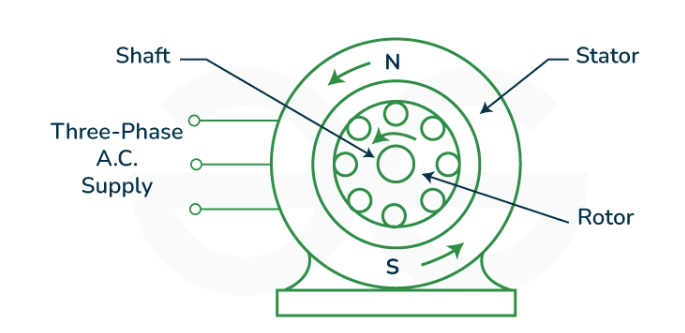
A 3-phase induction motor operates on 3-section AC strength, that is usually utilized in industrial and commercial packages due to its performance and energy skills.
Construction
Stator: Contains a 3-phase winding spaced a hundred and twenty electric levels aside, which produces a rotating magnetic area while connected to a 3-segment deliver.
Rotor: Typically a squirrel cage kind, although wound rotors are also used for precise applications.
Working Principle
The three-section induction motor relies on a rotating magnetic area created through the three-segment supply. This field induces a contemporary in the rotor bars, producing a secondary magnetic area that interacts with the stator subject, generating torque and causing the rotor to rotate.
3. Induction Motor with a Squirrel Cage
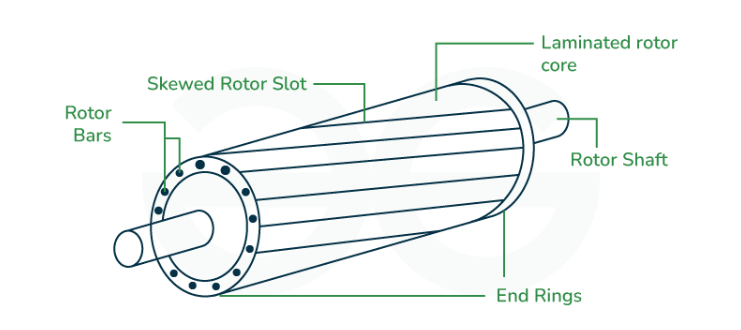
It is the maximum commonplace type and has a rotor fashioned like a squirrel cage. It is Simple, rugged, and cheaper.
2. Slip Ring Induction Motor
It consists of slip jewelry and brushes and allows out of doors resistance to be related to the rotor circuit. It is used for applications requiring excessive beginning torque.
.png)
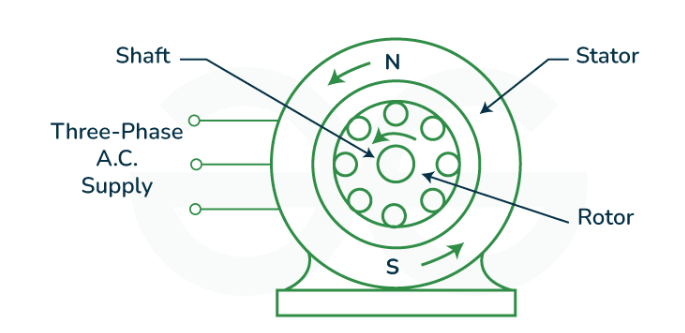
Basic Diagram of an Induction Motor
Explanation
- Stator: The table-certain part of the motor, consisting of windings related to the electricity deliver.
- Rotor: The rotating part of the motor, as a result of the usage of the magnetic area from the stator.
- Air Gap: The area among the stator and rotor, allowing rotation.
Working Principle
The electromagnetic induction principle of Faraday's law governs how an induction motor capabilities. When the stator windings are excited by means of an AC source, a spinning magnetic field is created. This magnetic field produces an electromotive pressure (EMF) that the rotor windings experience, which motivates the current to comply with healthy. These days, the torque produced with the useful resource of the rotor's interplay with the magnetic challenge reasons the rotor to revolve.
Components
- Stator: Contains laminated metal cores with slots for windings.
- Rotor: Can be both squirrel cage or wound type.
- Frame: Provides structural manual.
- Bearings: Reduce friction and help the rotor.
- End Bells: Enclose the motor and offer guide for bearings.
Construction
The manufacturing of an induction motor includes a stator, rotor, and various one of a kind additives housed inside a frame. The stator is a cylindrical shape with slots for windings. The rotor is placed within the stator, separated via a small air hollow. Bearings useful aid the rotor and permit smooth rotation. End bells enclose the motor, presenting safety and structural assist.
Important Terminologies
- Slip: The distinction a number of the synchronous pace and the real pace of the rotor.
- Synchronous Speed: The tempo at which the magnetic difficulty rotates.
- Rotor Current: The present day-day induced within the rotor.
- Torque: The rotational stress produced via the motor
Examples
- Household Fans: Use unmarried-phase induction cars.
- Conveyor Belts: Operated through 3-segment induction cars.
- Electric Vehicles: Employ induction cars for propulsion.
Differences
Induction Motor vs. Synchronous Motor
- Induction Motor: Rotor pace is less than synchronous velocity (non-synchronous).
- Synchronous Motor: Rotor velocity is same to synchronous velocity (synchronous).
Advantages and Disadvantages of Induction Motor
Advantages
- Simple Construction: Fewer transferring factors.
- Low Cost: Economical to fabricate.
- Durability: Long-lasting and strong.
- Maintenance-Free: No brushes or commutators.
- Efficiency: High overall performance in converting electrical energy to mechanical power.
Disadvantages
- Starting Torque: Generally lower than awesome vehicles.
- Speed Control: Complex and high priced.
- Power Factor: Operates at a lower energy component.
- Noise: Can be noisy underneath positive conditions.
- Heat Generation: Generates more heat as compared to one of a kind cars.
Applications of Induction Motor
- Pumps
- Fans
- Blowers
- Conveyors
- Cranes
- Lifts
- Compressors
- Mixers
- Industrial Machines
- Electric Vehicles
Conclusion
Induction cars are essential in current engineering due to their strong production, reliability, and overall performance. They are applied in a large sort of programs, from own family domestic gadget to business equipment. Understanding their advent, jogging precept, and various kinds is important for each person concerned in electric powered powered engineering or associated fields.
