
In signal processing and telecommunications, it is extremely necessary to know the baseband as well as band pass concepts when designing and optimizing communication systems. The original frequency range of such unmodulated signals is represented by baseband signals. However, in order to be transmitted, bandpass signals need to be modulated and shifted to a higher frequency band.
In this article we will learn about the definitions, types, differences, advantages, disadvantages and applications of baseband and bandpass signals while giving an overview of these basic principles.
Table of Content
Definitions of Baseband Signal and Bandpass Signal
Baseband Signal
A baseband signal is any signal that ranges from almost 0 Hz to some cut off frequency. It represents the initial unmodulated data for transmission or processing. Generally, baseband signals are used in wired communication systems and digital data transmission where they remain within their original frequency limits.
Bandpass Signal
On the other hand, a band pass signal is one whose frequency range has been modulated. It occurs over a specified range of frequencies with lower and upper cutoff frequencies for it. These signals are necessary in wireless communications and radio transmissions where the signal needs to be shifted to a higher frequency to allow convenient long distance transmission.
Types of Both
Types of Baseband Signals
- Analog Baseband Signals: Continuous signals like audio and video signals.
- Digital Baseband Signals: Discrete signals like binary data in computer networks.
- Multimedia Baseband Signals: A combination of audio, video, and other data.
- Low-Frequency Baseband Signals: Signals with low frequency components usually below 20 kHz.
- High-Frequency Baseband Signals: These are signals with high-frequency components within the baseband range.
Types of Bandpass Signals
- Narrow Band Pass Signal: Consist of a small frequency band surrounding the center frequency.
- Wide Band Pass Signal: Occupies a wide range of frequencies
- Single Side Band (SSB) signal: It uses one side of carrier frequency for transmission purpose.
- Double Side Band (DSB) signal: it uses both sides of the carrier frequency
- Modulated Bandpass Signals Involves signals which have been modulated using methods such as AM, FM and PM.
Diagrams with Explanation
Baseband Signal Diagram
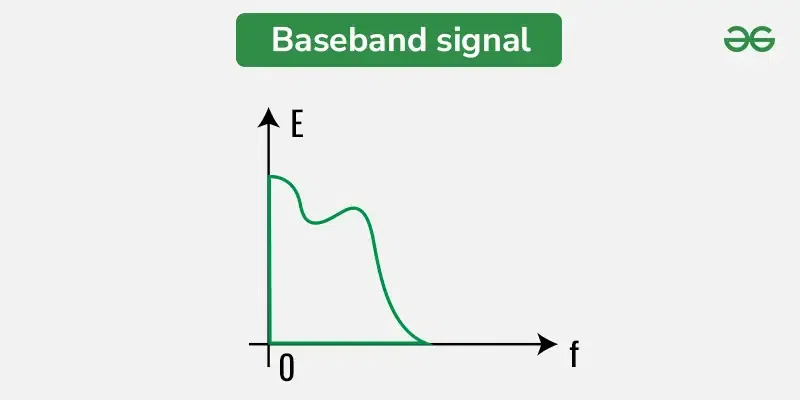
Explanation: The diagram illustrates the components of a baseband signal ranging from 0 Hz to the cut-off frequency. The signal is not modulated but contains initial data for transmission or processing.
Bandpass Signal Diagram
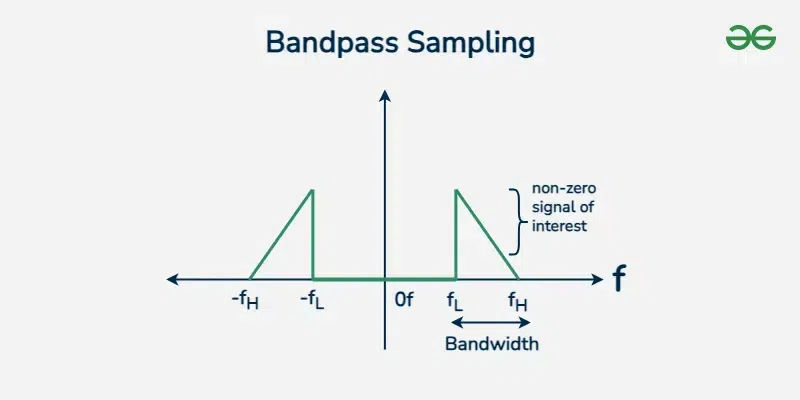
Explanation: The graph displays a band pass signal that has been modulated to occupy a higher frequency range often between lower cutoff and upper cutoff frequencies. Modulation shifts the original signal to a high-frequency region thus enabling it to be efficiently transmitted over numerous communication channels.
Differences Between Baseband and Bandpass Signals
Feature | Baseband Signal | Bandpass Signal |
|---|---|---|
Frequency Range | Near 0 Hz to a maximum cutoff frequency | Occupies a higher, specific frequency band |
Modulation | Unmodulated | Modulated to a higher frequency |
Transmission Medium | Typically wired systems | Used in wireless and radio communication |
Signal Type | Original, raw signal | Modulated, processed signal |
Bandwidth Requirement | Lower bandwidth required | Higher bandwidth required |
Noise Susceptibility | More susceptible to low-frequency noise | Less susceptible due to higher frequency |
Filtering Requirements | Requires low-pass filters | Requires band-pass filters |
Applications | Digital data, audio, and video | Wireless communication, broadcasting |
Transmission Distance | Suitable for short distances | Suitable for long distances |
Power Consumption | Lower power consumption | Higher power for longer transmissions |
Advantages and Disadvantages
Baseband Signal
Advantages:
- Ease: Simpler to implement and process.
- Low Bandwidth Requirement: Requires fewer bandwidths compared to bandpass signals.
- Cheapness: Lower cost transmission media for short distances.
- High Fidelity: Keeps the original signal quality.
- Direct Transmission: It can be transmitted directly over small distances.
Disadvantages:
- Noise Susceptibility: At low frequencies, greater susceptibility to noise and interference.
- Limited Range: Inappropriate for long distance transmissions.
- Signal Attenuation: Signal power loses more as it travels longer distances;
- Frequency Crowding : It is prone to much interference from other signals in the same frequency band.
- Few Applications: Dominantly, used in wired communication and short range transmission purposes.
Bandpass Signal
Advantages:
- Long-Distance Transmission : Appropriate for transmitting signals over a long distance
- Less Noise Interference : Higher frequencies have lesser problems with noise
- Efficient Use of Spectrum : Allows for efficient frequency allocation
- High Capacity : Supports multiple channels and higher data rates
- Versatility : Can work on many modulation schemes and applications
Disadvantages:
- Complexity: However, it is more challenging to implement and process.
- More Expensive: Thus, demands more sophisticated equipment and bigger power.
- Bandpass Filters: It requires the use of band-pass filters that may cost you a lot of money.
- Frequency Dependence: Actually, performance varies with frequency range and environment.
- Potential for Interference: If not properly regulated, this can disrupt other signals in close bands.
Applications
Baseband Signal
- Computer Networks: Transmitting digital data over Ethernet as well as other wired networks.
- Audio Processing: This handling audio signals in recording and playback systems.
- Video Transmission: It is meant for transmitting video signals short distances away from a camera or any other storage device into a display unit for example television set or monitor screen.
- Digital Communication: Low-frequency digital communication systems uses these filter types widely.
- Instrumentation: Technical devices used in processing signals by scientific instruments & sensors
Bandpass Signal
- Wireless Communication: Sending radio, cellular and satellite signals through space.
- Broadcasting: TV and radio broadcasting at far distances apart.
- Radar Systems: These are utilized for detection and ranging purposes.
- Telecommunications: Long distance telephony including data transfer at high speed can be done using this filter type.
- Medical Imaging: This is why they are used in technologies such as MRI scans or ultrasound imaging.
Conclusion
Baseband and bandpass signals are two basic approaches to signal transmission and processing. Baseband signals are unmodulated original signals ideal for short range and wired communication systems whereas bandpass signals are modulated to higher frequencies that make them suitable for long range wireless communication. Understanding these differences, advantages and applications of the two kinds of signal helps in designing efficient communication systems as well as choosing the right technology for specific requirements.
