
Both 8253 and 8254 are Programmable Interval Timers (PTIs) which are designed to perform different functions like time and counting by using triple 16-bit registers. Both 8253 and 8254 have 2 input pins and 1 output pin.
8253
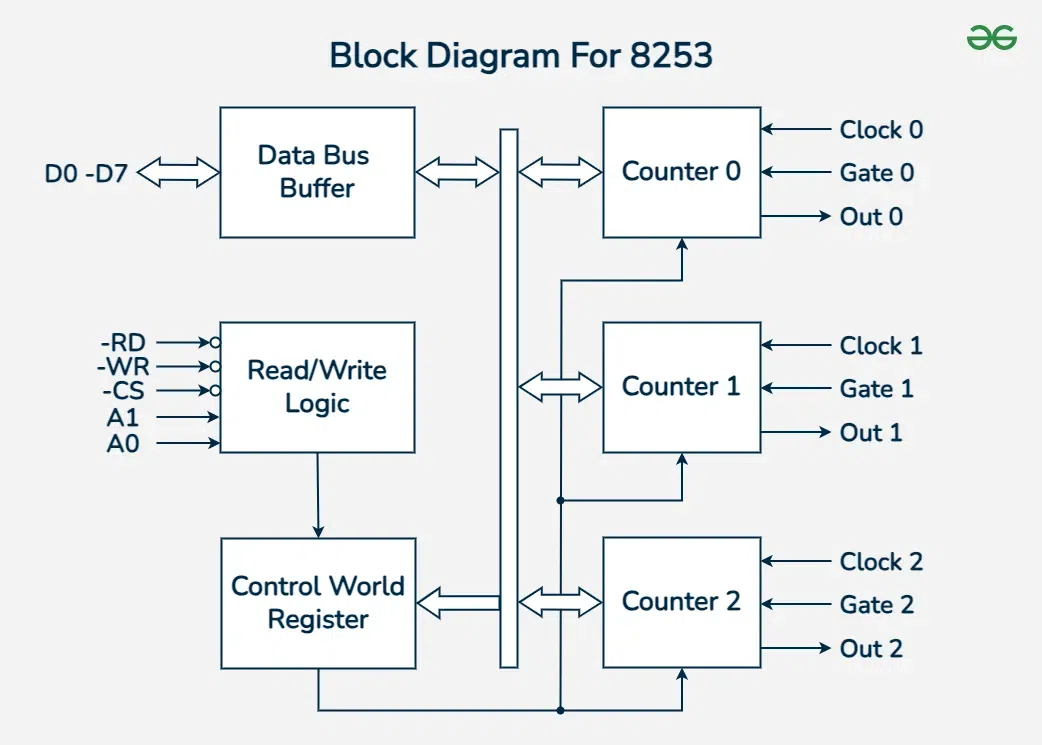
The Intel 8253 is a programmable interval timer or PIT chip. It performs counting and timing functions using three 16-bit counters for the microcomputers. Each counter has two specific input pins and one output pin. These can be programmed to perform the counting process in a binary mode. The modes of the 8253 determine how these counters work and also regulate the one output pin as well.
Advantages
- Simple Design: Easy to use for basic timing and counting applications.
- Three Independent Counters: Contains three separate 16-bit counters that can work simultaneously.
- Multiple Operating Modes: Supports 6 different operating modes for flexibility.
- Binary and BCD Counting: Can perform counting in both binary and BCD formats.
Disadvantages
- Lower Speed: Supports lower clock frequency (up to 2.6 MHz) compared to 8254.
- Higher Power Consumption: Uses NMOS technology, which consumes more power.
- No Read-Back Command: Cannot directly read counter status like 8254.
- Complex Control Words: Programming requires careful configuration of control words.
Applications
- Time Delay Generation: Used to generate accurate delays in microprocessor systems.
- Event Counting: Counts external pulses or events.
- Interrupt Generation: Produces periodic interrupts for CPU operations.
- Square Wave Generation: Generates clock and square wave signals.
Block Diagram For 8253
8254
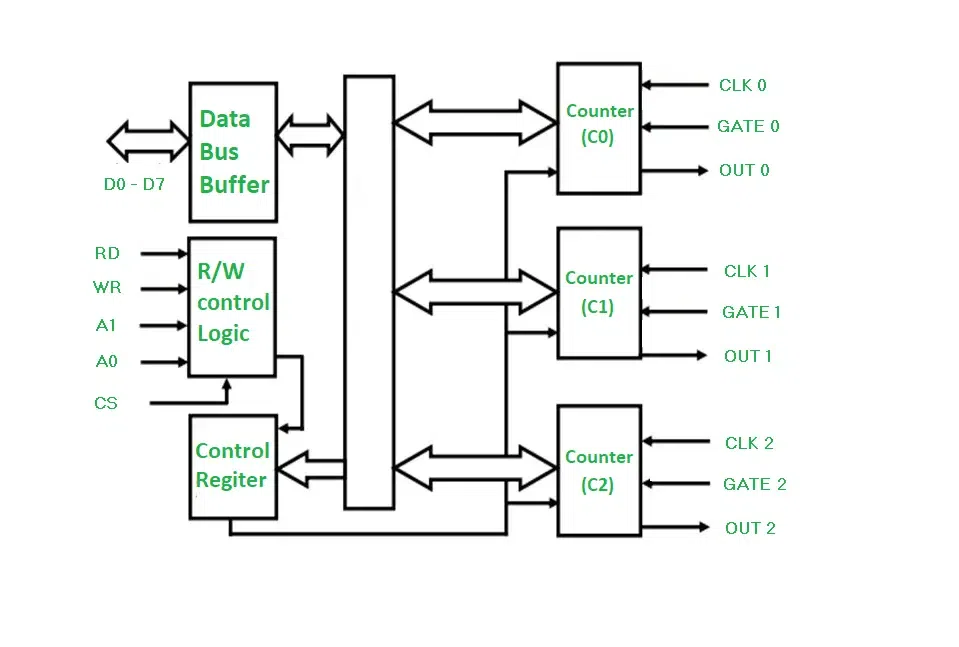
8254 Programmable Timer. The system is particularly used for timing control applications in different microcomputing systems. The timer has 3 independent counters capable of handling the clock inputs up to almost 10 MHz with a 16-bit size for each counter. The timer can work with the +5V power supply with 24-pin signals as well.
Advantages
- Versatility: Provides three independent 16-bit counters for different timing and counting operations.
- Programmability: Each counter can be programmed separately in different modes.
- High-Speed Operation: Supports clock frequencies up to 10 MHz.
- Reliable Timing: Useful for accurate delay generation and event counting.
Disadvantages
- Complex Programming: Different modes and control words make programming difficult for beginners.
- Limited Resolution: 16-bit counters are less precise compared to modern timers.
- Limited Features: Does not support advanced functions like PWM and input capture.
- Old Technology: Mostly replaced by modern microcontroller timers.
Applications
- Embedded Systems: Used for timing-critical operations.
- Event Scheduling: Generates delays and periodic interrupts.
- Real-Time Clock (RTC): Helps in clock and calendar functions.
- Industrial Automation: Controls timing in industrial machines and processes.
Block Diagram For 8254
Differences Between 8253 and 8254
| Aspect | 8253 | 8254 |
|---|---|---|
| Technology | NMOS | HMOS |
| Maximum Clock Frequency | 2.6 MHz | 10 MHz |
| Power Consumption | Higher | Lower |
| Read/Write Feature | Sequential operations | Read-back command supported |
| Control Word | Basic control word | Enhanced control word |
| Initialization Speed | Slower | Faster |
| Reset Behavior | Not clearly defined | Proper reset support |
| Compatibility | Compatible with 8255 | Compatible with 8255 |
| Operating Modes | 6 modes | 6 modes |
| Counters | Three 16-bit counters | Three 16-bit counters |
| Availability | Older device | Improved and widely used version |
