Many processes and phenomena that occur in our surroundings are continuous in time. Examples are the rotation of the planet around the sun, the movement of the pendulum in a clock, the tides of the sea, the rotation of a fan, etc. All these systems operate in a complicated way. However, some of the phenomena are periodic in nature. To analyze these systems one can make use of elementary functions like sine and cosine functions. On the other hand it is essential to examine if these systems can be explained as linear combinations of sine and cosine functions. For that purpose, Fourier series are used to determine conditions under which periodic systems can be represented as a linear combination of sine and cosine functions.
What is the Fourier Series?
the Fourier Series: A given function f(t) with fundamental time period \large\textbf{T} and fundamental frequency \large\omega_0 = \frac{2\pi}{T} can be represented in the form, % \f is defined as #1f(#2) using the macro
\begin{aligned}
\mskip{5cm}f(x) &= \frac{a_0}{2} + \sum_{n=1}^{\infty} \left[ a_n \cos(n \omega_0 t) + b_n \sin(n \omega_0 t) \right]
\end{aligned} Such series are known as Fourier series. \sf\text{Fourier coefficient}:Let f(t) be function with time period T then a_n and b_n, known as Fourier coefficient, are defined by
\begin{aligned}
\mskip{5cm}a_n &=\frac{2}{T} \int\limits_{\frac{-T}{2}}^{\frac{T}{2}} f(t)\cos n\omega_0t \,dt \hspace{2cm} n = 0,\,1,\,2,\,.\,.\,. \\
a_0 &= \frac{2}{T}\int\limits_{\frac{-T}{2}}^{\frac{T}{2}}f(t)dt\\
b_n &= \frac{2}{T} \int\limits_{\frac{-T}{2}}^{\frac{T}{2}} f(t)\sin n\omega_0t \,dt \hspace{2cm} n = 1,\,2,\,.\,.\,.
\end{aligned}
Types of Trigonometric Fourier Series
1. Fourier Sine Series: In order to find Fourier sine series for a odd function defined over time interval (0,\text{T}) we extend the time period to \text{(-T,T)} and since it is odd function it follows the property f(-t) = -f(t), the Fourier transform of f(t) can be transformed into following equation: \mskip{5cm} f(t) = \sum\limits_{n = 1}^{\infty}b_n\sin n\omega_0t
2. Fourier Cosine Series: In order to find Fourier cosine series for a even function defined over time interval (0,T) we extend the time period to (-T,T) then the Fourier series of f(t) is given by, \mskip{5cm} f(t) = \sum\limits_{n = 1}^{\infty}a_n\cos n\omega_0t
Properties of Trigonometric Fourier Series
1. The closure property of trigonometric orthogonal system implies that Fourier series of f(x) converges in norm to f. In other word if a_n and b_n are Fourier coefficient of f then, \begin{aligned}
\hspace{5cm}\lim\limits_{m\to\infty}||f(x) - (\frac{a_0}{2} + \sum\limits_{n = 1}^{m}(a_n\cos nx + b_n\sin nx))|| = 0
\end{aligned} 2. Bessel's inequality: Let f be the Fourier series and a_n, b_n be the Fourier coefficient then, \begin{aligned}\hspace{5cm}\frac{|{a_0}|^{2}}{2} + \sum\limits_{n = 1}^{\infty}(|a_n|^2 + |b_n|^2) \leq ||f||^2\end{aligned} 3. Riemann Lebesgue Lemma : Let f be Fourier series and a_n and b_n be the Fourier coefficient of then, \begin{aligned}
\hspace{5cm}\lim\limits_{n\to\infty}a_n = \lim\limits_{n\to\infty} = 0
\end{aligned} 4. Fourier series of any constant number is equal to that constant number. Let f(t)=k, k is a constant number, be the function and f is the Fourier series of that function then, \begin{aligned}
\hspace{5cm}f(t) &=f=k
\end{aligned}
Examples 1. f(t) = k ;k\in \R \ and \ t\in(-\pi,\pi). In order to find the Fourier equivalent of above function we have to find the Fourier coefficient. Let's find the value of a_n first. \begin{aligned}
\hspace{5cm}
a_0&=\frac{2}{T}\int\limits_{\frac{-T}{2}}^{\frac{-T}{2}}f(t)dt\\
a_0 &= \frac{2}{T}k [t]_{\frac{-T}{2}}^{\frac{T}{2}}\\
a_0&=\frac{2}{T} kT\\
a_0 &=2k\\
a_n &= \frac{2k}{T} \int_{-T/2}^{T/2} \cos(n \omega_0 t) \, dt \\
a_n &= \frac{2k}{T} \left[ \frac{\sin(n \omega_0 t)}{n \omega_0} \right]_{-T/2}^{T/2}\\
a_n &= \frac{2k}{T} \left( \frac{\sin(n \omega_0 \cdot \frac{T}{2})}{n \omega_0} - \frac{\sin(n \omega_0 \cdot \left(-\frac{T}{2}\right))}{n \omega_0} \right)\\
a_n &= \frac{2k}{T} \cdot \frac{1}{n \omega_0} \left( \sin\left( n \pi \right) - \sin\left( -n \pi \right) \right)\\
a_n &= 0\\
\end{aligned} After finding value of a_n it is time to find the value of second Fourier coefficient. \begin{aligned}
\hspace{5cm}b_n &= \frac{2k}{T} \int_{-T/2}^{T/2} \sin(n \omega_0 t) \, dt\\
b_n &= \frac{2k}{T} \left[ -\frac{\cos(n \omega_0 t)}{n \omega_0} \right]_{-T/2}^{T/2}\\
b_n &= \frac{2k}{T} \left( -\frac{\cos(n \omega_0 \cdot \frac{T}{2})}{n \omega_0} + \frac{\cos(n \omega_0 \cdot \left(-\frac{T}{2}\right))}{n \omega_0} \right)\\
b_n &= \frac{2k}{T} \cdot \frac{-1}{n \omega_0} \left( \cos\left( n \pi \right) - \cos\left( -n \pi \right) \right)\\
b_n &= \frac{2k}{T} \cdot \frac{-1}{n \omega_0} \left( (-1)^n - (-1)^n \right)\\
b_n &= 0\\
\end{aligned} After finding the value of both Fourier coefficient the Fourier series of f(t) = k will be, \begin{aligned}
\hspace{5cm}f(t) &= \frac{a_0}{2} + \sum_{n=1}^{\infty} \left( a_n \cos(n \omega_0 t) + b_n \sin(n \omega_0 t) \right) \\
f(t)&=\frac{2k}{2}+0+0\\
f(t) &= k
\end{aligned} 2. Let f(t)=t defined on interval -\pi<t<\pi. Find the Fourier series of this function. From formula the Fourier series of a function is, \begin{aligned}
\mskip{5cm}f(x) &= \frac{a_0}{2} + \sum_{n=1}^{\infty} \left[ a_n \cos(n \omega_0 t) + b_n \sin(n \omega_0 t) \right]
\end{aligned} But the value of Fourier coefficients a_n and b_n are unknown. First, we compute the value of a_0: \begin{aligned}
\hspace{5cm}a_0 &= \frac{1}{2\pi} \int_{-\pi}^{\pi} t \, dt\\
a_0 &= \frac{1}{2\pi} \left[ \frac{t^2}{2} \right]_{-\pi}^{\pi} \\
&= \frac{1}{2\pi} \left( \frac{\pi^2}{2} - \left( -\frac{\pi^2}{2} \right) \right) \\
&= 1.57
\end{aligned} Next, we calculate the value of a_n: \begin{aligned}
\hspace{5cm}a_n &= \frac{1}{\pi} \int_{-\pi}^{\pi} t \cos(n\omega_0t) \, dt\\
\end{aligned} Since (t\cos n\omega_0t) is odd function, the integral over symmetric interval evaluates to zero. \begin{aligned}
\hspace{5cm}a_n&=0
\end{aligned} Finally, we compute b_n: \begin{aligned}
\hspace{5cm}b_n &= \frac{1}{\pi} \int_{-\pi}^{\pi} t \sin(n\omega_0 t) \, dt\\
b_n &= \frac{1}{\pi} \left[ -\frac{t}{n} \cos(nt) \Bigg|_{-\pi}^{\pi} + \frac{1}{n} \int_{-\pi}^{\pi} \cos(n\omega_0t) \, dt \right]\\
b_n &= \frac{1}{\pi} \left( \left[ -\frac{t}{n} \cos(nt) \right]_{-\pi}^{\pi} + \frac{1}{n} \int_{-\pi}^{\pi} \cos(n\omega_0t) \, dt \right)\\
b_n &= \frac{2(-1)^{n+1}}{n}
\end{aligned} Thus, we get the Fourier series of f(t) = t as, \begin{aligned}
\hspace{5cm}f(t) &= \sum_{n=1}^{\infty} \frac{2(-1)^{n+1}}{n} \sin(nt)
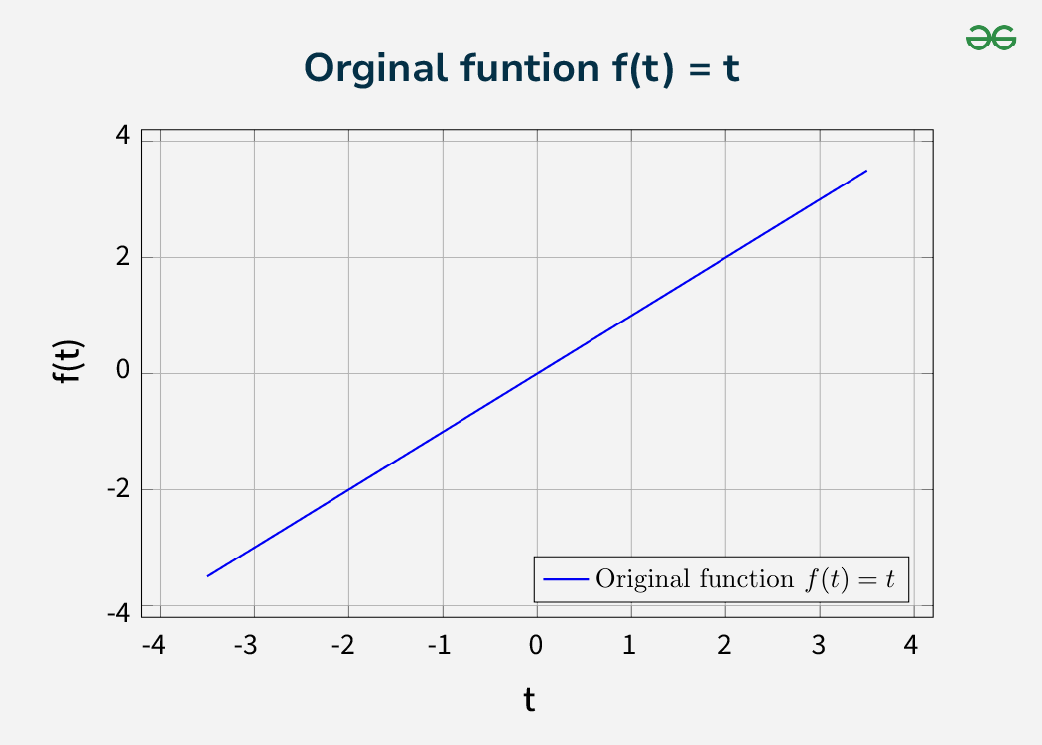
\end{aligned} Diagram: The plot of original function f(t) = t is,
Plot for Original Function
The Fourier series of this equation is f(t)= \sum_{n=1}^{\infty} \frac{2(-1)^{n+1}}{n} \sin(nt), plot of this equation up to five terms is given below,
Fourier Series Approximation t with 5 terms
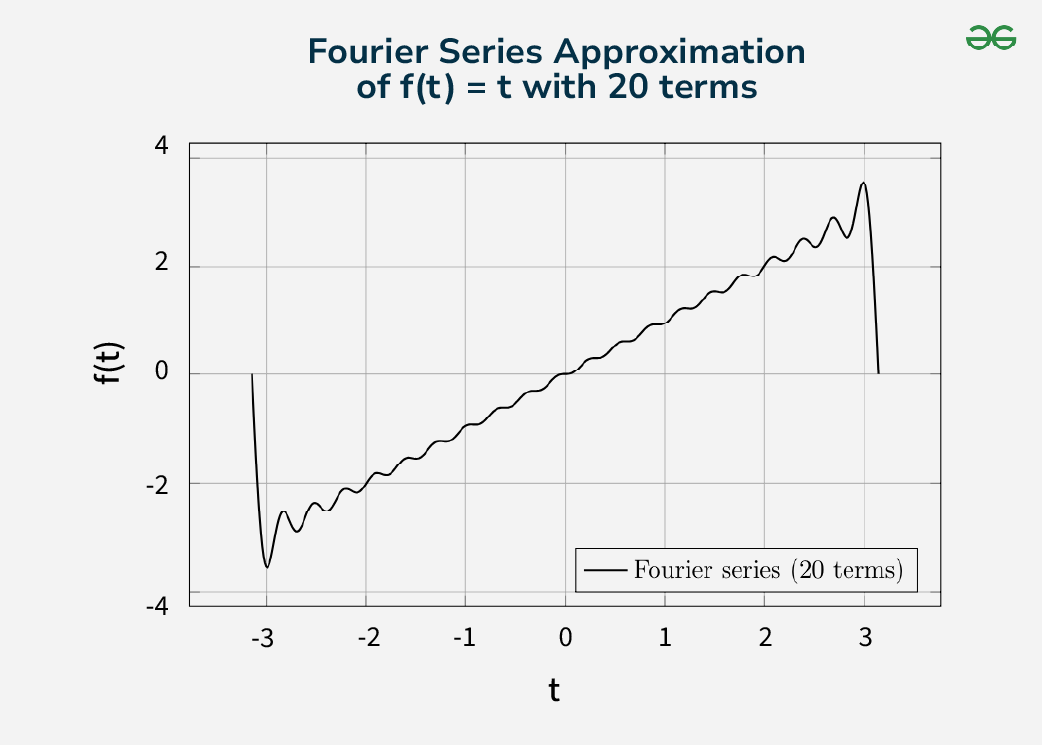
From graph it is clear that Fourier series of f(t) = t have some noise, it is because we have only included up to 5 terms in the series. The noise will decrease as we increase the number of terms but it will never be zero as computing sum till infinity is not possible. We can get plot with minimum noise if we increase the number of terms and the plot will become more and more similar to original plot of f(t) = t. Let us take a look at plot of series up to 20 terms, as we can see the plot is becoming more similar to original plot and the amount of noise is decreased significantly.
Fourier Series Approximation t with 20 terms
Advantages of Trigonometric Fourier series
Approximation of any function can be done using Trigonometric Fourier series.
Phenomena that are periodic can be analyzed with the help of Trigonometric Fourier series.
It can also helps in analyzing the process that are in linear combination of elementary periodic function, sine and cosine function.
Fourier series are used to calculate the power spectral density of a signal.
Fourier series can be used to simplify function for making calculation feasible.
Disadvantages of Trigonometric Fourier series
Fourier series of a function contains noise.
Trigonometric Fourier series are not preferred when the function are in terms of \large e^{\iota n\omega_0t} instead of function trigonometric function sine and cosine.
Non integrable function cannot be approximated using Trigonometric Fourier series.
Also calculation becomes difficult when the function have many terms whether the terms are periodic or non-periodic.
While approximating a function using Trigonometric Fourier series, to get the better result we have to calculate many terms, example in above example of f(t)=t, 20 terms were calculated to get noise minimum.
Application of Trigonometric Fourier Series
Response of system: Fourier series can be used to determine the response of linear time invariant system to periodic input.
Fourier series are broadly used in modulation, demodulation and filtering of voice signals.
In machine learning algorithms, Fourier series are used to analyze the periodic data and extract features from that data.
Fourier series are used in image compression as it reduces the data required for storage or transmission.
MRI (Magnetic Resonance Imaging) which is used to analyze and reconstruct images from the signal that are received from human body uses Fourier series to accomplish such task.
Conclusion
In this article we have studied Trigonometric Fourier series, its formula and tried to understand with the help of some examples. One should try to understand the general formula of Trigonometric Fourier series as it has many application in analog and digital communication. We have also discussed the advantages and disadvantages of the Fourier series.