
Cantor set is a basic notion in mathematics that plays an extremely important role in mathematical areas such as set theory and topology. It was first developed by the German mathematician Catarus at the end of the 19th century. Cantor Set exemplifies most intriguingly how seemingly straightforward sets have such far-reaching implications in distinctively different mathematics topics. The present article aims to provide a complete discussion of the Cantor Set and its definition, construction, properties, and importance.
Table of Content
What is a Set?
A set is a collection of distinguishable objects, which can be any, such as numbers, letters, or abstract things, and can be called a member or an element.
Sets are often used to categorize objects into those that have similar attributes or features in common. The elements of the sets are listed within the braces, e.g. {1,2,3}. It is usually denoted by uppercase letters such as A, B, or C. Sets can be finite or infinite, and they are an effective tool in realizing any representation of mathematical structures such as groups, rings, and fields.
What is the Cantor Set?
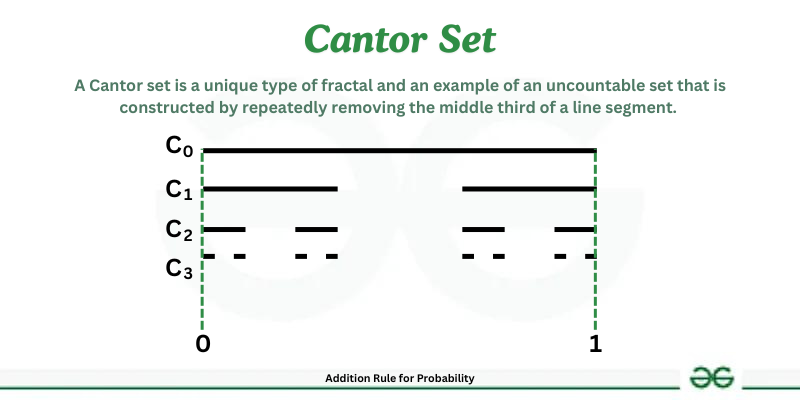
Cantor Set is a specific set that was introduced by Georg Cantor to demonstrate the concept of a set with zero volume but non-zero length.
It is constructed by iteratively removing the middle third of each interval in a line segment, starting from the unit interval. Cantor Set is named after Cantor because it was he who first introduced this concept to illustrate the idea of a set with zero volume but non-zero length.
Examples of Cantor Set
The examples of Cantor Sets involves:
One-Dimensional Cantor Set
Cantor Set in one dimension is constructed by iteratively removing the middle thirds from the unit interval. This can be represented symbolically as:
?0 = [1]
?1 = [0,1/3] ∪ [2/3,1]
?2 = [0,1/9] ∪ [2/9,1/3] ∪ [2/3,7/9] ∪ [8/9,1]
Two-Dimensional Cantor Set
Extending the Cantor Set to two dimensions involves starting with the unit square and symmetrically removing the middle-third squares. Symbolically, this can be represented as:
?0 = [1] × [1]
?1 = Remove middle third in both dimensions
?2 = Further remove middle thirds in each remaining square
Three-Dimensional Cantor Set
Extending the Cantor Set to three dimensions involves starting with the unit cube and removing the middle-third cubes symmetrically. Symbolically, this can be represented as:
?0 = [1] × [1] × [1]
?1 = Remove middle third in each dimension
?2 = Continue removing the middle thirds in each dimension
Cantor's Theorem Proof
Cantor's Theorem is a fundamental result in set theory that states the existence of uncountable sets. Here is an explanation of Cantor's Theorem using elements and sets:
Definition: Cantor's Theorem states that for any set ?, the power set of ? (denoted as ?(?) has a strictly greater cardinality than ?. In other words, there is no surjective function from a set to its power set.
Proof by Diagonal Argument:
Consider a set ? and its power set ?(?).
Assume there exists a function ?:?→?(?) that maps each element of ? to a subset of ?.
Construct a new set ?={?∈?∣?∉?(?)}
By construction, ? is a subset of ? but differs from every element in the range of ?.
Therefore, ? cannot be in the range of ?, leading to a contradiction.
Example: Let's consider a set ?={1,2,3}. The power set of ? is ?(?)={∅, {1}, {2}, {3}, {1,2}, {1,3}, {2,3}, {1,2,3}}.
If we try to map elements of ? to subsets in ?(?), we encounter the diagonal argument where we find a subset that is not in the range of the function, proving the uncountability of the power set.
Cantor's Theorem is a foundational result in set theory that demonstrates the existence of sets with cardinalities greater than that of natural numbers, providing a deep insight into the nature of infinite sets and their sizes.
Construction of a Cantor Set
The Cantor Set is constructed by iteratively removing middle thirds from a line segment. Here is the procedure in steps format with an example:
Step 1: Consider the closed interval.
Step 2: Remove the open middle third (1/3, 2/3) from. After removing (1/3, 2/3) from, we have two closed intervals: [0, 1/3] and [2/3, 1].
?1 = [0,1/3] ∪ [2/3,1]
Step 3: In the next step, remove the open middle third (1/9, 2/9) from [0, 1/3] and (7/9, 8/9) from [2/3, 1]. Now we have four closed intervals: [0, 1/9], [2/9, 1/3], [2/3, 7/9], and [8/9, 1].
?2 = [0,1/9] ∪ [2/9,1/3] ∪ [2/3,7/9] ∪ [8/9,1]
Step 4: Continue this process infinitely, removing the open middle third from each remaining interval.
Properties of Cantor Set with Proof
Here are the properties of the Cantor Set with proofs:
Property 1: The Cantor Set is Uncountable
Proof: To show that the Cantor Set is uncountable, we need to construct a function f from the Cantor Set C to the closed interval that is surjective.
Consider a point x = 0.a1a2a3... in C, where an ∈ {0, 2} for all n ∈ N.
Define
f(x) = \sum_{k=1}^{\infty} a_k \cdot 2^{-k} . This maps x to a binary representation of a real number in. Since every real number has a binary representation, f is surjective.Therefore, the cardinality of C is at least as large as the cardinality of, which is uncountable.
Property 2: The Cantor Set has a Length of Zero
Proof: Cantor Set has a length of zero, which means that it has no intervals.
This can be shown by the construction process, where each iteration removes open intervals, leaving only boundary points.
For example, after the first iteration, the open middle third (1/3, 2/3) is removed, leaving the closed intervals [0, 1/3] and [2/3, 1]. Continuing this process infinitely results in a set with no intervals
Property 3: The Cantor Set has No Interior Points
Proof: Cantor Set has no interior points, meaning that every point in the Cantor Set is a boundary point.
This can be shown by the construction process, where each iteration removes open intervals, leaving only boundary points.
For example, after the first iteration, the open middle third (1/3, 2/3) is removed, leaving the closed intervals [0, 1/3] and [2/3, 1]. Continuing this process infinitely results in a set with no interior points
Property 4: The Cantor Set is Bounded
Proof: Cantor Set is bounded as it is contained within the closed interval. This is evident from the construction process where each step involves removing open intervals from a bounded interval
Property 5: The Cantor Set is Closed
Proof: Cantor Set is closed as it is the complement relative to open intervals, the ones removed in its construction. This can be shown by the construction process, where each iteration removes open intervals, leaving only closed intervals
Property 6: The Cantor Set is Compact
Proof: Cantor Set is compact. By properties 4 and 5, we have Bounded + Closed on the real line, this implies that The Cantor Set is compact
Property 7: The Cantor Set has No Isolated Points
Proof: Cantor Set has no isolated points, meaning that in any neighborhood of a point in Cantor’s set, there is another point from Cantor’s set. Given say a = 0.0220020202... (3) ∈ C, one could find another element b = 0.0220022202... (3) ∈ C which is near a.
Property 8: The Cantor Set is Perfect
Proof: In topology, a set which is compact and has no isolated points is called a perfect set. By properties 6 and 7, we can say that the Cantor set is perfect.
Importance of Cantor Set
The Cantor Set holds significant importance in mathematics for various reasons:
- Compact Metrizable Space: The Cantor Set is considered "the most general compact metrizable space," showcasing its fundamental nature in topology.
- Counter examples in Analysis: It represent an essential guide for real analysis purposes, where the notion that a "closed set" bears the union of closed intervals plus some single points.
- Uncountable Set of Measure Zero: The Cantor set is an uncountable set of measure zero, and as such, it is a primary indication in the Lebeseague measure theory.
- Fractal Geometry: Also, fractals have strong ties with the Cantor Set being homomorphic to it, thus, it is an actively studied object in fractal geometry and self-similarity.
- Generalization to Higher Dimensions: Thus, Cantor's Set has other examples in higher dimensions of space, for example, two and three dimensions, which underline its versatility and capacity to operate in such spaces beyond the one-dimensional.
Examples on Cantor Set
Example 1: Construct the first few iterations of the Cantor set on [0, 1].
Solution:
Start with the interval [0, 1]
Iteration 1: Remove the middle third (1/3, 2/3). Left with [0, 1/3] ∪ [2/3, 1]
Iteration 2: Remove middle thirds of remaining intervals:
[0, 1/9] ∪ [2/9, 1/3] ∪ [2/3, 7/9] ∪ [8/9, 1]
Iteration 3: Continue removing middle thirds:
[0, 1/27] ∪ [2/27, 1/9] ∪ [2/9, 7/27] ∪ [8/27, 1/3] ∪
[2/3, 19/27] ∪ [20/27, 7/9] ∪ [8/9, 25/27] ∪ [26/27, 1]
Example 2: Construct a fat Cantor set with positive measure by removing intervals of decreasing lengths.
Solution:
Start with [0, 1]
Iteration 1: Remove middle 1/4. Left with [0, 3/8] ∪ [5/8, 1]
Iteration 2: Remove middle 1/8 from each remaining interval:
[0, 5/32] ∪ [7/32, 3/8] ∪ [5/8, 25/32] ∪ [27/32, 1]
Iteration 3: Remove middle 1/16 from each remaining interval, and so on.
Measure of this Cantor set is positive: 1 - (1/4 + 2(1/8) + 4(1/16) + ...) = 1/2
Example 3: What is the Hausdorff dimension of the generalized Cantor set where we remove the middle fraction p (0 < p < 1) at each step?
Solution:
Hausdorff dimension d is given by the solution to the equation:
2(1-p)d = 1
Solving for d:
d = log(2) / log(1/(1-p))
For example, when p = 1/3 (classic Cantor set), we get:
d = log(2) / log(3/2) ≈ 0.6309
Example 4: In the classic Cantor set construction, what is the total length of the intervals removed up to the nth iteration?
Solution:
Let Ln be the total length removed up to the nth iteration.
L1 = 1/3
L2 = 1/3 + 2/9
L3 = 1/3 + 2/9 + 4/27
The general formula is:
Ln = 1/3 + 2/9 + 4/27 + ... + (n-1)/3n
This is a geometric series with first term a = 1/3 and ratio r = 2/3.
The sum is given by:
Ln = (1/3) × (1 - (2/3)n) / (1 - 2/3) = 1 - (2/3)n
As n approaches infinity, Ln approaches 1, confirming that the Cantor set has measure zero.
Example 5: Consider the points in the Cantor set represented by ternary expansions using only 0 and 2. What is the sum of all points where the first non-zero digit is in the nth position?
Solution:
For n = 1, the point is 0.2 (in ternary) = 2/3
For n = 2, the points are 0.02 and 0.022222... = 2/9 + 2/9 = 4/9
For n = 3, the points sum to 2/27 + 2/27 = 4/27
General formula: 4 / (3n)
Sum for all n: Σ(n=1 to ∞) 4/(3n) = 2
Example 6: Consider a generalized Cantor set where we remove the middle fraction p at each step. For what value of p will the resulting set have a measure of 1/4?
Solution:
Measure of the set is 1 minus the sum of removed intervals.
(1 - p) + 2p(1-p) + 4p(1-p)2 + ...) = 1/4
This geometric series sums to p/(2p-1)
So, we need to solve:
(1 - p) / (2p-1) = 1/4
Solving this equation:
3p / (2p-1) = 3/4
4p = 3(2p-1)
4p = 6p - 3
2p = 3
p = 3/2
Therefore, we need to remove 3/2 at each step. However, this is impossible as p must be less than 1. This means there is no value of p that will result in a set with measure exactly 1/4.
Example 7: Consider two Cantor sets: C1 is the classic Cantor set on [0,1], and C2 is a Cantor set formed by removing the middle 1/4 at each step, also on [0, 1]. What is the Hausdorff dimension of their intersection?
Solution:
For C1: d1 = log(2) / log(3) ≈ 0.6309
For C2: d2 = log(2) / log(4/3) ≈ 0.7227
The dimension of the intersection is:
d = d1 + d2 - 1 ≈ 0.6309 + 0.7227 - 1 ≈ 0.3536
Example 8: Consider a Cantor-like set C constructed in base 4, where we keep the numbers that don't use the digits 1 or 2 in their base 4 expansion. What is the Hausdorff dimension of this set?
Solution:
In each step of the construction, we keep 2 out of every 4 intervals.
So, we need to solve:
2 × (1/4)d = 1
Taking logarithms:
log(2) - d×log(4) = 0
d = log(2)/log(4) = 1/2
Therefore, the Hausdorff dimension of this set is 1/2.
Practice Problems on Cantor Set
P1. What is the Hausdorff dimension of a Cantor set where we remove the middle 2/5 at each step?
P2. In the classic Cantor set construction, what is the total length of the intervals remaining after the nth iteration?
P3. Consider a modified Cantor set where we remove the middle 1/4 at odd-numbered steps and the middle 1/3 at even-numbered steps. What is the measure of the resulting set?
P4. If we represent points in the Cantor set using ternary expansions (using only 0 and 2), what is the smallest positive number in the set?
P5. In a generalized Cantor set where we remove p fraction at each step, for what value of p will the resulting set have the same Hausdorff dimension as the classic Cantor set?
P6. Consider two Cantor sets on [0, 1]: C1 is the classic Cantor set, and C2 is formed by removing the middle 1/5 at each step. What is the measure of their union?
P7. What is the probability that a randomly chosen point from the classic Cantor set has no 2's in its ternary expansion?
P8. In the construction of the Cantor set, how many intervals are there of length (1/3)10 after the 10th iteration?
P9. Consider a Cantor-like set in base 5, where we keep numbers that don't use the digits 1, 2, or 3 in their base 5 expansion. What is its Hausdorff dimension?
P10. If we modify the Cantor set construction to remove the first and last quarters of each interval at each step (instead of the middle third), what is the measure of the resulting set?
Conclusion
To sum up, the Cantor Set is a fundamental concept in mathematics that has applications in many different areas of mathematics. It is the set that’s generated by iteratively removing intervals from the unit interval producing a set with unique features that is its zero volume but non-zero length. Cantor Set is widely used to discuss the concept of sets having length which is nonexistent but the line is nonzero.
Such an idea is of utmost importance in understanding the theory of fractals and its use in practical applications. It is also used to show the concept of a set which is non-measurable, which is essential in the understanding of the properties of sets in mathematics.
Related Articles:
