
Definite integrals are the extension after indefinite integrals, definite integrals have limits [a, b]. It gives the area of a curve bounded between given limits.
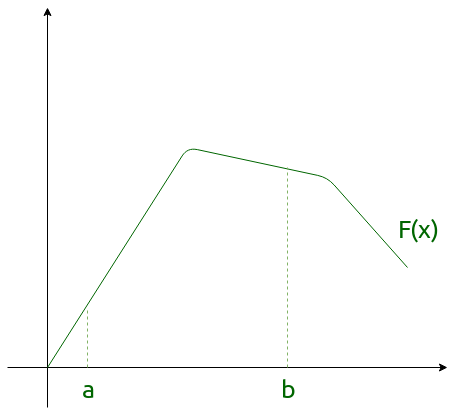
Note: If f is a continuous function defined on the closed interval [a, b] and F be an anti derivative of f.
Then
Example:
\int_{a}^{b}f(x)dx=\int_{a}^{b}f(t)dt \int_{a}^{b}f(x)dx=-\int_{b}^{a}f(x)dx \int_{a}^{b}f(x)dx=\int_{a}^{c}f(x)dx+\int_{c}^{b}f(x)dx \int_{a}^{b}f(x)=\int_{a}^{b}f(a+b-x)dx \int_{0}^{b}f(x)=\int_{0}^{b}f(b-x)dx \int_{0}^{2a}f(x)dx=\int_{0}^{a}f(x)dx+\int_{0}^{a}f(2a-x)dx \int_{-a}^{a}f(x)dx=2\int_{0}^{a}f(x)dx, \textup{if f(x) is even function i.e f(x)=f(-x)} \int_{-a}^{a}f(x)dx=0, \textup{if f(x) is odd function} \bold{\int\limits_{0}^{2a}f(x)dx = \begin{cases} 2\int\limits_{0}^{a}f(x)dx & , if f(2a - x) = f(x) \\ 0 & , if f(2a - x) = -f(x)\end{cases}}
These properties can be used directly to find the value of a particular definite integral and also interchange to other forms if required.
