
The professionals at GeeksforGeeks have provided IELTS Exam Practice Mock Full-Length Test questions for all four sections of IELTS- reading, writing, speaking, and listening. To help you efficiently prepare for the IELTS exam, our team of knowledgeable educators and test-prep experts has carefully created these Free IELTS Practice Questions.
Our IELTS Exam Practice Mock Full-Length Tests are priceless, whether you’re just starting your IELTS preparation process or want to hone your abilities before exam day. Let’s begin learning all the skills you’ll need to ace the IELTS!
IELTS Reading Section Questions
DIRECTIONS: Each passage or pair of passages below is followed by several questions. After reading each passage or pair, choose the best answer to each question based on what is stated or implied in the passage or passages
Passage 1: The Future of Space Tourism
The Future of Space Tourism
Space tourism, once a concept confined to the realms of science fiction, is rapidly becoming a reality. Companies like SpaceX, Blue Origin, and Virgin Galactic are at the forefront of this burgeoning industry. These companies are not only developing technologies to transport humans to space but also working on making these trips commercially viable.
SpaceX, led by Elon Musk, has announced plans for a private moon mission. The company’s Starship spacecraft is designed to carry up to 100 passengers on interplanetary journeys. Blue Origin, founded by Amazon’s Jeff Bezos, aims to make space travel more accessible by reducing costs through reusable rockets. Virgin Galactic, headed by Richard Branson, focuses on suborbital spaceflights, offering customers a few minutes of weightlessness and a view of the Earth from space.
While the prospect of space tourism is exciting, it also raises several concerns. The environmental impact of rocket launches, the safety of passengers, and the potential for space debris are significant issues that need addressing. Furthermore, the high cost of these trips currently limits access to a wealthy few.
Despite these challenges, the space tourism industry is poised for growth. As technologies advance and costs decrease, space travel could become a mainstream holiday option. Companies are also exploring the potential for space hotels, lunar tours, and even Mars colonization.
Questions
1. Which companies are mentioned as leaders in the space tourism industry?
A. SpaceX, NASA, Virgin Galactic
B. SpaceX, Blue Origin, Virgin Galactic
C. SpaceX, Blue Origin, NASA
D. SpaceX, Blue Origin, Space Adventures
2. What is the primary focus of Virgin Galactic’s space tourism efforts?
A. Lunar tours
B. Mars colonization
C. Suborbital spaceflights
D. Interplanetary journeys
3. Which issue is NOT mentioned as a concern for space tourism?
A. Environmental impact
B. Safety of passengers
C. Space debris
D. Competition among companies
4. Complete the sentence below using words from the passage.
The space tourism industry is expected to grow as technologies advance and __________.
5. Match the following companies with their founders:
- SpaceX
- Blue Origin
- Virgin Galactic
i. Jeff Bezos
ii. Richard Branson
iii. Elon Musk
Answers:
- B
- C
- D
- costs decrease
- SpaceX - iii, Blue Origin - i, Virgin Galactic - ii
Passage 2: The Rise of Electric Vehicles
The Rise of Electric Vehicles
Electric vehicles (EVs) have seen a significant surge in popularity in recent years. With growing concerns over climate change and air pollution, governments and consumers alike are turning to EVs as a cleaner alternative to traditional petrol and diesel cars.
One of the main drivers of this shift is government policy. Many countries offer subsidies and tax incentives to encourage the purchase of electric cars. Additionally, regulations are becoming stricter regarding emissions from conventional vehicles, pushing manufacturers to develop more electric models.
Technological advancements have also played a crucial role. Improvements in battery technology have increased the range of electric vehicles, addressing one of the main concerns of potential buyers. Charging infrastructure has expanded, making it easier for EV owners to charge their cars at home and on the go.
Despite these positive developments, challenges remain. The initial cost of electric vehicles is still higher than that of conventional cars, although this gap is narrowing. The production of batteries requires rare minerals, raising concerns about supply chain sustainability and environmental impact.
Nevertheless, the future looks promising for electric vehicles. As production scales up and technology continues to improve, EVs are expected to become the norm rather than the exception.
Questions
1. What is one reason for the increased popularity of electric vehicles?
A. Lower fuel prices
B. Government policies
C. Fewer car models
D. Higher emissions
2. How have technological advancements influenced the adoption of electric vehicles?
A. By reducing vehicle weight
B. By increasing battery range
C. By lowering initial costs
D. By simplifying vehicle design
3. What concern is associated with the production of batteries for electric vehicles?
A. High production costs
B. Limited driving range
C. Rare mineral supply chain
D. Lack of charging infrastructure
4. Complete the summary using words from the passage.
Electric vehicles are becoming more popular due to government ________ and technological advancements. However, challenges such as high initial costs and concerns about battery production remain.
5. Match the following advancements with their impact on electric vehicles:
- Improved battery technology
- Expanded charging infrastructure
i. Easier charging
ii. Increased range
Answers:
- B
- B
- C
- policies
- Improved battery technology - ii, Expanded charging infrastructure - i
IELTS Writing Practice Questions
IELTS Writing Task 1 (Academic)
Question 1:
The table below shows the average monthly temperatures and the amount of monthly rainfall in three cities.
| Month | City A Temperature (°C) | City B Temperature (°C) | City C Temperature (°C) | City A Rainfall (mm) | City B Rainfall (mm) | City C Rainfall (mm) |
|---|---|---|---|---|---|---|
| January | 5 | -3 | 22 | 78 | 50 | 30 |
| February | 7 | -1 | 23 | 60 | 40 | 25 |
| March | 10 | 5 | 25 | 70 | 60 | 35 |
| April | 15 | 12 | 27 | 50 | 70 | 40 |
| May | 20 | 18 | 28 | 40 | 90 | 50 |
| June | 25 | 22 | 30 | 30 | 100 | 60 |
| July | 30 | 25 | 32 | 20 | 110 | 70 |
| August | 28 | 23 | 31 | 25 | 105 | 65 |
| September | 22 | 18 | 29 | 35 | 90 | 55 |
| October | 15 | 10 | 26 | 50 | 80 | 45 |
| November | 10 | 3 | 24 | 60 | 70 | 35 |
| December | 7 | -2 | 23 | 75 | 60 | 30 |
Answer:
The table provides information on the average monthly temperatures and rainfall in three different cities. City A experiences a moderate climate with temperatures ranging from 5°C in January to 30°C in July. Rainfall is highest in January at 78 mm and lowest in July at 20 mm. City B, on the other hand, has a colder climate with temperatures from -3°C in January to 25°C in July. It receives the most rainfall in July at 110 mm and the least in February at 40 mm. City C has a tropical climate with temperatures consistently above 22°C and peaking at 32°C in July. Rainfall in City C is relatively stable, with slight variations throughout the year, highest in July at 70 mm and lowest in February at 25 mm.
Question 2: The diagram below shows the process of recycling plastic bottles.
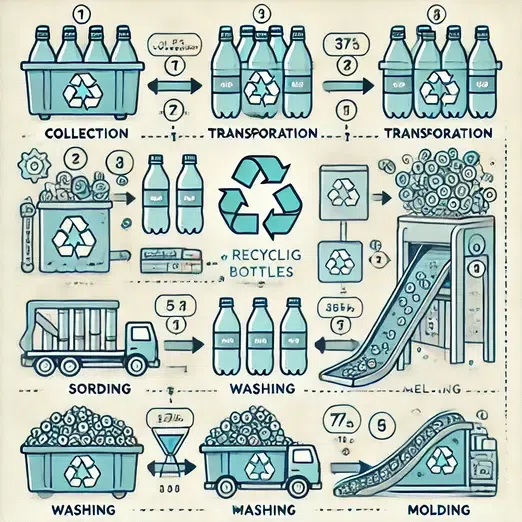
- Collection: Consumers place plastic bottles in recycling bins.
- Transportation: The bottles are transported to a recycling facility.
- Sorting: Bottles are sorted by type and color.
- Shredding: Bottles are shredded into small pieces.
- Washing: Shredded plastic is washed to remove impurities.
- Melting: Clean plastic is melted into liquid form.
- Molding: Melted plastic is molded into new products.
Answer:
The diagram illustrates the process of recycling plastic bottles, which involves seven steps. Initially, consumers place plastic bottles into recycling bins (Step 1). These bottles are then transported to a recycling facility (Step 2), where they are sorted based on type and color (Step 3). Next, the sorted bottles are shredded into small pieces (Step 4). These shredded pieces undergo a washing process to eliminate impurities (Step 5). Once cleaned, the plastic is melted into a liquid form (Step 6). Finally, the melted plastic is molded into new products (Step 7), completing the recycling process.
IELTS Writing Task 2
Question 1:
Some people believe that climate change is the greatest threat to humanity, while others argue that it is overhyped and there are more pressing issues. Discuss both views and give your opinion.
Answer:
Climate change is often considered the greatest threat to humanity due to its long-term impacts on the environment, economies, and societies. Proponents argue that rising temperatures, sea levels, and extreme weather events pose significant risks to food security, health, and livelihoods globally. For instance, increased frequency of hurricanes and floods can displace communities and disrupt economies.
On the other hand, some argue that the threat of climate change is exaggerated and other issues like poverty, terrorism, and disease are more immediate concerns. They believe that resources should be allocated to address these pressing issues, which have a direct and immediate impact on human lives.
In my opinion, while it is crucial to address immediate threats like poverty and disease, climate change should not be underestimated. Its effects are already visible and will worsen if not addressed. A balanced approach is needed, where immediate issues are tackled alongside long-term strategies to mitigate climate change.
Question 2:
Many people believe that social media has a negative impact on personal relationships. To what extent do you agree or disagree?
Answer:
Social media is often criticized for negatively impacting personal relationships by reducing face-to-face interactions and fostering superficial connections. Excessive use of social media can lead to misunderstandings, decreased quality time with loved ones, and even feelings of jealousy or inadequacy due to constant comparison with others.
However, social media also has positive aspects. It allows people to stay connected with friends and family across distances, share important moments, and even form new relationships. For introverts or those with social anxiety, online interactions can provide a comfortable space to communicate and build connections.
I believe that the impact of social media on personal relationships depends on its usage. When used mindfully, it can enhance relationships by keeping people connected. However, excessive or inappropriate use can indeed harm personal interactions. Striking a balance and prioritizing face-to-face communication is essential for maintaining healthy relationships.
IELTS Speaking Practice Questions
Using the most popular IELTS speaking topics and answers, you’ll practice with a free IELTS speaking test in this guide. With the help of our thoroughly tested speaking templates, you will discover how to respond to IELTS Speaking Parts 1, 2, and 3.
After finishing an IELTS speaking practice exam, receive free IELTS speaking sample answers
IELTS Speaking Task 1
Topic: Technology
Question 1: Do you use any gadgets on a daily basis?
Answer: Yes, I use several gadgets daily, including my smartphone, laptop, and smartwatch. These devices help me stay connected, complete my work, and monitor my fitness.
Question 2: How has technology changed the way we communicate?
Answer: Technology has revolutionized communication by making it faster and more convenient. We can now send messages instantly, make video calls, and share information globally in real-time. Social media platforms have also enabled us to connect with a wider audience.
Question 3: Do you think people rely too much on technology these days?
Answer: In some ways, yes. Many people depend on technology for everyday tasks, such as navigation, shopping, and even social interactions. While technology provides many benefits, over-reliance can lead to issues like reduced face-to-face communication and privacy concerns.
IELTS Speaking Task 2
Topic: A Memorable Meal
1. Describe a memorable meal you had. You should say:
- When and where you had the meal
- Who you were with
- What you ate
- And explain why this meal was memorable.
Answer:
One of the most memorable meals I had was last year at a small Italian restaurant in my city. It was my birthday, and I celebrated it with my closest friends. The restaurant had a cozy atmosphere and served authentic Italian cuisine. We started with a variety of appetizers, including bruschetta and calamari. For the main course, I had a delicious pasta dish with homemade pesto sauce. The meal was special because it was a rare occasion where all my friends could gather together, and the food was exceptionally good. The laughter and conversations we shared made the evening unforgettable.
IELTS Speaking Task 3
Topic: Food and Culture
Question 1: How important is food in your culture?
Answer: Food plays a significant role in my culture as it is central to most social gatherings and celebrations. It is a way to express hospitality, bring people together, and pass down traditions from one generation to the next.
Question 2: Do you think the traditional foods of a country can tell you something about its culture and history?
Answer: Absolutely. Traditional foods often reflect the geography, climate, and history of a country. For example, coastal regions tend to have seafood-based dishes, while areas with rich agricultural land may have a variety of vegetable and grain dishes. Traditional recipes can also tell stories of past events, such as historical trade routes or cultural exchanges.
Question 3: How has globalization affected the food habits of people in your country?
Answer: Globalization has significantly influenced food habits in my country by introducing a wide variety of international cuisines. People now have more dining options and are more open to experimenting with new flavors and ingredients. However, this has also led to a decline in traditional cooking practices among younger generations.
IELTS Listening Section
Section 1: Conversation between two people set in an everyday context
Topic: Booking a Tour
Transcript:
Receptionist: Good morning, Green Valley Tours. How can I help you?
Customer: Hi, I'd like to book a tour for next Saturday.
Receptionist: Sure. We have several options. Are you interested in a half-day or full-day tour?
Customer: A full-day tour, please.
Receptionist: Great. We have a city tour that covers all the major landmarks and a countryside tour which includes a visit to a vineyard.
Customer: I'll go with the countryside tour. How much is it?
Receptionist: It's $75 per person. Customer: Perfect. I'd like to book for two adults.
Receptionist: Certainly. Can I have your names, please?
Customer: John Smith and Emily Brown.
Questions:
- What type of tour does the customer book?
- A) City tour
- B) Countryside tour
- C) Museum tour
- How much does the countryside tour cost per person?
- A) $50
- B) $60
- C) $75
- How many people is the customer booking the tour for?
- A) One
- B) Two
- C) Three
Answers:
- B) Countryside tour
- C) $75
- B) Two
Section 2: A monologue set in an everyday social context
Topic: Information about a Local Event
Transcript:
Speaker: Welcome to the annual Spring Festival! This year's event will be held at the Central Park on May 15th. The festival will start at 10 AM and continue until 8 PM. There will be a variety of activities for all ages, including live music performances, food stalls, and a craft market. For children, we have face painting, games, and a puppet show. The entry fee is $10 for adults and $5 for children under 12. We hope to see you there!
Questions:
- Where is the Spring Festival being held?
- A) Town Hall
- B) Central Park
- C) Riverside Park
- What is the entry fee for children under 12?
- A) $5
- B) $10
- C) Free
- What time does the festival end?
- A) 6 PM
- B) 7 PM
- C) 8 PM
Answers: 4. B) Central Park 5. A) $5 6. C) 8 PM
Section 3: A conversation among up to four people set in an educational or training context
Topic: Group Discussion on a Project
Transcript:
Student 1: So, we need to decide on a topic for our project. Any ideas?
Student 2: How about renewable energy? It's a hot topic right now.
Student 3: I agree. We could focus on solar and wind energy.
Student 4: Sounds good. We should also look into the economic impact of these energy sources.
Student 1: Great. I'll start researching solar energy, and you guys can divide the other parts.
Student 2: I'll take wind energy. Student 3: And I'll handle the economic aspects.
Student 4: Perfect. Let's meet again next week to discuss our progress.
Questions:
- What is the main topic of the group's project?
- A) Climate change
- B) Renewable energy
- C) Fossil fuels
- Which energy source is Student 1 researching?
- A) Wind energy
- B) Solar energy
- C) Hydroelectric energy
- Who is responsible for researching the economic impact of renewable energy?
- A) Student 2
- B) Student 3
- C) Student 4
Answers: 7. B) Renewable energy 8. B) Solar energy 9. B) Student 3
Section 4: A monologue on an academic subject
Topic: The Benefits of Learning a Second Language
Transcript:
Speaker: Learning a second language has numerous benefits. Firstly, it improves cognitive skills, such as problem-solving and multitasking. Studies have shown that bilingual individuals have better memory and attention span. Secondly, it opens up career opportunities. Many employers prefer candidates who can speak more than one language. Thirdly, it enhances cultural awareness. Understanding a second language helps in appreciating different cultures and perspectives. Additionally, it can be a rewarding personal achievement. The process of learning a new language can be challenging, but the sense of accomplishment is significant.
Questions:
- What is one cognitive benefit of learning a second language mentioned in the talk?
- A) Better handwriting
- B) Improved problem-solving skills
- C) Faster reading speed
- Why do many employers prefer candidates who speak more than one language?
- A) They are more punctual
- B) They have better communication skills
- C) They can handle international clients
- What is a personal benefit of learning a second language according to the speaker?
- A) Earning more money
- B) Enhancing cultural awareness
- C) Getting a degree faster
Answers: 10. B) Improved problem-solving skills 11. C) They can handle international clients 12. B) Enhancing cultural awareness
Also Read:
