
Flink is an open-source stream processing framework developed by the Apache Software Foundation. It's designed to process real-time data streams and batch data processing. Flink provides features like fault tolerance, high throughput, low-latency processing, and exactly-once processing semantics. It supports event time processing, which is crucial for handling out-of-order data in streaming applications. Flink is often used in various industries for tasks such as real-time analytics, fraud detection, monitoring, and more.
Flink offers several benefits:
- Low Latency and High Throughput
- Fault Tolerance
- Support for Event Time and Batch Processing
- Exactly-Once Processing Semantics
- Rich APIs and Libraries
- Integration Ecosystem
Flink Installation Steps
Follow every step-by-step instruction to install Flink:
Step 1: Java is one requirement for the run Flink, so, first check installation of Java is correct or not
java -version

if, correct install java then follow the nest step.
Step 2: Download the Flink tar File in Flink original site
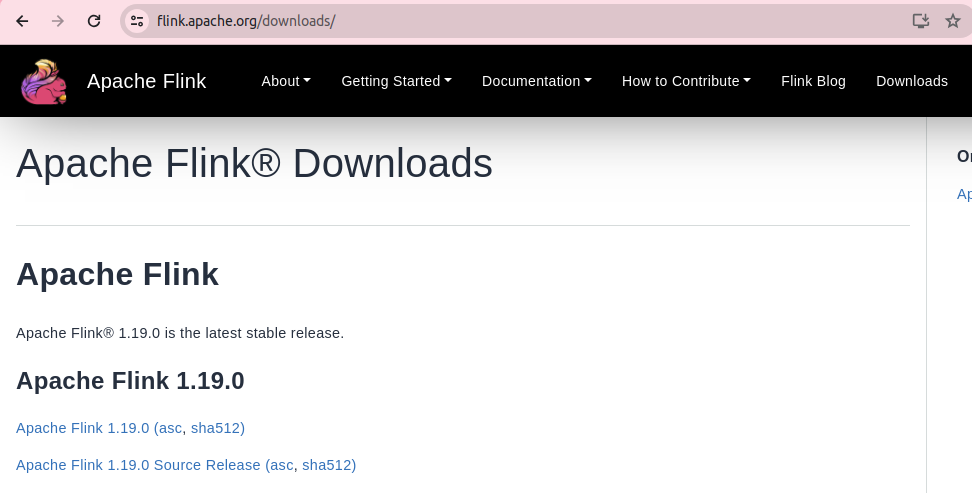
Step 3: Then it downloaded tar file need to untar and reach the till flink tar file - as like cd Downloads/
tar -xzf flink-1.19.0-bin-scala_2.12.tgz
and then move in this flink-1.19.0 directory
cd flink-1.19.0/

Step 4: Now, Successfully install Flink , Then Check it proper work or not?
First, Start the Flink local server
./bin/start-cluster.sh

Step 5: Then submit the job as a jar file
./bin/flink run examples/streaming/WordCount.jar

Step 6: Then put command
tail log/flink-*-taskexecutor-*.out

we can see also Flink UI after server start on localhost:8081

Step 7: Now, We can stop the Flink local server
./bin/stop-cluster.sh

Scenario 2: If need to run jar (Maven Project) in flink server.
./bin/flink run Test-1.0-SNAPSHOT.jar Real-World Use Cases and Applications
Real-Time Analytics
- Processing streaming data for insights and monitoring
- Use cases: Clickstream analysis, social media analytics, IoT data processing
Fraud Detection
- Real-time detection of fraudulent activities
- Benefits of Flink's low latency and fault tolerance
Recommendation Systems
- Personalized recommendations based on real-time user behavior
- Implementing recommendation algorithms with Flink
Batch Processing and ETL
- Integrating batch processing with stream processing
- ETL pipelines and data warehouse integration
Here's an example Flink code that consumes data from Kafka, aggregates it, and produces the aggregated results back into Kafka:
This example assumes you have Kafka running locally on localhost:9092, with input data stored in a topic named input_topic. It takes data from this Kafka topic, performs word count aggregation, and produces the aggregated results to another Kafka topic named output_topic. User may need to adjust the Kafka bootstrap server addresses and topic names according to your setup.
Conclusion
Apache Flink is recognized as a strong platform for stream processing because of its quick response time, ability to handle failures, and support for both event-driven and batch processing. Its extensive API offerings and easy integration features make it a top pick for businesses in different sectors, providing immediate understanding and flexible solutions for handling large amounts of data. Whether it's for in-the-moment analysis, identifying fraudulent activities, or managing intricate ETL processes, Flink's features give developers and data engineers the tools to create robust and effective applications for stream processing.
