
Remix is a modern, complete-stack internet framework constructed on React that specializes in imparting a seamless developer revel in and turning in rapid, dynamic web programs. It leverages server-facet rendering (SSR) and a powerful routing system to create especially interactive and performant internet applications.
Table of Content
What is Remix?
Remix is a framework for building internet packages that emphasizes overall performance, scalability, and developer productiveness. It allows developers to build both the frontend and backend using a single framework, making it easier to manipulate and preserve applications. Remix handles information fetching on the server side, which ends up in faster load instances and higher search engine marketing.
Remix JS is a Framework based on React that uses the server to render the code due to that remix become more popular in performance and Search Engine Optimization as compared to React. Remix was created by Michael Jackson and Ryan Florence, co-creators of React Route, launched in 2020. Initially, it was paid but in 2021 it became open-source. Remix is popular for simplification of complex data fetching, nested routing, and form handling to improve web performance.
Prerequisites of Remix
Before you start running with Remix, ensure you have the subsequent:
- Node.Js installed on your system.
- Npm or yarn for package management.
- Basic information of React.
- A code editor like Visual Studio Code.
Features of Remix
- Server-Side Rendering (SSR): Remix renders your utility at the server, presenting faster load times and progressed SEO.
- Routing: Remix uses a file-based totally routing system, making it clean to outline routes by using clearly creating documents and folders.
- Error Boundaries: Built-in aid for error barriers lets in you to deal with mistakes gracefully and offer a higher user enjoy.
- Form Handling: Remix simplifies shape dealing with with built-in guide for shape submissions and validation.
- Nested Routes: Allows you to create complex layouts with nested routes, making it less difficult to control and prepare your application.
- Data Loading: Efficient facts loading mechanisms that fetch records on the server and ship it to the customer.
Steps to Install and Set up Remix
Step 1: Install Node.Js and npm
Ensure you've got Node.Js and npm established. You can download from the Node.Js website.
Step 2: Create a New Remix Project
Open your terminal and run the subsequent command to create a brand new Remix project:
Now create a new folder and navigate to it in the terminal. Run the following command to create a Remix app with its latest version.
npx create-remix@latest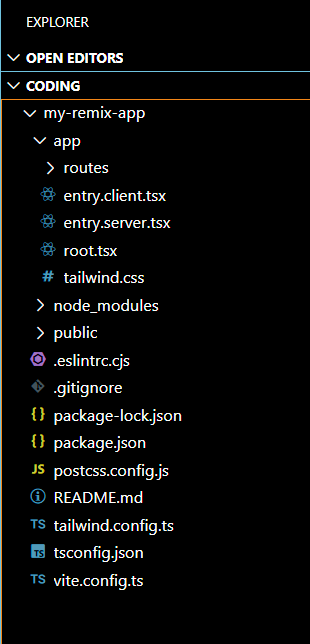
Step 3: Switch to project directory
Navigate to the Project Directory by the terminal using the command below. Now you can access the project Directory .
cd my-remix-appStep 4: Install Depenndencies
By using the terminal Install the Dependencies.
npm installStep 5: Run the Application
Start the Development Server you need to use the command given below.
npm run devThe updated Depdendencies in the package.json file are:
"dependencies": {
    "@remix-run/node": "^2.11.2",
    "@remix-run/react": "^2.11.2",
    "@remix-run/serve": "^2.11.2",
    "isbot": "^4.1.0",
    "react": "^18.2.0",
    "react-dom": "^18.2.0"
},
"devDependencies": {
    "@remix-run/dev": "^2.11.2",
    "@types/react": "^18.2.20",
    "@types/react-dom": "^18.2.7",
    "@typescript-eslint/eslint-plugin": "^6.7.4",
    "@typescript-eslint/parser": "^6.7.4",
    "autoprefixer": "^10.4.19",
    "eslint": "^8.38.0",
    "eslint-import-resolver-typescript": "^3.6.1",
    "eslint-plugin-import": "^2.28.1",
    "eslint-plugin-jsx-a11y": "^6.7.1",
    "eslint-plugin-react": "^7.33.2",
    "eslint-plugin-react-hooks": "^4.6.0",
    "postcss": "^8.4.38",
    "tailwindcss": "^3.4.4",
    "typescript": "^5.1.6",
    "vite": "^5.1.0",
    "vite-tsconfig-paths": "^4.2.1"
},
Rendering Approaches in Remix
Easy Access to <head> Tags & Document Any route module can provide easy access to head tags. In the head tag, you can easily add meta tags, descriptions, and CSS links .You get typescript right out of the box, you can easily generate your boilerplate app with typescript. Remix provides a built-in function called create Cookie to work with cookies.
Remix consist of the different approaches for building an web application.
1. Server-side rendering (SSR)
In SSR, the server generates complete HTML for the web page on every request.
When a user requests a page, the server processes the request, retrieves the required data, and displays the HTML before sending it to the client.
Features:
SEO: Content is available in HTML upon request, making it easier for search engines to index the page.
Dynamic content: Suitable for pages that need to display real-time or user-specific data.
Initial Load Speed: The initial page load can be faster because the server sends a fully rendered page to the client.
Syntax:
// app/routes/index.jsx
import { json } from "@remix-run/node";
import { useLoaderData } from "@remix-run/react";

export const loader = async () => {
    const data = await fetchData();
    return json(data);
};

export default function Index() {
    const data = useLoaderData();
    return <div>{data.message}</div>;
}
Use of Server-side rendering (SSR):
- E-commerce sites
- News websites
- Social media programs
2. Static Site Generation (SSG)
In SSG, the HTML of the web page is generated during creation rather than on a per-request basis.
The generated HTML is then presented to the users, making it a seamless site.
Features:
Performance: Because the HTML is pre-built, pages load very fast.
Scalability: Serving static files takes less resources, making it easier to handle high traffic.
Security: Compared to active sites, passive sites have lower levels of attack.
Cost savings: Server costs are reduced because server-side processing is not required for each request.
syntax:
// app/routes/index.jsx
import { json } from "@remix-run/node";
import { useLoaderData } from "@remix-run/react";

export const loader = async () => {
    const data = await fetchData();
    return json(data);
};

export const handle = {
    static: true,
};

export default function Index() {
    const data = useLoaderData();
    return <div>{data.message}</div>;
}
// app/routes/index.jsx
import { json } from "@remix-run/node";
import { useLoaderData } from "@remix-run/react";

export const loader = async () => {
  const data = await fetchData();
  return json(data);
};

export const handle = {
  static: true,
};

export default function Index() {
  const data = useLoaderData();
  return <div>{data.message}</div>;
}
Use of Static Site Generation (SSG) :
- Writing blogs
- The book of writing
- marketing websites
3. Client-Side Rendering (CSR)
In CSR, the preliminary HTML sent to the consumer is minimum, and JavaScript is used to render the rest of the content inside the browser.
This technique is common in single-web page applications (SPAs).
Features:
Interactivity: Allows for highly interactive person interfaces.
Reduced Server Load: Since rendering happens on the consumer side, the server is less stressed.
Smooth User Experience: Once the initial page is loaded, subsequent interactions can be quicker and smoother as they don’t require full web page reloads.
Syntax:
// app/routes/index.jsx
import { useEffect, useState } from "react";

export default function Index() {
    const [data, setData] = useState(null);

    useEffect(() => {
        fetchData().then((data) => setData(data));
    }, []);

    if (!data) return <div>Loading...</div>;
    return <div>{data.message}</div>;
}
Use Cases of Client-Side Rendering (CSR):
- Web programs with complex person interactions
- Dashboards
- Social media structures
4. Hybrid Rendering
Hybrid rendering combines aspects of SSR, SSG, and CSR to leverage the strengths of every method.
For instance, the initial page load may be server-rendered for higher search engine optimization and quicker first paint, at the same time as next navigation may be handled purchaser-aspect for a smoother user revel in.
Benefits:
Best of Both Worlds: Combines the benefits of SSR, SSG, and CSR to optimize performance, search engine optimization, and user revel in.
Flexibility: Allows developers to pick out the first-class rendering approach for distinct parts of the application.
Improved Performance: By leveraging specific rendering techniques, hybrid rendering can offer a balance among speedy initial load instances and smooth, interactive consumer stories.
Syntax:
// app/routes/index.jsx
import { json } from "@remix-run/node";
import { useLoaderData } from "@remix-run/react";
import { useEffect, useState } from "react";

export const loader = async () => {
    const data = await fetchData();
    return json(data);
};

export default function Index() {
    const serverData = useLoaderData();
    const [clientData, setClientData] = useState(null);

    useEffect(() => {
        fetchData().then((data) => setClientData(data));
    }, []);

    return (
        <div>
            <div>Server Data: {serverData.message}</div>
            <div>Client Data: {clientData ? clientData.message : "Loading..."}</div>
        </div>
    );
}
// app/routes/index.jsx
import { json } from "@remix-run/node";
import { useLoaderData } from "@remix-run/react";
import { useEffect, useState } from "react";

export const loader = async () => {
  const data = await fetchData();
  return json(data);
};

export default function Index() {
  const serverData = useLoaderData();
  const [clientData, setClientData] = useState(null);

  useEffect(() => {
    fetchData().then((data) => setClientData(data));
  }, []);

  return (
    <div>
      <div>Server Data: {serverData.message}</div>
      <div>Client Data: {clientData ? clientData.message : "Loading..."}</div>
    </div>
  );
}
Use Cases:
- Complex web programs with varied content material types.
- E-trade web sites with both static and dynamic content material.
- News websites with regularly updated content material.
Project structure:

Example: This example implements basic routing in index.jsx and dynamix routing in $id.jsx with the help of useParams() hooks.
// Filename - /app/routes/users/index.jsx

const Users = () => {
    return (
        <h1>All Users</h1>
    )
 }

 export default Users
// Filename - /app/routes/users/$id.jsx

import { useParams } from "remix";

const User = () => {

  // To access all the parameters
  // in the route
  const params = useParams();

  // Destructuring id from params.
  const id = params.id;

  return <h1>User with id : {id}</h1>;
};
Step to run the application: Open the terminal and type the following command.
npm run devOutput:

Conclusion
Remix is a powerful framework that simplifies the system of building modern-day internet packages with React. Its features like server-facet rendering, efficient routing, and built-in blunders dealing with make it an fantastic choice for builders trying to create rapid, scalable, and maintainable internet packages. By leveraging Remix’s skills, you may enhance your application’s performance and user revel in appreciably. The framework’s intuitive document-based routing system and support for nested and dynamic routes provide a bendy and prepared way to control your software’s navigation. Additionally, Remix’s shape handling and mistakes obstacles ensure sturdy and consumer-pleasant interactions. Setting up a Remix assignment is easy, and with the proper conditions, you can quickly get began on constructing your application. The instance supplied demonstrates how easy it's far to create routes and render content, showcasing Remix’s simplicity and efficiency.
