
Prerequisites: Auto-encoders
This article will demonstrate the process of data compression and the reconstruction of the encoded data by using Machine Learning by first building an Auto-encoder using Keras and then reconstructing the encoded data and visualizing the reconstruction. We would be using the MNIST handwritten digits dataset which is preloaded into the Keras module about which you can read here.
The code is structured as follows: First all the utility functions are defined which are needed at different steps of the building of the Auto-encoder are defined and then each function is called accordingly.
Step 1: Importing the required libraries
Python3 1==
Step 2: Defining a utility function to load the data
Python3 1==
Note: While loading the data, notice that the space where the training labels are loaded are kept empty because the compression process does not involve the output labels
Step 3: Defining a utility function to build the Auto-encoder neural network
Python3 1==
Step 4: Defining a utility function to build and train the Auto-encoder network
Python3 1==
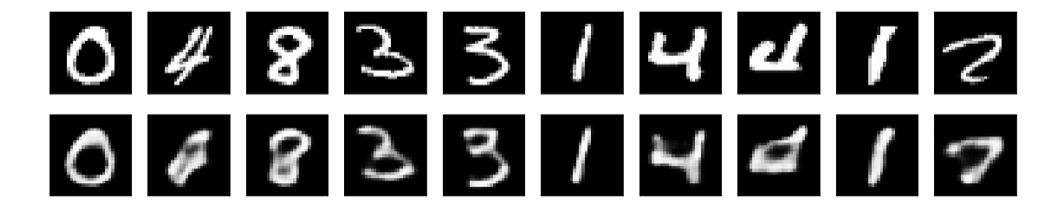
Step 5: Defining a utility function to visualize the reconstruction
Python3 1==
Step 6: Calling the utility functions in the appropriate order
a) Loading the data
Python3 1==
b) Building the network
Python3 1==
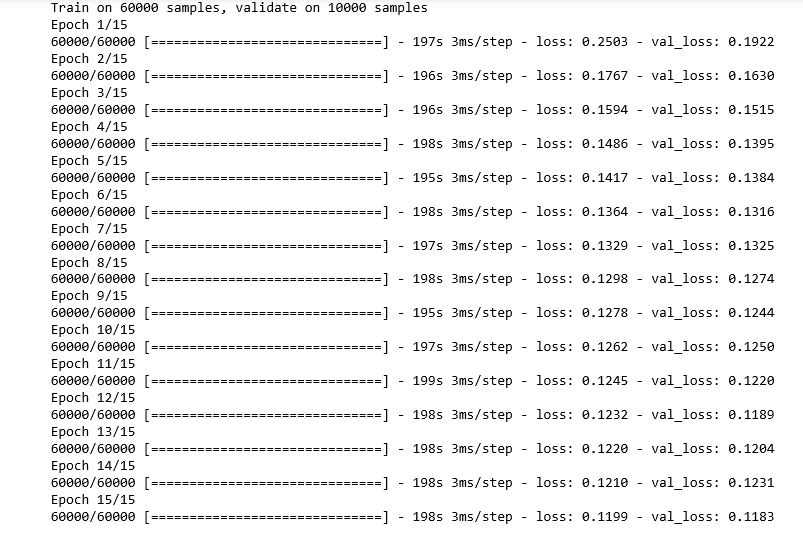
c) Building and training the Auto-encoder
Python3 1==
 d) Visualizing the reconstruction
Python3 1==
import numpy as np
import matplotlib.pyplot as plt
from random import randint
from keras import backend as K
from keras.layers import Input, Dense, Conv2D, MaxPooling2D, UpSampling2D
from keras.models import Model
from keras.datasets import mnist
from keras.callbacks import TensorBoard
def load_data():
    # defining the input image size
    input_image = Input(shape =(28, 28, 1))

    # Loading the data and dividing the data into training and testing sets
    (X_train, _), (X_test, _) = mnist.load_data()

    # Cleaning and reshaping the data as required by the model
    X_train = X_train.astype('float32') / 255.
    X_train = np.reshape(X_train, (len(X_train), 28, 28, 1))
    X_test = X_test.astype('float32') / 255.
    X_test = np.reshape(X_test, (len(X_test), 28, 28, 1))

    return X_train, X_test, input_image
def build_network(input_image):

    # Building the encoder of the Auto-encoder
    x = Conv2D(16, (3, 3), activation ='relu', padding ='same')(input_image)
    x = MaxPooling2D((2, 2), padding ='same')(x)
    x = Conv2D(8, (3, 3), activation ='relu', padding ='same')(x)
    x = MaxPooling2D((2, 2), padding ='same')(x)
    x = Conv2D(8, (3, 3), activation ='relu', padding ='same')(x)
    encoded_layer = MaxPooling2D((2, 2), padding ='same')(x)

    # Building the decoder of the Auto-encoder
    x = Conv2D(8, (3, 3), activation ='relu', padding ='same')(encoded_layer)
    x = UpSampling2D((2, 2))(x)
    x = Conv2D(8, (3, 3), activation ='relu', padding ='same')(x)
    x = UpSampling2D((2, 2))(x)
    x = Conv2D(16, (3, 3), activation ='relu')(x)
    x = UpSampling2D((2, 2))(x)
    decoded_layer = Conv2D(1, (3, 3), activation ='sigmoid', padding ='same')(x)

    return decoded_layer
def build_auto_encoder_model(X_train, X_test, input_image, decoded_layer):

    # Defining the parameters of the Auto-encoder
    autoencoder = Model(input_image, decoded_layer)
    autoencoder.compile(optimizer ='adadelta', loss ='binary_crossentropy')

    # Training the Auto-encoder
    autoencoder.fit(X_train, X_train,
                epochs = 15,
                batch_size = 256,
                shuffle = True,
                validation_data =(X_test, X_test),
                callbacks =[TensorBoard(log_dir ='/tmp / autoencoder')])

    return autoencoder
def visualize(model, X_test):

    # Reconstructing the encoded images
    reconstructed_images = model.predict(X_test)

    plt.figure(figsize =(20, 4))
    for i in range(1, 11):

        # Generating a random to get random results
        rand_num = randint(0, 10001)

        # To display the original image
        ax = plt.subplot(2, 10, i)
        plt.imshow(X_test[rand_num].reshape(28, 28))
        plt.gray()
        ax.get_xaxis().set_visible(False)
        ax.get_yaxis().set_visible(False)

        # To display the reconstructed image
        ax = plt.subplot(2, 10, i + 10)
        plt.imshow(reconstructed_images[rand_num].reshape(28, 28))
        plt.gray()
        ax.get_xaxis().set_visible(False)
        ax.get_yaxis().set_visible(False)

    # Displaying the plot
    plt.show()
X_train, X_test, input_image = load_data()
decoded_layer = build_network(input_image)
auto_encoder_model = build_auto_encoder_model(X_train,
                                             X_test,
                                             input_image,
                                             decoded_layer)
visualize(auto_encoder_model, X_test)
