
Self-training is a semi-supervised learning technique where a model is first trained on a small labeled dataset and then iteratively improves itself using its own high-confidence predictions on unlabeled data.
Before getting started, install the required libraries using the following command:
pip install fastapi uvicorn scikit-learn pydantic
Step-by-Step Implementation
Step 1: Import Required Libraries
We first import all the necessary modules like FastAPI, scikit-learn, and pydantic.
from fastapi import FastAPI
from sklearn.datasets import load_iris
from sklearn.naive_bayes import GaussianNB
from pydantic import BaseModel
Explanation:
- FastAPI helps in creating the API endpoints and load_iris loads the Iris dataset used for training.
- GaussianNB is the Naive Bayes model used for classification.
- BaseModel from pydantic is used to define the input data format and validate it automatically.
Step 2: Define Input Data Format
Next, we define what kind of input data our API will accept. Using Pydantic’s BaseModel, we define the structure of the incoming JSON data.
class IrisFeatures(BaseModel):
    sepal_length: float
    sepal_width: float
    petal_length: float
    petal_width: float
Explanation:
- Each attribute corresponds to a feature from the Iris dataset.
- All values are of type float, ensuring the API accepts only numeric inputs.
- FastAPI uses this class to automatically validate incoming requests and show clear error messages if input is invalid.
Step 3: Train the Machine Learning Model
We’ll now load the Iris dataset and train a simple Gaussian Naive Bayes classifier to predict the flower type.
# Load Iris dataset
iris = load_iris()

# Extract features and labels
X, y = iris.data, iris.target

# Train the model
clf = GaussianNB()
clf.fit(X, y)
Explanation:
- load_iris() loads the dataset with features (measurements) and labels (flower types).
- GaussianNB() creates a Naive Bayes classifier.
- fit(X, y) trains the model using the dataset.
Step 4: Create the FastAPI App and Prediction Endpoint
Now, we’ll combine everything create the FastAPI app, load the model, and add a /predict endpoint that accepts JSON input and returns the predicted flower class.
# Create FastAPI instance
app = FastAPI()

# Define prediction endpoint
@app.post("/predict")
def predict(data: IrisFeatures):
    test_data = [[
        data.sepal_length,
        data.sepal_width,
        data.petal_length,
        data.petal_width
    ]]
    class_idx = clf.predict(test_data)[0]
    return {"class": iris.target_names[class_idx]}
Explanation:
- @app.post("/predict") defines an endpoint that accepts POST requests with input data.
- The data parameter (of type IrisFeatures) automatically validates and parses the JSON input.
- The model predicts the class of the flower using clf.predict().
- The result is returned as a JSON object containing the predicted flower name.
Step 5: Run and Test the API
Now, save your code (for example, as basic.py) and run the server using:
uvicorn basic:app --reload
Explanation:
- basic is the name of your Python file (without .py).
- app is the FastAPI instance inside that file.
- --reload restarts the server automatically whenever you update the code.
Output
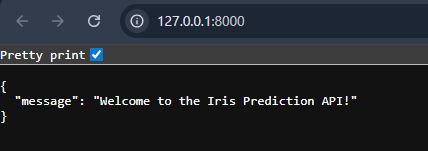
Then, open your browser and go to http://127.0.0.1:8000/ You’ll see a message showing that your FastAPI app is running.
To test our API we'll be using Swagger UI now to access that you'll just need to add /docs at the end of your path. So go to http://127.0.0.1:8000/docs. And you should see the following output:
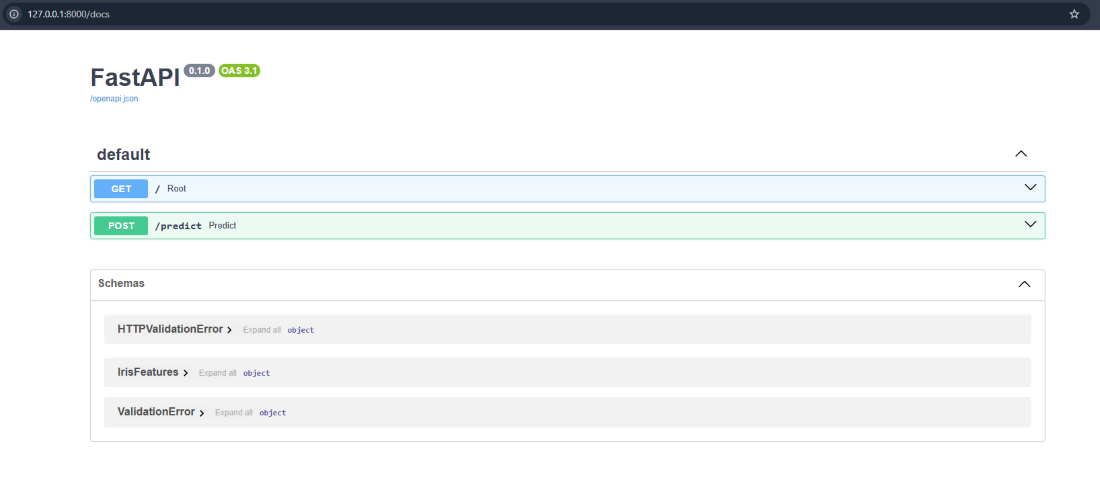
Here, you’ll see the /predict endpoint we created along with a “Try it out” button to test the API directly. Click “Try it out” and enter the following JSON input in the text box:
{
"sepal_length": 5.1,
"sepal_width": 3.5,
"petal_length": 1.4,
"petal_width": 0.2
}
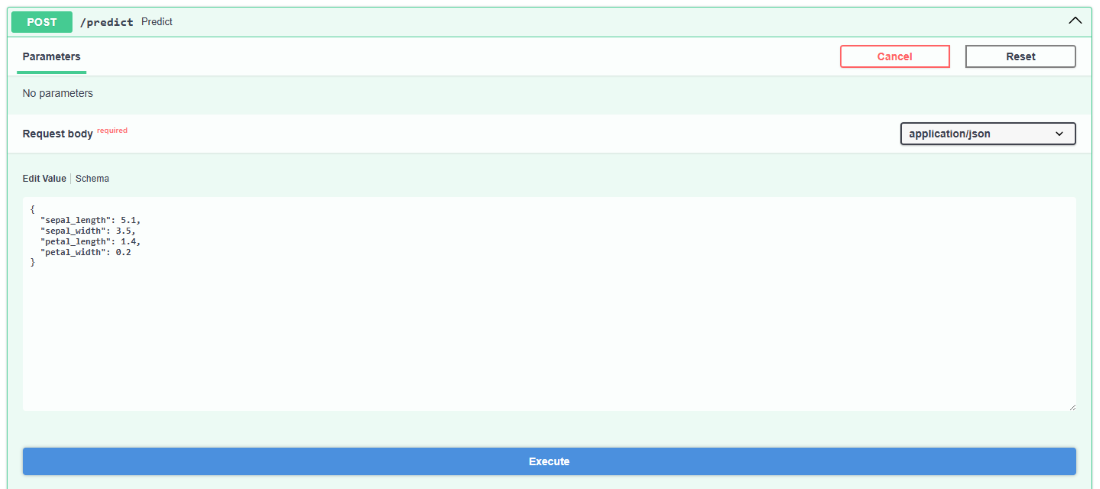
After entering the data, click “Execute.” You’ll see the output under the Responses section showing the predicted flower type, for example:

That means the model has classified the input as the Setosa species.
