
The identity 2 cos A cos B = cos(A + B) + cos(A – B) is one of the important product-to-sum formulas in trigonometry.
This identity is used to convert a product of cosine functions into a sum of cosines, which can simplify the process of solving trigonometric equations, evaluating integrals, and performing other algebraic manipulations involving trigonometric expressions.
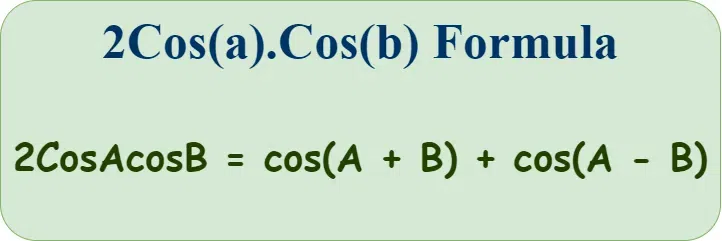
This formula is derived using the angle sum and angle difference formulas. Before learning more about the 2sinAsinB Formula, let’s first learn briefly about Trigonometric Ratios
Example: The product-to-sum formulae for half angles are,
2 cos (x/2) cos (y/2) = cos [(x + y)/2] + cos [(x - y)/2]
Apart from this identity, there are three other product-to-sum formulas in trigonometry:
- 2 sinA sinB = cos(A − B) − cos(A + B)
- 2 sinA cosB = sin(A + B) + sin(A − B)
- 2 cosA sinB = sin(A + B) − sin(A − B)
These formulas are especially useful, particularly simplifying trigonometric expressions, solving equations, and calculating integrals or derivatives involving trigonometric functions.
2 cosA cosB Formula Derivation
To derive the identity:
2 cos (x/2) cos (y/2) = cos [(x + y)/2] + cos [(x - y)/2]
From the sum and difference formulae of trigonometry, we have,
- cos (A + B) = cos A cos B - sin A sin B ———— (1)
- cos (A - B) = cos A cos B + sin A sin B ———— (2)
Now, by adding equations (1) and (2), we get
⇒ cos (A + B) + cos (A - B) = cos A cos B - sin A sin B + cos A cos B + sin A sin B
⇒ cos (A + B) + cos (A - B) = Cos A cos B + Cos A cos B
⇒ cos (A + B) + cos (A - B) = 2 Cos A cos B
Hence, 2 Cos A cos B = cos (A + B) + cos (A - B)
Article Related to 2 cosA cosB Formula:
Solved Question on 2 cosA cosB Formula
Question 1: Express 3 cos 5x cos 7x in terms of the sum function.
Solution:
3 cos 5x cos 7x
Now multiply and divide the given equation by 2.
(2/2) 3 cos 5x cos 7x
= 3/2 [2 cos 5x cos 7x]We have,
2 Cos A cos B = cos (A + B) + cos (A - B)
3/2 [2 cos 5x cos 7x] = 3/2 [cos (5x + 7x) + cos (5x - 7x)]z
= 3/2 [cos (12x) + cos (-2x)]
= 3/2 [cos 12x + cos 2x] {since cos (-θ) = cos θ}Hence, 3 cos 5x cos 7x = 3/2 [cos 12x + cos 2x]
Question 2: Prove that, cos 2x cos (3x/2) - cos 3x cos (5x/2) = sin x sin (9x/2).
Solution:
Let us consider the equation on left hand side,
L.H.S = cos 2x cos (3x/2) - cos 3x cos (5x/2)
= 1/2 [2 cos 2x cos (3x/2) - 2 cos 3x cos (5x/2)}We have, 2 Cos A cos B = cos (A + B) + cos (A - B)
= 1/2 [cos (2x + 3x/2) + cos (2x - 3x/2) - cos (3x + 5x/2) - 2 cos (3x - 5x/2)]
= 1/2 [cos (7x/2) + cos (x/2) - cos (11x/2) - cos (x/2)]
= 1/2 [cos (7x/2) - cos (11x/2)]By using cos A - cos B = - 2 sin [(A + B)/2] sin [(A - B)/2] we get,
= 1/2 {-2 sin [(7x/2 + 11x/2)/2] sin [(7x/2 - 11/2)/2]}
= - sin (18x/4) sin(-4x/4)
= - sin (9x/2) sin (-x)
= sin x sin (9x/2) {Since sin (-θ) = -sin θ}
= R.H.SHence, it is proved that cos 2x cos (3x/2) - cos 3x cos (5x/2) = sin x sin (9x/2)
Question 3: What is the value of the integral of 2 cos 4x cos (5x/2) dx?
Solution:
By,
2 cos A cos B = cos (A + B) + cos (A – B)
2 cos 4x cos (5x/2) = cos [4x + (5x/2)] + cos [4x - (5x/2)]
= cos (13x/2) + cos (3x/2)Now, integral of 2 cos 4x cos (5x/2) dx = ∫2 cos 4x cos (5x/2) dx
= ∫[cos (13x/2) + cos (3x/2)] dx
= 2/13 sin (13x/2) + 2/3 sin (3x/2) + C {Since, the integral of cos(ax) is (1/a) sin (ax) + C}Hence, ∫ 2 cos 4x cos (5x/2) dx = (2/3) sin (3x/2) + (2/13) sin (13x/2) + C
Question 4: Determine the derivative of 2 cos (x/2) cos (3x/2).
Solution:
By,
2 cos A cos B = cos (A + B) + cos (A – B)
2 cos (x/2) cos (3x/2) = cos [(x/2) + (3x/2)] + cos [(x/2) - (3x/2)]
= cos (4x/2) + cos (-2x/2)
= cos (2x) + cos (-x)
= cos x + cos 2x {since cos (-θ) = cos θ}Now, derivative of 2 cos (x/2) cos (3x/2) = d [2 cos (x/2) cos (3x/2) ]/dx
= d [cos x + cos 2x]/dx
= - sin x - 2 sin 2x {Since, d[cos (ax)] = -a sin (ax)}
= - (sin x + sin 2x)Hence, the derivative of 2 cos (x/2) cos (3x/2) = - (sin x + sin 2x).
Question 5: Find the value of the expression 3 cos 37.5° cos 52.5° using the 2coscosb formula.
Solution:
3 cos 37.5° cos 52.5° = 3/2 [2 cos 37.5° cos 52.5°]
By,
2 cos A cos B = cos (A + B) + cos (A – B)
3/2 [2 cos 37.5° cos 52.5°] = 3/2 [cos (37.5° + 52.5°) + cos (37.5° - 52.5°)]
= 3/2 [cos (90°) + cos (-15°)]
= 3/2 [cos 90° + cos 15°] {since cos (-θ) = cos θ}cos 90° = 0 and cos 15° = 0.9659
= 3/2 [0 + 0.9659]
= 1.44885Hence, 3 cos 37.5° cos 52.5° = 1.44885
Question 6: Write 4 cos 2y cos 5y in terms of the sum function.
Solution:
4 cos 2y cos 5y = 2 ( 2 cos 2y cos 5y)
We have,
2 Cos A cos B = cos (A + B) + cos (A - B)
2 ( 2 cos 2y cos 5y) = 2 [cos (2y + 5y) + cos (2y - 5y)]
= 2 [cos 7y + cos (-3y)]
= 2 [cos 7y + cos 3y] {since cos (-θ) = cos θ}Hence, 4 cos 2y cos 5y = 2 [cos 7y + cos 3y]
Question 7: Find the value of the expression 2 cos 44.5° cos 135.5° using the 2coscosb formula.
Solution:
By,
2 cos A cos B = cos (A + B) + cos (A – B)
2 cos 44.5° cos 135.5° = cos (44.5° + 135.5°) + cos (44.5° - 135.5°)
= cos (180°) + cos (-91°)
= cos (180°) + cos (91°) {since cos (-θ) = cos θ}
= -1 + (-0.01745) = -1.01745 {cos 180° = -1 and cos 91° = -0.01745}Hence, 2 cos 44.5° cos 135.5° = -1.01745
