
Addition and Subtraction are basic arithmetic operations with many applications in various fields of mathematics and daily life. Understanding these processes is important as they form the basis for more complicated mathematical concepts.
In this article, we will solve addition and subtraction problems.
Table of Content
What are Addition and Subtraction?
- Addition is the process of combining or adding or summing up two or more numbers to get a total or sum. It is represented by the symbol "
+". - Whereas, Subtraction is the process of taking one number away from another to find the difference. It is represented by the symbol "
-".
Example of Addition
Suppose we want to add 3 in 5. So we can do 3+5 = 8. The 8 is the sum or total of 3 and 5.
We can also do decimal additions.
Example: Add 2.2 and 4.2.
Solution:
2.2 + 4.2 = 6.4
Example of Subtraction
Suppose we want to subtract 5 from 3. So we can do 8−3 = 5. The 5 is the result of subraction.
We can also do decimal subtractions.
Example: Subtract 2.2 from 4.2.
Solution:
4.2 - 2.2 = 2.0
Solved Examples on Addition and Subtraction
Example 1: Add 23 + 15
Solution:
23 + 15 = 38
Example 2: Subtract 72 − 34
Solution:
72 − 34 = 38
Example 3: Add 56 + 89
Solution:
56 + 89 = 145
Example 4: Subtract 150 − 7.5
Solution:
150 − 7.5 = 142.5
Example 5: Add 234 + 567
Solution:
234 + 567 = 801
Example 6: Subtract 645 − 289
Solution:
645 − 289 = 356
Example 7: Add 910 + 284
Solution:
910 + 284 = 1194
Example 8: Subtract 1024 − 4.89
Solution:
1024 − 4.89 = 1019.11
Example 9: Add 678 + 432
Solution:
678 + 432 = 1110
Example 10: Subtract 1000 − 543
Solution:
1000 − 543 = 457
Worksheet: Addition and Subtraction
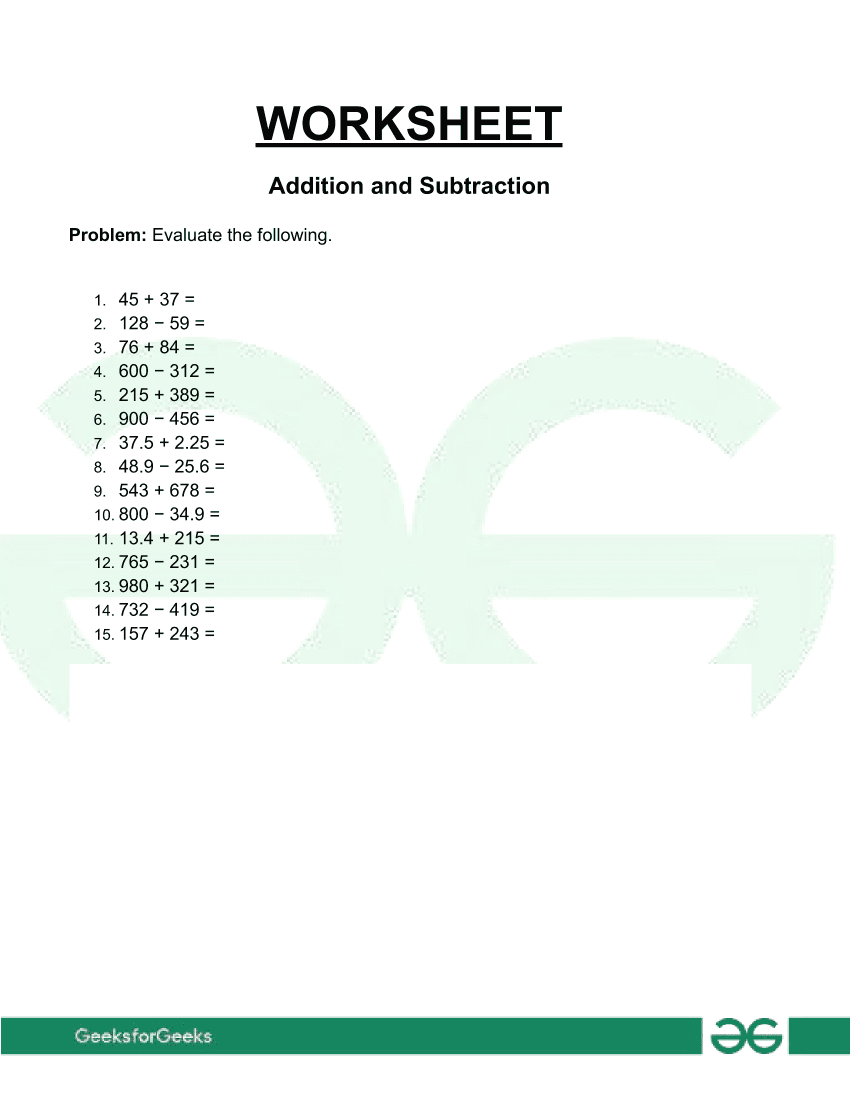
You can download this worksheet from below with answers:
