
The Pythagoras Theorem states that in a right-angled triangle, the square of the hypotenuse is equal to the sum of the squares of the base and the perpendicular.
Real-Life Example: Find the shortest distance between James’s house and Sarah’s house.
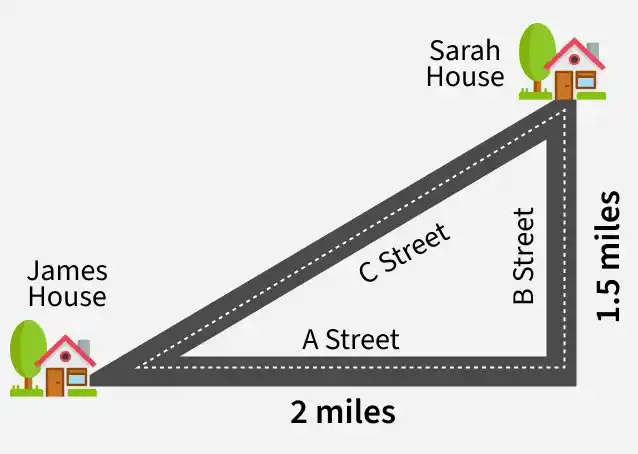
Solution:
Base (A Street) = 2 miles
Perpendicular (B Street) = 1.5 milesUsing Pythagoras Theorem:
Hypotenuse² = Base² + Perpendicular²AC² = (2)² + (1.5)²
AC² = 4 + 2.25
AC² = 6.25AC = √6.25 = 2.5 miles
Application of Pythagorean Theorem
The Pythagorean Theorem is widely used in real life to calculate distances and ensure efficiency in various fields:
- Road Transportation: Helps in finding the shortest distance between two points, useful in designing roads and planning efficient routes.
- Airlines: Used to calculate the shortest flight paths and design safe runway layouts.
- Robotics: Assists in navigation by helping robots determine the shortest path between two points.
- Mechanics: Used to find the resultant of perpendicular vectors, such as force and velocity, and in structural analysis.
- Electronics: Applied in circuit design to determine optimal distances and improve signal efficiency.
