
Trigonometric functions are mathematical functions that relate the angles of a right triangle to the ratios of its sides. There are six primary trigonometric functions, each defined based on the angles of a right triangle, such as sine, cosine, tangent, and their reciprocals, cosine, csc, and cot.
One of the real-life applications is Measuring Heights and Distances of a Building without any special gadgets.
For example, you are standing 100 feet away from a building. The angle of elevation to the top of the building is 40°. What is the height of the building?
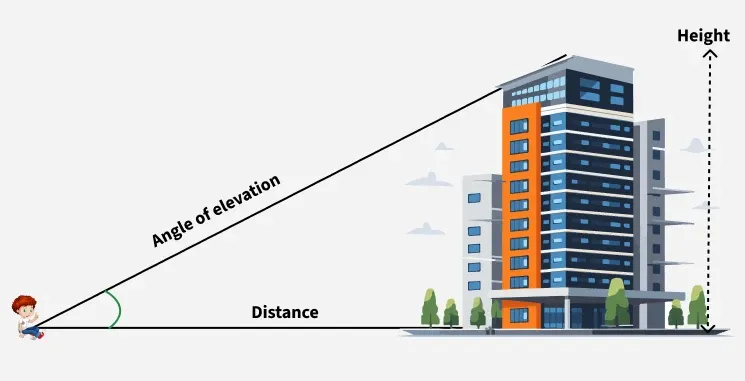
Solution:
Given that, the value of θ = 40°, distance = 100 feet
height = 100 × tan(40°)
height = 100 × 0.8391 = 83.91feet
Trigonometric functions have a wide range of applications across various fields. Here are some key areas where trigonometry is applied:
In Physics
Resolving Forces
In mechanics, trigonometry is used to resolve a force into its horizontal and vertical components, which makes it easier to analyze the motion of objects.
Example:
Imagine a worker pulling a cart with a rope that is inclined at an angle above the horizontal. The rope creates a force at an angle, rather than directly forward or upward.
This angled force can be resolved into two components:
- A horizontal component that helps move the cart forward.
- A vertical component that slightly lifts the cart (reducing normal force and friction).
Wave Motion
Trigonometric functions describe the behaviour of periodic waves, such as sound and light waves. The displacement of a wave can be represented using sine or cosine functions.
Example: A sound wave can be represented by a sine wave: y(t) = A sin(2πft + ϕ), where A is the amplitude, f is the frequency, t is time, and ϕ is the phase shift.
Oscillations:
Simple harmonic motion, such as the motion of a pendulum or spring, is modelled using sine and cosine functions.
Example: The displacement of a mass on a spring in simple harmonic motion is modelled as x(t) = A cos(ωt + ϕ), where A is the maximum displacement (amplitude), ω is the angular frequency, and ϕ is the phase constant.
In electromagnetism, trigonometric functions are used to describe the electric and magnetic fields of travelling waves.
In Engineering
Signal Processing:
Trigonometric functions, particularly sine and cosine, are crucial in analyzing signals, especially in the context of Fourier analysis, which breaks down complex signals into simpler sine and cosine components.
Example: A complex signal f(t) can be broken into sine and cosine waves using the Fourier Transform:
AC Circuits:
In electrical engineering, alternating current (AC) voltages and currents are described using sinusoidal functions, helping in understanding waveforms and their properties.
The voltage across a resistor in an AC circuit is given by: V(t) = V0cos(ωt + ϕ), where V0 is the peak voltage, ω is the angular frequency, and ϕ is the phase shift.
Structural Engineering:
Trigonometry helps in determining forces and moments in structures. For example, the calculation of angles and forces in trusses or beams often uses trigonometric identities.
In Geography and Navigation
Surveying
Trigonometry is used in land surveying to calculate distances, angles, and elevations. Theodolites, which measure angles, rely on trigonometric principles to calculate horizontal and vertical positions.
Example: To calculate the distance between two points in a triangle:
GPS and Mapping
Trigonometric functions are essential in calculating distances and directions when determining locations using latitude and longitude coordinates.
Example: Latitude and longitude can be converted to distances using spherical trigonometry:
Navigation
Trigonometry helps in determining courses, distances, and positions when navigating, particularly in aviation and maritime contexts.
In Computer Science and Graphics
Computer Graphics
Trigonometric functions are used to simulate lighting, shadows, and rotations in 3D rendering.
Example: Rotating a point (x, y) in 2D by an angle θ:
Robotics
In robotics, trigonometric functions help model the movements and rotations of robotic arms and other mechanical systems.
Example: The position of a robotic arm joint can be modeled using trigonometric functions:
In Acoustics
Sound Waves
The propagation of sound can be modeled using sine and cosine functions, which describe amplitude, frequency, and phase shifts.
Musical Tuning
Trigonometric functions are used in sound frequency analysis and to describe musical intervals in terms of wavelengths and frequencies.
Example: The frequency of a musical note can be related to the harmonic series: fn = nf1, where fn is the frequency of the nth harmonic, and f1 is the fundamental frequency.
Read More,
