
Polar curves are represented using polar coordinates (r, θ), where r is the distance of a point from the pole (origin), and θ is the angle measured from the positive x-axis.
- Polar coordinates are particularly useful for describing curves such as circles, cardioids, roses, and spirals.
- Integration can be used to find the area enclosed by a polar curve or the area between two polar curves.
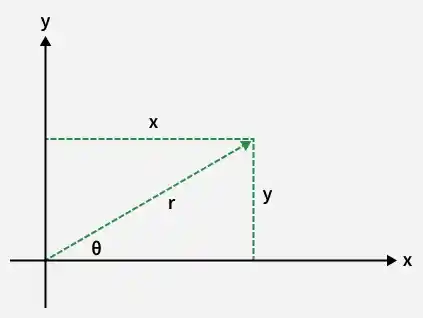
These coordinates (r, θ) are called polar coordinates. Many curves are easily described in this manner.
For example, the equation of the circle in the Cartesian system is given by, x2 + y2 = a2
The equation of the same curve is polar coordinates will be given by, r = a
This means that the curve includes all the points on the plane whose distance from the origin is “a”. Notice that there is no θ in the equation, which means that whatever the angle made by the point from the x-axis. The distance is independent of that angle and is given by “a”.
Area defined by Polar Graphs
Polar graphs are the curves that are defined in the polar coordinate system.
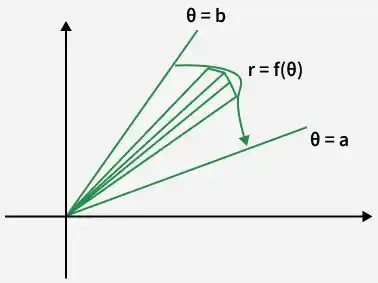
Consider a polar curve r = f(θ). A small change in angle (dθ) forms a narrow sector whose area is approximately:
Adding the areas of all such sectors from (θ = a) to (θ = b) gives the total area enclosed by the curve:
A=\frac{1}{2}\int_a^b r^2d\theta , where (r = f(θ).
Example: Find the area enclosed by the cardioid (r = 1-cosθ) from (θ = 0) to (θ = ℼ /2).
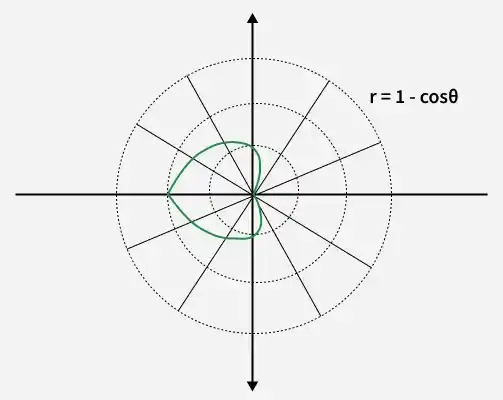
Using the polar area formula,
A=\frac{1}{2}\int_0^{\pi/2}(1-\cos\theta)^2d\theta Expanding the square:
A=\frac{1}{2}\int_0^{\pi/2}(1+\cos^2\theta-2\cos\theta)d\theta Using ,
\cos^2\theta=\frac{1+\cos2\theta}{2} we get,
A=\frac{1}{2}\int_0^{\pi/2}\left(\frac{3}{2}+\frac{\cos2\theta}{2}-2\cos\theta\right)d\theta Integrating,
A=\frac{1}{2}\left[\frac{3}{2}\theta+\frac{1}{4}\sin2\theta-2\sin\theta\right]_0^{\pi/2} Substituting the limits,
A=\frac{1}{2}\left(\frac{3\pi}{4}-2\right) Therefore, the required area is
\frac{3\pi}{8}-1
Area Between Two Polar Curves
Steps to Find the Area Between Two Polar Curves are as follow:
- Find the points of intersection by setting (r1=r2).
- Determine the interval of integration.
- Identify the outer and inner curves.
- Substitute into the area formula.
- Evaluate the integral.
Suppose two polar curves are given by , r=r1(θ) and r=r2(θ)
where r1(θ) is the outer curve and r2(θ) is the inner curve on the interval [a,b].
The area between the two curves is:
A=\frac{1}{2}\int_a^b\left(r_1^2-r_2^2\right)d\theta ,where (a) and (b) are the angles at which the curves intersect.
Example :Consider two polar graphs that are given by, r = 3sin(θ) and r = 3cos(θ). The goal is to calculate the area enclosed between these curves.'
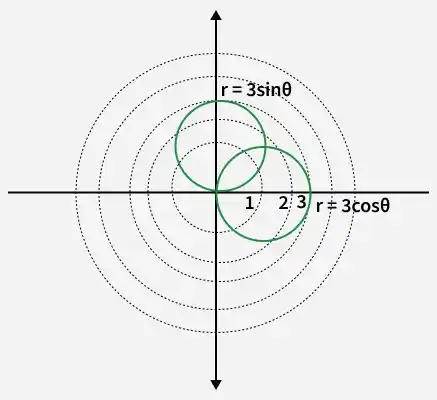
The curves intersect when
3\sin\theta=3\cos\theta \\ \frac{\sin\theta}{\cos\theta}=\frac{3}{3} \\ \tan\theta=1
so ,\theta=\frac{\pi}{4} The common region is symmetric about the line (
\theta=\frac{\pi}{4} ), so we first find half of the area and then double it.For (
0\le\theta\le\frac{\pi}{4} ), the smaller radius is (r=3\sin\theta ).Thus,
A_{\text{half}} =\frac{1}{2}\int_0^{\pi/4}(3\sin\theta)^2,d\theta =\frac{9}{2}\int_0^{\pi/4}\sin^2\theta,d\theta Using
\sin^2\theta=\frac{1-\cos2\theta}{2}, A_{\text{half}}=\frac{9}{4}\int_0^{\pi/4}(1-\cos2\theta)d\theta =\frac{9}{4}\left[\theta-\frac{\sin2\theta}{2}\right]_0^{\pi/4}\\[3pts]\frac{9}{4}\left(\frac{\pi}{4}-\frac{1}{2}\right).
Therefore,A=2A_{\text{half}} =\frac{9}{2}\left(\frac{\pi}{4}-\frac{1}{2}\right) =\frac{9\pi}{8}-\frac{9}{4} square units.
Sample Problems
Question 1: Find the area enclosed by the curve r = 3 in the first quadrant.
The area can be calculated using the formula studied above,
A =
\frac{1}{2}\int^{\frac{\pi}{2}}_{0}r^2d\theta A =
\frac{1}{2}\int^{\frac{\pi}{2}}_{0}3^2d\theta A =
\frac{1}{2}\times9[\theta]^{\frac{\pi}{2}}_{0} A =
\frac{9\pi}{4}
Question 2: Find the area enclosed by the curve r = 5 + θ in the first two quadrants.
The area can be calculated using the formula studied above,
A =
\frac{1}{2}\int^{\frac{\pi}{2}}_{0}r^2d\theta A =
\frac{1}{2}\int^{\pi}_{0}(5 + \theta)^2d\theta A =
\frac{1}{2}\int^{\pi}_{0}(25 + 10.\theta + \theta^2)d\theta A =
\frac{1}{2}[25\theta + 5.\theta^2 + \frac{\theta^3}{3})]^{\pi}_{0} A =
[\frac{25\pi}{2}+ \frac{5\pi^2}{2} + \frac{\pi^3}{6}]
Question 3: Find the area enclosed by the curve r = 5 + eθ in the first two quadrants.
The area can be calculated using the formula studied above,
A =
\frac{1}{2}\int^{\frac{\pi}{2}}_{0}r^2d\theta A =
\frac{1}{2}\int^{\pi}_{0}(5 + e^\theta)^2d\theta A =
\frac{1}{2}\int^{\pi}_{0}(25 + 10e^\theta + e^{2\theta})d\theta A =
\frac{1}{2}[25\theta + 10e^\theta + \frac{e^{2\theta}}{2})]^{\pi}_{0} A =
\frac{1}{2}(25\pi + 10e^\pi + \frac{e^{2\pi}}{2}-10-\frac{1}{2}) A =
\frac{25\pi}{2} + 5e^\pi + \frac{e^{2\pi}}{4}-\frac{21}{4})
Question 4: Find the area under this curve from θ = 0 to θ = 180°: r = 1 + cos(θ)
A = \int^{b}_{a} \frac{1}{2}r^2d\theta In this case, a = 0 and b = 180° and r = 1 + cos(θ)
Plugging these values into the formula,
A = \int^{\pi}_{0} \frac{1}{2}r^2d\theta \\ = A = \int^{\pi}_{0} \frac{1}{2}(1 + cos(\theta))^2d\theta \\ = A = \frac{1}{2}\int^{\pi}_{0}(1 + cos^2(\theta) +2cos(\theta))d\theta Rearranging the equation with the identity cos(2θ) = 1 - 2cos2(θ)
A =
\frac{1}{2}\int^{\pi}_{0}(1 + (\frac{1 + cos(2\theta)}{2}) +2cos(\theta))d\theta A =
\frac{1}{2}\int^{\pi}_{0}(\frac{3}{2} + \frac{cos(2\theta)}{2} +2cos(\theta))d\theta A =
\frac{1}{2}[\frac{3}{2}\theta +2sin(\theta) + \frac{1}{4}sin(2\theta)]^{\pi}_{0} A =
\frac{3}{4}\pi
Practice Problem
Question 1: Find the area enclosed by the polar curve r = 4 for 0 ≤ θ ≤ 2π.
Question 2: Find the area enclosed by the cardioid r = 1+cosθ for 0 ≤ θ ≤ 2π.
Question 3: Find the area of one petal of the rose curve r = 2sin(2θ).
Question 4: Find the area between the curves r = 3 and r = 3sinθ for 0 ≤ θ ≤ π.
Question 5: Find the area common to the curves r = 2sinθ for r = 2cosθ.
