
A composite figure is a shape that consists of two or more simple geometric shapes combined. In this worksheet, students will practice breaking down these composite figures into simpler parts, such as rectangles, triangles, and circles, and calculating their areas.
This worksheet is designed to make learning interactive and engaging, helping students enhance their problem-solving skills step by step.
What is Composite Figure?
A composite figure (or composite shape) is a shape that is made up of two or more basic geometric shapes such as rectangles, squares, triangles, circles, semicircles, trapezoids, etc. These figures are often irregular in shape, but they can be broken down into simpler, well-known shapes.
Examples of Composite Figures
Some examples are:
- A rectangle with a semicircle on top.
- An L-shaped figure composed of two rectangles.
- A figure made of a triangle and a rectangle.
Area of Composite Figures
The area of composite figures refers to the total area of the shape that is made up of the two or more simple geometric shapes such as the rectangles, triangles, circles etc.
To find the area or perimeter of a composite figure, you can:
- Break the figure into smaller, basic shapes (like rectangles, triangles, or circles).
- Calculate the area or perimeter of each basic shape using known formulas.
- Add or subtract the areas to get the total area or perimeter of the composite figure.
Formulas for Area of Composite Figures
Some of the common composite figures are listed in the following table:
| Composite Figure | Basic Shapes Involved | Formula for Area | Explanation |
|---|---|---|---|
| Rectangle with a Semicircle | Rectangle + Semicircle | A = lw + (1/2)πr2 | Add the area of the rectangle and half the area of a circle. |
| Triangle with a Rectangle | Triangle + Rectangle | A = (1/2)bh + lw | Add the area of the triangle and the rectangle. |
| Circle inside a Square | Square - Circle | A = s2−πr2 | Subtract the area of the circle from the area of the square. |
| L-shaped Figure (two rectangles) | Two Rectangles | A = l1w1 + l2w2 | Add the areas of the two rectangles. |
| Trapezoid with a Triangle | Trapezoid + Triangle | A = (1/2)(b1 + b2)h + (1/2)bh | Add the area of the trapezoid and the triangle. |
| Semicircle on top of a Rectangle | Rectangle + Semicircle | A = lw + (1/2)πr2 | Add the area of the rectangle and the semicircle. |
| Hexagon with an Inscribed Circle | Hexagon - Circle | A = (3√3/2)s2 − πr2 | Subtract the area of the circle from the hexagon. |
| Sector with a Triangle | Sector + Triangle | A = (θ/360)πr2 + (1/2)bh | Add the area of the sector and the triangle. |
| Composite of Two Circles | Circle + Circle | A = πr12 + πr22 | Add the areas of both circles. |
| Right Triangle with a Semicircle | Right Triangle + Semicircle | A = (1/2)bh + (1/2)πr2 | Add the area of the right triangle and the semicircle. |
Area of Composite Figures: Practice Questions with Solutions
Problem 1: Find the area of a composite figure consisting of a rectangle with the dimensions 8 cm by 6 cm and a semicircle with a radius of 3 cm attached to one side.
Solution:
Area of Rectangle = 8×6 = 48cm2
Area of Semicircle = 1/2 × π × 32 = 1\2×π×9≈14.14cm2
Total Area = 48 + 14.14≈62.14cm2
Problem 2: A composite figure consists of a square with the side of 5 cm and a quarter circle of radius 5 cm attached to one corner of the square. Find the area of the composite figure.
Solution:
Area of Square = 5×5 = 25cm2
Area of Quarter Circle = 1\4×π×52 = 1\4×π×25≈19.63cm2
Total Area = 25 + 19.63≈44.63cm2
Problem 3: Calculate the area of a composite figure consisting of a triangle with the base of 6 cm and height of 4 cm and a rectangle with a width of 6 cm and height of 3 cm.
Solution:
Area of Triangle = 1\2×6×4 = 12cm2
Area of Rectangle = 6×3 = 18cm2
Total Area = 12 + 18 = 30cm2
Problem 4: A composite figure is made of a trapezoid and a triangle. The trapezoid has bases of the 10 cm and 6 cm and a height of 4 cm. The triangle has a base of 6 cm and a height of 4 cm. Find the total area.
Solution:
Area of Trapezoid = 1\2×(10 + 6)×4 = 32cm2
Area of Triangle = 1\2×6×4 = 12cm2
Total Area = 32 + 12 = 44cm2
Problem 5: Find the area of a composite figure consisting of a rectangle with dimensions 10 cm by the 4 cm and a right triangle with a base of 10 cm and height of 6 cm.
Solution:
Area of Rectangle:
10 × 4 = 40 cm2
Area of Right Triangle:
\frac{1}{2} \times 10 \times 6 = 30 \, \text{cm}^2 Total Area:
40 + 30 = 70cm2
Problem 6: A composite figure consists of a parallelogram with a base of 8 cm and height of 5 cm and a triangle with a base of 8 cm and height of 3 cm.
Solution:
Area of Parallelogram:
8 × 5 = 40 cm2
Area of Triangle:
\frac{1}{2} \times 8 \times 3 = 12 \, \text{cm}^2 Total Area:
40 + 12 = 52 cm2
Problem 7: Calculate the area of a composite figure consisting of a circle with the radius 7 cm and a sector of the circle with an angle of 60 degrees.
Solution:
Area of Circle:
\pi \times 7^2 = \pi \times 49 \approx 153.94 \, \text{cm}^2 Area of Sector:
\frac{60}{360} \times \pi \times 7^2 = \frac{1}{6} \times \pi \times 49 \approx 25.98 \, \text{cm}^2 Total Area:
153.94 + 25.98 \approx 179.92 \, \text{cm}^2
Problem 8: Find the area of a composite figure made of a hexagon and an equilateral triangle with each side 4 cm.
Solution:
Area of Equilateral Triangle:
\frac{\sqrt{3}}{4} \times 4^2 = \frac{\sqrt{3}}{4} \times 16 \approx 6.93 \, \text{cm}^2 Area of Regular Hexagon:
\frac{3 \sqrt{3}}{2} \times 4^2 = \frac{3 \sqrt{3}}{2} \times 16 \approx 83.14 \, \text{cm}^2 Total Area:
83.14 + 6.93 \approx 90.07 \, \text{cm}^2
Problem 9: A composite figure consists of a rectangle with the dimensions 12 cm by 5 cm and a semicircle with a radius of 5 cm attached to one of the longer sides.
Solution:
Area of Rectangle:
12 × 5 = 60 cm2
Area of Semicircle:
\frac{1}{2} \times \pi \times 5^2 = \frac{1}{2} \times \pi \times 25 \approx 39.27 \, \text{cm}^2 Total Area:
60 + 39.27 \approx 99.27 \, \text{cm}^2
Problem 10: Calculate the area of a composite figure consisting of a square with the side length 7 cm and a quarter circle with the radius 7 cm attached to one corner of the square.
Solution:
Area of Square:
7 × 7 = 49 cm2
Area of Quarter Circle:
\frac{1}{4} \times \pi \times 7^2 = \frac{1}{4} \times \pi \times 49 \approx 38.48 \, \text{cm}^2 Total Area:
49 + 38.48 \approx 87.48 \, \text{cm}^2
Area of Composite Figures: Worksheet
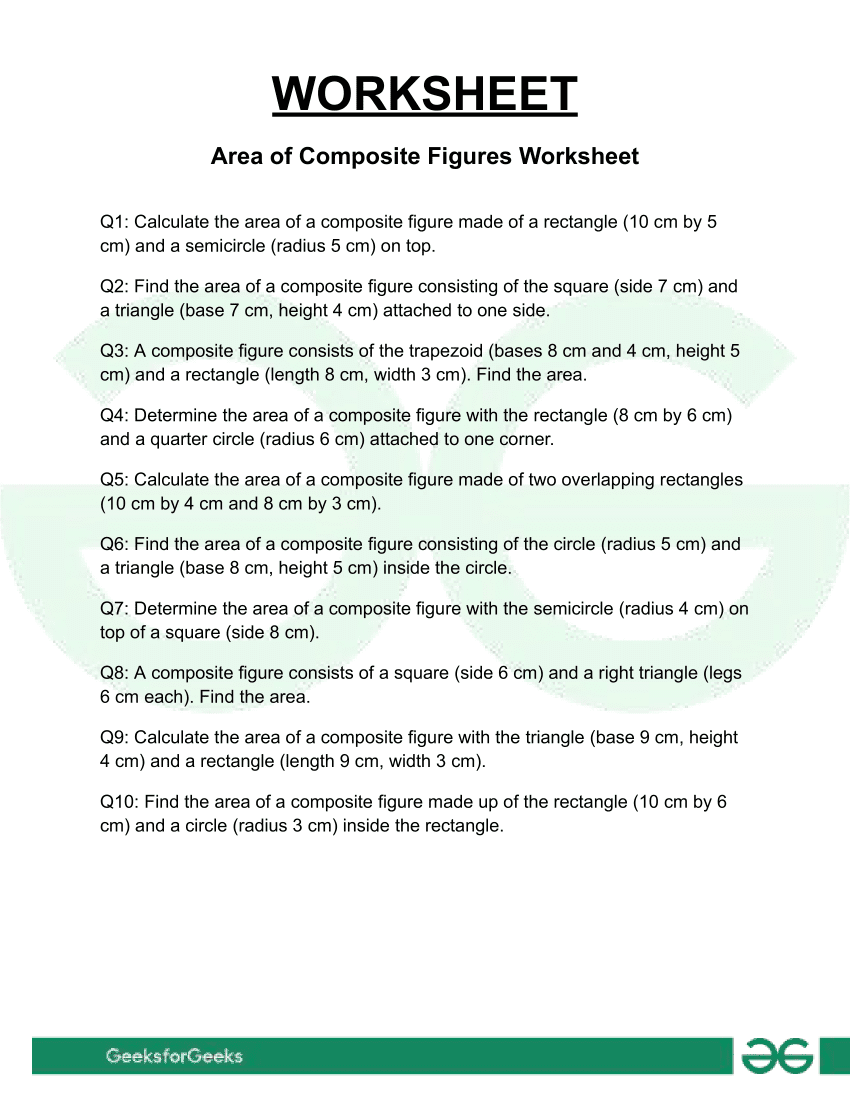
You can download this worksheet from the following:
Conclusion
Area of Composite Figures Worksheet provides a valuable opportunity for students to strengthen their understanding of geometry by practicing the calculation of complex shapes. By breaking down composite figures into simpler geometric shapes and finding their individual areas, students can develop confidence in solving real-world math problems.
Read More,
