In math (especially in navigation), bearings are a way of describing direction using angles. To correctly measure and express bearings, follow these important rules:
Bearings are always measured from the North line (0° line is always the North line).
They must be written as three-figure angles (for example, 60° is written as 060°).
They are always measured in a clockwise direction.
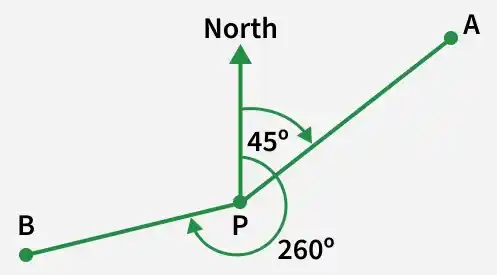
Example: The diagram shows three points A, B, and P.
The angles are measured clockwise from the North line.
The bearing of A from P is 045°
The bearing of B from P is 260°
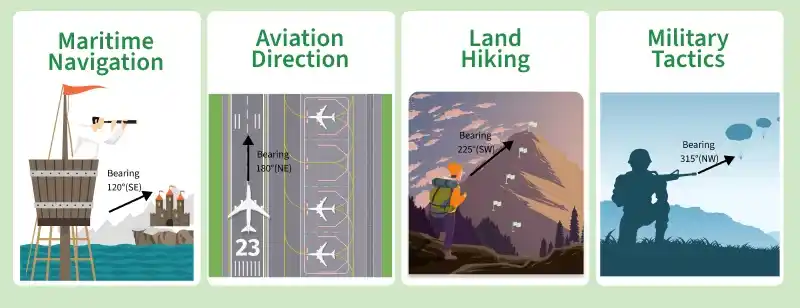
Real-Life Applications of Bearings
Maritime Navigation: Helps ships travel safely and reach the correct destination.
Aviation: Helps pilots follow the correct flight path and navigate accurately.
Hiking and Trekking: Helps hikers find direction and avoid getting lost.
Military Operations: Helps in locating targets and planning movements.
How to Draw Bearings
To draw a bearing correctly, follow these simple steps:
Mark the starting point and draw a North line from it (if not already given).
Place a protractor at the starting point, align its 0° with the North line, and measure the angle clockwise.
Make a small mark at the measured angle and draw a straight line in that direction.
If a distance is given, measure it along the line to locate the final point.
Solved Examples
Example 1: Measuring a Bearing
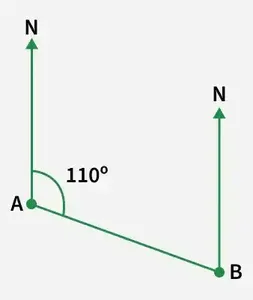
Find the bearing of B from A.
Note: “B from A” means the direction is measured from point A towards point B.
Solution:
Start at point A and draw or identify the North line.
Bearings are measured clockwise from the North line.
Move clockwise until you reach the line joining A to B.
Measure this angle using a protractor.
Therefore, the bearing of B from A is 110°.
Example 2: Drawing a Bearing
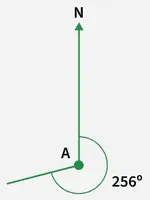
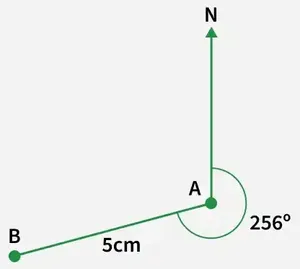
Two boats A and B are 5 km apart. The bearing of B from A is 256°. Using the scale 1 cm : 1 km, construct a diagram showing the positions of A and B.
Solution:
Start by marking point A and drawing a North line.
Bearings are measured clockwise, but since 256° is difficult to measure directly with a protractor, we use: 360° − 256° = 104°
Now measure 104° anticlockwise from the North line and draw a line in that direction.
Using the scale 1 cm : 1 km, measure 5 cm along this line from point A.
Mark this point as B.
The diagram shows point B located 5 cm from A along a direction of 256°.
Example 3: Finding a Reverse Bearing
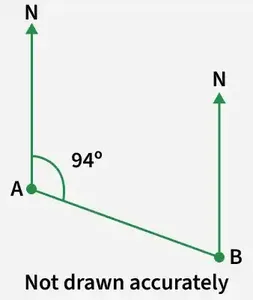
The diagram shows the bearing of B from A; find the bearing of A from B.
Solution:
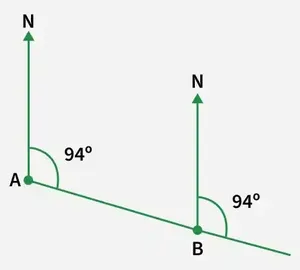
The bearing of B from A is 94°.
The North lines at A and B are parallel, so the angle at B is also 94° (corresponding angles).
To find the bearing of A from B, we measure clockwise from the North line at B to the line BA.
Since this forms a straight line, we add 180°:
So, 94° + 180° = 274°
The bearing of A from B is 274°.
Practice Questions
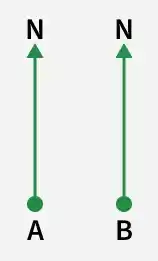
Question 1: Point C lies on a bearing of 065° from A and 310° from B. On the diagram, mark the position of point C with an x.
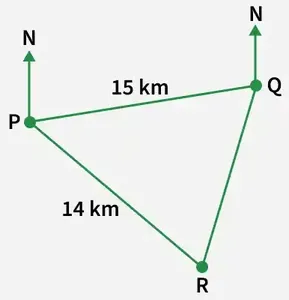
Question 2: The diagram shows the positions of three points P, Q, and R, where Q is on a bearing of 080° from P and R is on a bearing of 132° from P. The distances PQ = 15 km and PR = 14 km.
a) Find the distance QR b) Find the bearing of R from Q