
The Ceiling Function is a mathematical function that returns the smallest integer greater than or equal to a given number. It is denoted as ⌈x⌉ or ceil(x). This function is widely used in maths, computer science, and many other fields.
Mathematically, the ceiling function is defined as follows:
Ceil(x) OR ⌈x⌉ = min{n ∈ Z : n ≥ x}
Where:
- Z represents the set of all integers.
- n is the smallest integer that is greater than or equal to x.
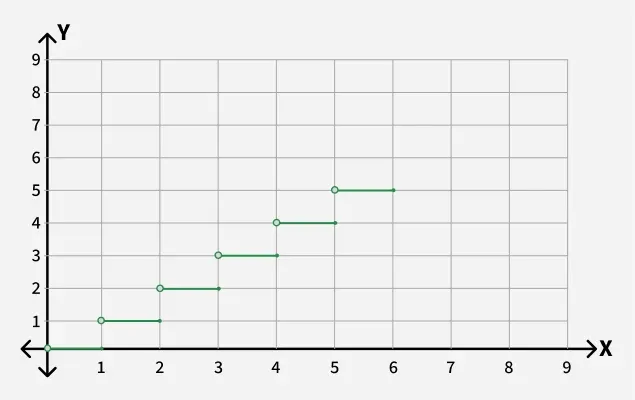
The graph below illustrates how the ceiling function works. For example, ⌈3.5⌉ = 4, as the smallest integer greater than or equal to 3.5 is 4.

Examples:
- ⌈3.3⌉ = 4
- ⌈−1.7⌉ = −1
- ⌈5⌉ = 5
- ⌈0.001⌉ = 1
Ceiling Function Symbol
The ceiling function is denoted using the symbol ⌈ ⌉. Thus we can denote ceiling(x) by ⌈x⌉. Other than this, ceiling function is also denoted by the abbreviation of ceiling i.e., ceil(x).
Domain And Range of Ceiling Function
The Domain of the ceiling function is all real numbers i.e. R and the co-domain and range of the signum function are set of all integers i.e. Z.

Graph of Ceiling Function
The graph of a ceiling function is a step graph or a broken graph in which the plotted lines are parallel to the X-axis. On the graph, a line represents the range of inputs and the output of the ceiling function is shown using a circle. The maximum integer value returned by the ceiling function is shown by a dot. The graph of ceiling function is shown below:
Properties of Ceiling Function
Properties of the Ceiling function are used to simplify the equations that involve the use of the Ceiling function. Ceiling Function ⌈x⌉ has the following properties:
1. Integer Output:
- The value returned by ⌈x⌉ is always an integer.
2. Boundary Property:
- If ⌈x⌉ = a then: a - 1 < x ≤ a
This means x lies between a − 1 and a, including a but not a − 1.
3. Alternative Bounding Property:
- If ⌈x⌉ = a then: x ≤ a < x + 1
This ensures a is the smallest integer greater than or equal to x.
4. Summation Property:
- ⌈x⌉ + ⌈y⌉ - 1 ≤ ⌈x + y⌉ ≤ ⌈x⌉ + ⌈y⌉
This provides upper and lower bounds for the ceiling of a sum.
5. Translation Property:
- If a is an integer: ⌈x + a⌉ = ⌈x⌉ + a
This means adding an integer inside the ceiling function is the same as adding it outside.
6. Comparison Property:
If a is a real number:
- a < ⌈x⌉ if a < x
- a ≤ ⌈x⌉ if x < a
This shows how aaa relates to the ceiling function.
Floor And Ceiling Function
Floor function is a function that returns the greatest integer which is smaller than or equal to the input number. It is represented using ⌊x⌋, where x is the input number. Differences between floor and ceiling functions are as follows:
Ceiling Function | Floor Function |
|---|---|
It returns the smallest integer greater than or equal to the integer of the input number. | It returns the greatest integer smaller than or equal to the integer of the input number. |
If the input x is a positive decimal, then the ceiling function returns 1 more than the whole integer part of the decimal. | If the input x is a positive decimal, then the floor function returns the integer part of the decimal. |
If input x is a negative decimal number, then the output is the integer part of the decimal. | If input x is a negative decimal number, then output is 1 less than the integer part of the decimal. |
It is represented using ⌈x⌉. | It is represented using ⌊x⌋. |
Read More: Difference Between Floor and Ceil Function
Applications of Ceiling Function
The ceiling function has various applications in different fields. Some of its applications are:
- Calculating the value of postage stamps makes use of the ceiling function.
- It is also used by various companies to calculate the billing amount.
- It is used to solve complex problems in mathematics, science, and engineering.
- It is used to find the smallest number which is greater than or equal to a given number.
Related Reads:
Solved Examples of Ceiling Function
Example 1: Find possible values of x If ⌈x⌉ = 4.
Solution:
We know that ceiling function returns 1 more than the input decimal if the input is positive.
Thus we can say that in this case value of x will be greater than 3 but less than or equal to 4.
3 < x ≤ 4
Example 2: Find the possible values of x If ⌈x⌉ = -3.
Solution:
We know that ceiling function returns the whole integer value of input decimal if the input is negative.
Thus we can say that in this case value of x will be less than or equal to -3.
-3 > x
Example 3: Calculate the value of the ceiling function for the values in the set [1.3, -0.51, 0.465, 1].
Solution:
We know that
\lceil x \rceil = \min(a ~\epsilon~Z, a\geq x) ⌈1.3⌉ = 2
⌈-0.51⌉ = 0
⌈0.465⌉ = 1
⌈1⌉ = 1
Example 4: Calculate the value of ⌈5.1 + 1⌉.
Solution:
We know that ⌈x + a⌉ = ⌈x⌉ + a
⌈5.1 + 1⌉ = ⌈5.1⌉ + 1 = 6 + 1
= 7
Example 5: Calculate.the value of the ceiling function for the values in the set [-0.3, -0.91, 3.465, -9.4].
Solution:
We know that
\lceil x \rceil = \min(a ~\epsilon~Z, a\geq x) ⌈-0.3⌉ = 0
⌈-0.91⌉ = 0
⌈3.465⌉ = 4
⌈-9.4⌉ = -9
Practice Problems on Ceiling Function
Question 1: What is the value of ⌈6.7⌉?
Question 2: Calculate ⌈-3.4⌉.
Question 3: Determine ⌈2.71828⌉ (where 2.71828 is the value of the mathematical constant "e").
Question 4: If x is an even positive integer, express ⌈x/2⌉ in terms of x.
Question 5: Solve for x in the equation ⌈3x - 2⌉ = 9.
Question 6: Given a real number y, find the largest integer n such that ⌈y⌉ = n.
Question 7: Compute ⌈⌈5.5⌉ + ⌈3.9⌉⌉.
Question 8: What is the sum of the first 4 positive integers rounded up to the nearest integer using the ceiling function?
Question 9: Determine the value of ⌈⌈⌈8.2⌉/4⌉/2⌉.
Question 10: Solve for x in the equation ⌈1.5x⌉ = 6.
