
Chapter 10 of the NCERT Class 10 Mathematics textbook focuses on Circles which is a fundamental topic in geometry. Exercise 10.1 delves into the basic problems related to circles including the properties and important theorems.
This exercise helps students build a strong foundation in working with the circles preparing them for the more advanced topics in mathematics.
What is a Circle?
A circle is a two-dimensional geometric shape consisting of all points in a plane that are equidistant from the fixed point called the center. The distance from the center to any point on the circle is known as the radius. The longest distance across the circle passing through the center is called the diameter which is twice the radius. The boundary of the circle is known as the circumference and any line segment connecting two points on the circle's boundary is known as a chord.
Question 1. How many tangents can a circle have?
Solution:
A circle can have an infinite number of tangents because it has a infinite number of points on its circumference and each point can have its individual tangent.
Question 2. Fill in the blanks:
(i) A tangent to a circle intersects it in _______ point (s).
(ii) A line intersecting a circle in two points is called a __________.
(iii) A circle can have __________ parallel tangents at the most.
(iv) The common point of a tangent to a circle and the circle is called ____.
Solution:
(i) one
(ii) secant
(iii) two
(iv) Point of contact
Question 3. A tangent PQ at a point P of a circle of radius 5 cm meets a line through the centre O at a point Q so that OQ = 12 cm. Length PQ is :
(A) 12 cm (B) 13 cm (C) 8.5 cm (D) √119 cm
Solution:
As we know that the line drawn from the centre of the circle to the tangent is perpendicular to the tangent at the point of the contact.
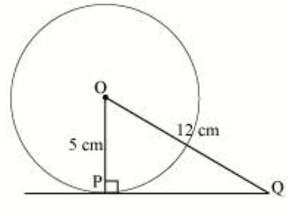
Here OP is perpendicular to PQ.
Hence, the triangle OPQ is a Right angled Triangle, and we can apply Pythagoras Theorem in it.
PQ = √(OQ2−OP2)
PQ = √(122 - 52)cm
PQ = √119 cm
Hence, Option D is the correct answer.
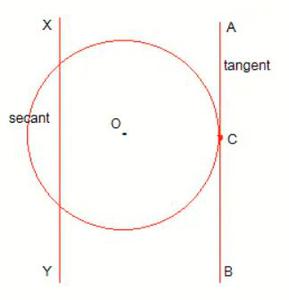
Question 4. Draw a circle and two lines parallel to a given line such that one is a tangent and the other, a secant to the circle.
Solution:
Here AB is the tangent to the circle at point C and XY is the secant to the circle. Also, both lines are parallel.
Conclusion
Understanding circles and their properties is essential for the solving the various geometric problems and proofs. Exercise 10.1 in Chapter 10 provides students with the practice in applying fundamental concepts related to the circles such as the radius diameter and various theorems. Mastery of these concepts not only enhances geometric problem-solving skills but also lays the groundwork for the more advanced studies in mathematics.
