
Question 1. Find the distance between the following pair of points:
(i) (-6, 7) and (-1,-5)
(ii) (a + b, b + c) and (a - b, c - b)
(iii) (a sin a, -b cos a) and (-a cos a, b sin a)
(iv) (a, 0) and (0, b)
Solution:
(i) Given that P(-6, 7) and Q(-1, -5)
So, x1 = -6, y1 = 7
x2 = -1, y2 = -5
Now we find the distance between PQ:
PQ=\sqrt{(x_2-x_1)^2+(y_2-y_1)^2}\\ PQ=\sqrt{[-1-(-6)]^2+(-5-7)^2}\\ PQ=\sqrt{(-1+6)^2+(-5-7)^2}\\ PQ=\sqrt{(5)^2+(-12)^2}\\ PQ=\sqrt{25+144}\\ PQ=\sqrt{169}\\ PQ=13\\ (ii) Given that P(a + b, b + c) and Q(a - b, c - b)
So, x1 = a + b, y1 = b + c
x2 = a - b, y2 = c - b
Now we find the distance between PQ:
PQ=\sqrt{(x_2-x_1)^2+(y_2-y_1)^2}\\ PQ=\sqrt{[a-b-(a+b)]^2+(c-b-(b+c))^2}\\ PQ=\sqrt{(a-b-a-b)^2+(c-b-b-c)^2}\\ PQ=\sqrt{(-2b)^2+(-2b)^2}\\ PQ=\sqrt{4b^2+2b^2}\\ PQ=\sqrt{8b^2}\\ PQ=\sqrt{4*2b^2}\\ PQ=2\sqrt{2b} (iii) Given that P(a sin a,-b cos a) and Q(-a cos a, b sin a)
So, x1 = a sin a, y1 = -b cos a
x2 = a cos a, y2 = b sin a
Now we find the distance between PQ:
PQ=\sqrt{(x_2-x_1)^2+(y_2-y_1)^2}\\ PQ=\sqrt{(-a\cos a-a\sin a)^2+[-b\sin a-(-b\cos a)]^2}\\ PQ=\sqrt{(-a\cos a)^2+(-a\sin a)^2+2(a-\cos a)(-a\sin a)+(b\sin a)^2+(-b\cos a)^2-2(b\sin a)(-b\cos a)}\\ PQ=\sqrt{a^2cos^2a+a^2\sin^2a+2a^2\cos a\sin a+b^2\sin^2a+b^2\cos^2a+2b^2\sin a\cos a}\\ PQ=\sqrt{a^2(\cos^2a+\sin^2a)+2a^2\cos a\sin a+b^2(\sin^2a+\cos^2a)+2b^2\sin a\cos a}\\ PQ=\sqrt{a^2*1+2a^2\cos a\sin a+b^2*12b^2\sin a\cos a}\\ PQ=\sqrt{a^2+b^2+2a^2\cos a\sin a+2b^2\sin a\cos a}\\ PQ=\sqrt{(a^2+b^2)+2\cos a\sin a(a^2+b^2)}\\ PQ=\sqrt{(a^2+b^2)+(1+2\cos a\sin a)}\\ (iv) Given that P(a, 0) and Q(0, b)
So, x1 = a, y1 = 0
x2 = 0, y2 = b
Now we find the distance between PQ:
PQ=\sqrt{(x_2-x_1)^2+(y_2-y_1)^2}\\ PQ=\sqrt{(0-a)^2+(b-0)^2}\\ PQ=\sqrt{(-a)^2+(b)^2}\\ PQ=\sqrt{a^2+b^2}\\
Question 2. Find the value of a when the distance between the points (3, a) and (4, 1) is √10.
Solution:
Given that point P(3, a) and Q(4, 1) and the distance between them is √10
So, we have to find the value of a
So,
PQ=\sqrt{(x_2-x_1)^2+(y_2-y_1)^2}\\ \sqrt{10}=\sqrt{(4-3)^2+(1-a)^2}\\ \sqrt{10}=\sqrt{(1)^2(1-a)^2}\\ \sqrt{10}=\sqrt{1+1+a^2-2a}\\ \sqrt{10}=\sqrt{2+a^2-2a} Squaring on both sides we get
(√10)2 = (√{2 + a2 - 2a})2
10 = 2 + a2 - 2a
a2 - 2a + 2 - 10 = 0
a2 - 2a - 8 = 0
On Splitting the middle term we get
a2 - 4a + 2a - 8 = 0
a(a - 4) + 2(a - 4) = 0
(a - 4)(a + 2) = 0
a = 4, a = -2
Question 3. If the points (2, 1) and (1, 2) are equidistant from the point(x, y) show that x + 3y = 0.
Solution:
Given that P(2, 1) and Q(1, -2) and R(x, y)
Also, PR = QR
PR=\sqrt{(x-2)^2+(y-1)^2}\\ PR=\sqrt{x^2(2)^2-2xx*2+y^2+(1)^2-2*y*1}\\ PR=\sqrt{x^2+4-4x+y^2+1-2y}\\ PR=\sqrt{x^2+5-4x+y^2-2y}\\ QR=\sqrt{(x-1)^2+(y+2)^2}\\ PR=\sqrt{x^2+1-2x+y^2+4+4y}\\ PR=\sqrt{x^2+5-2x+y^2+4y}\\ PR=QR\\ \sqrt{x^2+5-4x+y^2-2y}=\sqrt{x^2+5-2x+y^2+4y} x2 + 5 - 4x + y2 - 2y = x2 + 5 - 2x + y2 + 4y
x2 + 5 - 4x + y2 - 2y = x2 + 5 - 2x + y2 + 4y
-4x + 2x - 2y - 4y = 0
-2x - 6y = 0
-2(x + 3y) = 0
x + 3y = 0/-2
x + 3y = 0
Hence Proved
Question 4. Find the values of x, y if the distance of the point(x, y) from(-3, 0) as well as from (3, 0) are 4.
Solution:
Given that P(x, y), Q(-3, 0) and R(3, 0).
Also, PQ = PR = 4
So,
PQ=\sqrt{(x+3)^2+(y-0)^2}\\ 4=\sqrt{x^2+9+6x+y^2} On squaring on both sides, we get
(4)2 = (√x2 + 9 + 6x + y2)2
16 = x2 + 9 + 6x + y2
x2 + y2 = 16 - 9 - 6x
x2 + y2 = 7 - 6x ........(1)
PR=(\sqrt{(x-3)^2+(y-0)^2})\\ 4=\sqrt{x^2+9-6x+y^2} On squaring on both sides, we get
(4)2 = (√x2 + 9 - 6x + y2)2
16 = x2 + 9 - 6x + y2
x2 + y2 = 16 - 9 + 6x
x2 + y2 = 7 + 6x ........(2)
From equation (1) and (2)
7 - 6x = 7 + 6x
7 - 7 = 6x + 6x
0 = 12x
x = 12
On substituting the value of x = 0 in eq(2)
x2 + y2 = 7 + 6x
0 + y2 = 7 + 6 * 0
y2 = 7
y = ±√7
Question 5. The length of a line segment is of 10 units and the coordinates of one end-point are (2, -3). If the abscissa of the other end is 10, find the coordinate of the other end.
Solution:
Let the ordinate of other end by y, then The distance between (2, -3) and (10, y) is
=\sqrt{(x_2-x_1)^2+(y_2-y_1)^2}\\ =\sqrt{(10-2)^2+(y+3)^2} = 10Squaring on both sides we get
(8)2 + (y + 3)2 = 100
64 + y2 + 6y + 9 = 100
y2 + 6y + 73 - 100 = 0
y2 + 6y - 27 = 0
y2 + 9y - 3y - 27 = 0
y(y + 9) - 3(y + 9) = 0
(y + 9)(y - 3) = 0
When y + 9 = 0, then y = -9
or when y - 3 = 0, then y = 3
So, the coordinates will be -9 or 3
Question 6. Show that the points (-4, -1), (-2, -4), (4, 0), and (2, 3) are the vertices points of a rectangle.
Solution:
Let us considered ABCD is a rectangle whose vertices are
A(-4, -1), B(-2, -4), C(4, 0) and D(2, 3)
Now
AB =
\sqrt{(x_2-x_1)^2+(y_2-y_1)^2} =
\sqrt{(-2+4)^2+(-4+1)^2}\\ =\sqrt{(2)^2+(-3)^2}=\sqrt{4+9}=\sqrt{13} Similarly, CD =√13
AD = √52
and BC = √52
AC = √65 and BD = √65
Here, AB = CD and AD = BC
and diagonals AC = BD
So, ABCD is a rectangle
Question 7. Show that the points A (1, -2), B (3, 6), C (5, 10), and D (3, 2) are the vertices of a parallelogram.
Solution:
Given points are A (1, -2), B (3, 6), C (5, 10) and D (3, 2)
Now AB =
\sqrt{(x_2-x_1)^2+(y_2-y_1)^2}\\ =\sqrt{(3-1)^2+(6+2)^2}=\sqrt{(2)^2+(8)^2}\\ =\sqrt{4+64}=\sqrt{68} Similarly BC =
\sqrt{(x_2-x_1)^2+(y_2-y_1)^2}\\ =\sqrt{(2)^2+(4)^2}=\sqrt{20}\\ CD=\sqrt{(3-5)^2+(2-10)^2}\\ =\sqrt{(-2)^2+(-8)^2}=\sqrt{4+64}=\sqrt{68} \\DA=\sqrt{(3-1)^2+(2+2)^2}\\ \sqrt{(2)^2+(4)^2}=\sqrt{20} So, from the above we conclude that AB = CD and AD = BC
Hence, ABCD is a parallelogram.
Question 8. Prove that the points A (1, 7), B (4, 2), C (-1, -1), and D (-4, 4) are the vertices of a square.
Solution:
Given points are A (1, 7), B (4, 2), C (-1,-1), D (-4, 4)
If these are the vertices of a square, then its diagonals and sides are equal
AC =
\sqrt{(1+1)^2+(7+1)^2}=\sqrt{2^2+8^2}\\ =\sqrt{4+64}=\sqrt{68}\\ BD=\sqrt{(4+4)^2+(2-4)^2}=\sqrt{(8)^2+(-2)^2}\\ =\sqrt{64+4}=68 So, AC = BD
Now AB=
\sqrt{(1-4)^2+(7-2)^2}\\ =\sqrt{(-3)^2+(5)^2}=\sqrt{9+25}=\sqrt{34}\\ BC=\sqrt{(4+1)^2+(2+1)^2}=\sqrt{(5)^2+(3)^2}\\ =\sqrt{25+9}=\sqrt{34}\\ CD=\sqrt{(-1+4)^2+(-1+4)^2}\\ =\sqrt{(3)^2+(-5)^2}=\sqrt{9+25}=\sqrt{34}\\DA=\sqrt{(1+4)^2+(2-4)^2}\\ =\sqrt{(5)^2+(3)^2}=\sqrt{25+9}=\sqrt{34} So, AB = BC = CD = DA and diagonal AC = BD
Hence, the given figure ABCD is a square.
Question 9.Prove that the points (3, 0), (6, 4), and (-1, 3) are the vertices of a right-angled isosceles triangle.
Solution:
Given points are A(3, 0), B(6, 4), and C(-1, 3)
Now we find the length of AB =
\sqrt{(x_2-x_1)^2+(y_2-y_1)^2}\\ =\sqrt{(6-3)^2+(4-0)^2}=\sqrt{(3)^(4)^2}\\ \sqrt{25}=5 Similarly, BC=
\sqrt{(-1-6)^2(3-4)^2}=\sqrt{(7)^2(-1)^2}\\ \sqrt{49+1}=\sqrt{50}\\ CA=\sqrt{(3+1)^2(0-3)^2}=\sqrt{(4)^2(3)^2}\\ =\sqrt{16+9}=\sqrt{25}=5 From the above we conclude that AB = CA and BC is the longest side
Now we verify the Pythagoras theorem,
So, BC2 = AB2 + CA2
BC2 = (5)2 + (5)2
BC2 = 25 + 25
50 = 50
So, AB2 + CA2 = BC2
Hence, the given triangle ABC is an isosceles right triangle.
Question 10. Prove that (2, -2), (-2, 1), and (5, 2) are the vertices of a right-angled triangle. Find the area of the triangle and the length of the hypotenuse.
Solution:
Given points are A(2, -2), B(-2, 1) and C(5, 2)
Now we find the length of
AB=\sqrt{(x_2-x_1)^2+(y_2-y_1)^2}\\ =\sqrt{(-2-2)^2+(1+2)^2}=(-4)^2+(3)^2\\ \sqrt{25}=5\\ BC=\sqrt{(5+2)^2+(2-1)^2}\\ =\sqrt{(7)^2+(1)^2}=\sqrt{49+1}=\sqrt{50}\\ CA=\sqrt{(3+1)^2+(0-3)^2}=\sqrt{(4)^2+(-3)^2}\\ \sqrt{16+9}=\sqrt{25}=5 We see that AB = CA and BC is the longest side.
Now we verify the Pythagoras theorem,
So, BC2 = AB2 + CA2
BC2 = (5)2 + (5)2
BC2 = 25 + 25
50 = 50
So, AB2 + CA2 = BC2
So, the given triangle ABC is a right-angled triangle
Now we find the area of triangle ABC = 1/2 × Base × height
= 1/2 × 5 × 5
= 25/2 sq.units
And the length of the hypotenuse BC is √50.
Question 11. Prove that the points (2a, 4a), (2a, 6a), and (2a + √3 a, 5a) are the vertices of an equilateral triangle.
Solution:
Given points are A(2a, 4a), B(2a, 6a) and C(2a + √3 a, 5a)
Now we find the length of
AB=\sqrt{(x_2-x_1)^2+)(y_2-y_1)^2}\\ =\sqrt{(2a-2a)^2+)(6a-4a)^2}\\ \sqrt{0+4a^2}=\sqrt{4a^2}=2a\\ BC=\sqrt{(2a+\sqrt{3a}-2a)^2+(5a-6a)^2}\\ =\sqrt{3a^2+a^2}\\ =\sqrt{4a^2}=2a \\ CA=\sqrt{(2a-2a-\sqrt{3a})^2(4a-5a)^2}\\ \sqrt{3a^2+a^2}\\ =\sqrt{4a^2}=2a So, we conclude that the length of side AB = BC = CA = 2a
Hence, ∆ABC is equilateral triangle.
Question 12. Prove that the points (2, 3), (-4, -6), and (1, 32) do not form a triangle.
Given points are A(2, 3), B(-4, -6), and C(1, 32)
Now we find the length of AB =
\sqrt{(x_2-x_1)^2+)(y_2-y_1)^2}\\ =\sqrt{(-4-2)^2+(-6-3)^2}\\ \sqrt{36+81}=\sqrt{117}\\ Similarly, for BC = √89 and CA = √2
As we know that the sum of two sides of triangle are always greater than the third side
So, BC + CA= √89 + √2 not greater than AB
Hence, the given points do not form a triangle.
Question 13. The points A (2, 9), B (a, 5), and C (5, 5) are the vertices of a triangle ABC right-angled at B. Find the values of a and hence the area of ∆ABC.
Solution:
Given that, the points A (2, 9), B (a, 5) and C (5, 5) are the vertices of ∆ABC right-angled at B.
By Pythagoras theorem,
AC2 = AB2 + BC2 ………(i)
Now, by distance formula,
We find the length of AB =
\sqrt{(a-2)^2+(5-9)^2} =
\sqrt{a^2+4-4a+16}=\sqrt{a^2-4a+20}\\ BC=\sqrt{(5-a)^2+(5-5)^2}\\ =\sqrt{(5-a)^2+0}=5-a\\ AC=\sqrt{(2-5)^2+(9-5)^2}\\ =\sqrt{(-3)^2+(4)^2}=\sqrt{9+16}=\sqrt{25}=5 ]Now put the values of AB, BC and AC in equation(i), we get
(5)^2=\sqrt{(a^2-4a+20)^2+(5-a)^2} 25 = a2 - 4a + 20 + 25 + a2 - 10a
2a2 - 14a + 20 = 0
a2 - 7a + 10 = 0
a2 - 2a - 5a + 10 = 0
a(a - 2) - 5(a - 2) = 0
(a - 5)(a - 5) = 0
a = 2, 5
Here, a ≠ 5, since at a = 5, the length of BC = 0. It is not possible because
the sides AB,BC and CA from a right angled triangle.
So, a = 2
Now, the coordinates are A (2, 9), B (2, 5) and C (5, 5)
Now we find the area of ∆ABC =
\frac{1}{2}[x_1(y_2-y_3)+x_2(y_3-y_1)+x_3(y_1-y_2)] = 1/2[2(5 - 5) + 2(5 - 9) + 5(9 - 5)]
= 1/2(0 - 8 + 20)
= 1/2 × 12
= 6
Hence, the required area of ∆ABC is 6sq. units.
Question 14. Show that the quadrilateral whose vertices are (2, -1), (3, 4), (-2, 3), and (-3, -2) is a rhombus.
Solution:
Given points are A(2, -1), B(3, 4), C(-2, 3), and D(-3, -2)
Now we find the length of sides AB, CD, DA, BD and diagonals AC, BD
AB=\sqrt{(x_2-x_1)^2+(y_2-y_1)^2}\\ =\sqrt{(3-2)^2+(4+1)^2}=\sqrt{(1)^2+(5)^2}=\sqrt{1+25}=\sqrt{26}\\ BC=\sqrt{(-2-3)^2+(3-4)^2}\\ \sqrt{(-5)^2+(-1)^2}=\sqrt{25+1}=\sqrt{26}\\ CD=\sqrt{(-3+2)^2+(-2-3)^2}=\sqrt{(-1)^2+(-5)^2}=\sqrt{1+25}=\sqrt{26}\\DA=\sqrt{(2+3)^2+(-1+2)^2}\\ =\sqrt{(5)^2+(1)^2}=\sqrt{25+1}=\sqrt{26}\\AC=\sqrt{(-2-2)^2+(3+1)^2}\\ =\sqrt{(-4)^2+(4)^2}=\sqrt{16+16}=\sqrt{32} \\BD=\sqrt{(-3-3)^2+(-2-4)^2}\\ =\sqrt{(-6)^2+(-6)^2}=\sqrt{36+36}=\sqrt{72} Now we conclude that AB = BC = CD = DA = √26 and diagonal AC ≠ BD
Hence, ABCD is a rhombus
Question 15. Two vertices of an isosceles triangle are (2, 0) and (2, 5). Find the third vertex if the length of the equal sides is 3.
Solution:
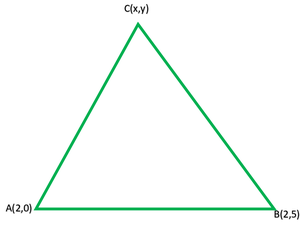
Let us considered ABC is an isosceles triangle whose two vertices are A (2, 0) and B (2, 5)
So, the co-ordinates of third vertex C be (x, y)
And also given that AC = BC = 3
Now
AC=\sqrt{(x-2)^2+(y-0)^2}\\ =\sqrt{(x-2)^2+y^2}\\ \sqrt{(x-2)^2+y^2}=3 On squaring both sides, we get
(x - 2)2 + y2 = 9
x2 - 4x + 4 + y2 = 9
x2 + y2 - 4x = 5 .......(i)
Similarly,
BC=\sqrt{(x-5)^2+(y-5)^2}\\ \sqrt{(x-2)^2+(y-5)^2}=3 On squaring both sides, we get
(x - 2)2 + (y - 5)2 = 9
x2 - 4x + 4 + y2 - 10y + 25 = 9
x2 + y2 - 4x - 10y = -20 .......(ii)
Now on subtracting eq(ii) from (i), we get
10y = 25
y = 25/10 = 5/2
On substituting the value of y in eq(i)
x2 - 4x + (5/2)2 = 5
x2 - 4x + 25/4 - 5 = 0
4x2 - 16x + 25 - 20 = 0
4x2 - 16x + 5 + 5 = 0
Here a = 4, b = -16, c = 5
x=\frac{-b±\sqrt{b^2-4ac}}{2a}\\ \frac{-(-16)±\sqrt{(-16)^2-4\times 4\times 5}}{2\times 4}\\ =\frac{16±\sqrt{256-80}}{8}=\frac{16±\sqrt{179}}{8}\\ =\frac{16±\sqrt{16\times 11}}{8}\\ =\frac{16±4\sqrt{11}}{8}=\frac{4±\sqrt{11}}{2}=2±\frac{\sqrt{11}}{2} So, the co-ordinate of C will be (2 + √11/2, 5/2) or (2 - √11/2, 5/2)
Question 16. Which point on x-axis is equidistant from (5, 9) and (-4, 6)?
Solution:
Let co-ordinates of two points are A (5, 9), B (-4, 6)
The required point is on x-axis
Its ordinates or y-co-ordinates will be 0
Let the co-ordinates of the point C be (x, 0)
AC = CB
Now
AC=\sqrt{(x-5)^2+(0-9)^2}=\sqrt{(x-5)^2+81}\\ and\space CB=\sqrt{(x+4)^2+(0-6)^2}=\sqrt{(x+4)^2+36}
\sqrt{(x-5)^2+81}=\sqrt{(x+4)^2+36} Squaring both sides, we get
(x - 5)2 + 81 = (x + 4)2 + 36
x2 - 10x + 25 + 81 = x2 + 8x + 16 + 36 - 10x - 8x
-18 = 52 - 106
-18x = -54
x = -54/18
x = 3
Hence, the required point is (3, 0)
Question 17. Prove that the point (-2, 5), (0, 1) and (2, -3) are collinear.
Solution:
Given points are A(-2, 5), B(0, 1) and C(2, -3)
Now we find the length of AB, BC, and CA
AB=\sqrt{(x_2-x_1)^2+(y_2-y_1)^2}\\ =\sqrt{(0+2)^2+(1-5)^2}\\ =\sqrt{(2)^2+(-4)^2}=\sqrt{4+16}\\ \sqrt{20}=\sqrt{4*5}=2\sqrt{5}\\BC=\sqrt{(2-0)^2+(-3-1)^2}\\ =\sqrt{(2)^2+(-4)^2}\\ =\sqrt{4+16}=\sqrt{20}=\sqrt{4*5}=2\sqrt{5}\\ CA=\sqrt{(-2-2)^2+(5+3)^2}\\ =\sqrt{(-4)^2+(8)^2}=\sqrt{16+64}\\ \sqrt{80}=\sqrt{16*5}=4\sqrt{5} Now AB + BC = 2√5 + 2√5
And CA = 4√5
AB + BC = CA
Hence, A, B and C are collinear
Question 18. The coordinates of the point P are (-3, 2). Find the coordinates of the point Q which lies on the line joining P and origin such that OP = OQ.
Solution:
Given that the co-ordinates of P are (-3, 2) and origin O are (0, 0)
Let us assume that the co-ordinates of Q be (x, y)
Here, O is the mid-point of line PQ
so by using mid point formula we get,
(x - 3)/2 = 0 and (y + 3)/2 = 0
x = 3, y = -2
Hence, the coordinates of the point Q are (3, -2)
Question 19. Which point on y-axis is equidistant from (2, 3) and (-4, 1)?
Solution:
The required point lies on y-axis
Its abscissa will be zero
So, let us assume that the point be C (0, y) and A (2, 3), B (-4, 1)
Now, we find the length of AC and BC
AC=\sqrt{(x_2-x_1)^2+(y_2-y_1)^2}\\ =\sqrt{(0-2)^2+(y-3)^2}\\ =\sqrt{(-2)^2+(y-3)^2}=\sqrt{4+(y-3)^2}\\BC=\sqrt{(0-4)^2+(y-1)^2}\\ =\sqrt{16+(y-1)^2}\\ Here, we conclude that AC = BC
So,
\sqrt{4+(y-3)^2}=\sqrt{16+(y-1)^2} On squaring both sides, we get
4 + (y - 3)2 = 16 + (y - 1)2
4 + y2 + 9 - 6y = 16 + y2 + 1 - 2y
-6y + 2y = 17 - 13
-4y = 4 = y = 4/-4 = 1
Hence, the coordinates of the required point is (0,-1)
