
De Morgan’s Laws describe how complements interact with union and intersection in set theory and with AND and OR operations in Boolean algebra and logic.
In set theory, there are two De Morgan's Laws:
- First De Morgan's Law
- Second De Morgan's Law
First De Morgan's Law (De Morgan's Law of Union)
First law states:
The complement of the union of two sets is equal to the intersection of the complements of each set.
Let A and B be two sets; then mathematically, First De Morgan's Law is given as:
(A ∪ B)' = A' ∩ B'
where,
- U represents the Union operation between sets,
- ∩ represents the intersection operation between sets, and
- ' represents the complement operation on a set.
Proof using Algebra of Sets
We need to prove, (A ∪ B)' = A' ∩ B'
Let X = (A ∪ B)' and Y = A' ∩ B'
Let p be any element of X, then p ∈ X ⇒ p ∈ (A ∪ B)'
⇒ p ∉ (A ∪ B)
⇒ p ∉ A or p ∉ B
⇒ p ∈ A' and p ∈ B'
⇒ p ∈ A' ∩ B'
⇒ p ∈ Y∴ X ⊂ Y . . . (i)
Again, let q be any element of Y, then q ∈ Y ⇒ q ∈ A' ∩ B'
⇒ q ∈ A' and q ∈ B'
⇒ q ∉ A and q ∉ B
⇒ q ∉ (A ∪ B)
⇒ q ∈ (A ∪ B)'
⇒ q ∈ X∴ Y ⊂ X . . . (ii)
From (i) and (ii) X = Y
(A ∪ B)' = A' ∩ B'
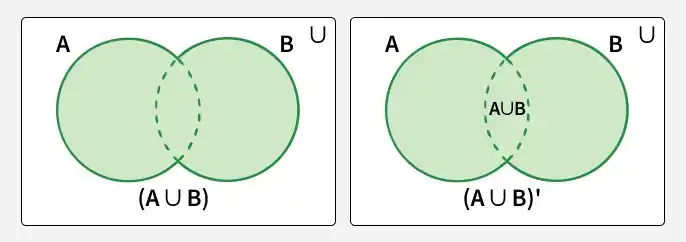
Proof using a Venn Diagram
Venn Diagram for (A ∪ B)'
Venn Diagram for A' ∩ B'
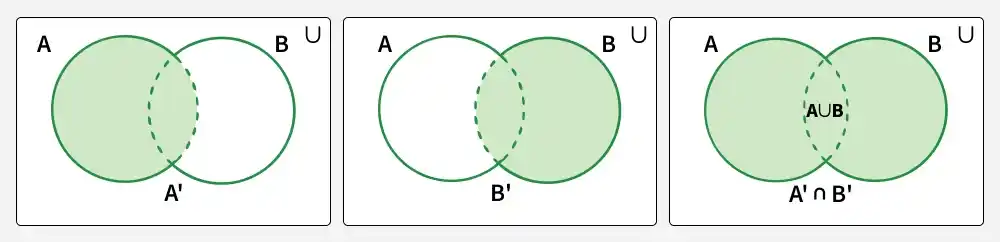
From both Diagrams, we can clearly say,
(A ∪ B)' = A' ∩ B'
That is the First De Morgan's Law.
Second De Morgan's Law (De Morgan's Law of Intersection)
Second law states:
The complement of intersection of two sets is equal to the union of the complements of each set
Let A and B be two sets, then mathematically First De Morgan's Law is given as:
(A ∩ B)' = A' ∪ B'
where
- U represents the Union operation between sets,
- ∩ represents the intersection operation between sets, and
- ' represents complement operation on a set.
Proof using Algebra of Sets
Second De Morgan's law: (A ∩ B)' = A' ∪ B'
Let X = (A ∩ B)' and Y = A' ∪ B'
Let p be any element of X, then p ∈ X ⇒ p ∈ (A ∩ B)'
⇒ p ∉ (A ∩ B)
⇒ p ∉ A or p ∉ B
⇒ p ∈ A' or p ∈ B'
⇒ p ∈ A' ∪ B'
⇒ p ∈ Y∴ X ⊂ Y --------------(i)
Again, let q be any element of Y, then q ∈ Y ⇒ q ∈ A' ∪ B'
⇒ q ∈ A' or q ∈ B'
⇒ q ∉ A and q ∉ B
⇒ q ∉ (A ∩ B)
⇒ q ∈ (A ∩ B)'
⇒ q ∈ X∴ Y ⊂ X --------------(ii)
From (i) and (ii) X = Y
(A ∩ B)' = A' ∪ B'
Proof using Venn Diagram
Venn Diagram for (A ∩ B)'
Venn diagram for A' ∪ B'
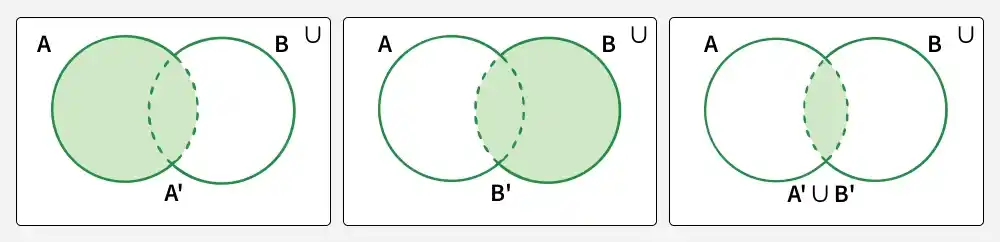
From both diagrams, we can clearly say
(A ∩ B)' = A' ∪ B'
That is the Second De Morgan's Law.
De Morgan's Law in Boolean Algebra
De Morgan's Law Boolean Algebra defines the relation between the OR, AND, and the complements of variables, and is given for both the complement of AND and OR of two values.
First De Morgan's Law in Boolean Algebra
The complement of OR of two or more variables is equal to the AND of the complement of each variable
Let A and B be two variables, then mathematically First De Morgan's Law is given as:
(A + B)' = A' . B'
where
- + represents the OR operator between variables,
- . represents AND operator between variables, and
- ' represents complement operation on the variable.
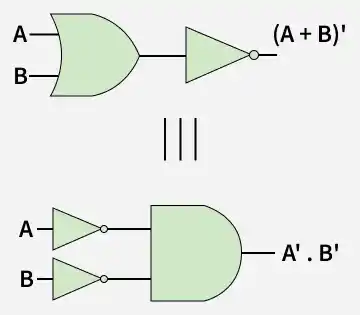
The truth table for first De Morgan's Law is given as follows:
A | B | A + B | (A + B)' | A' | B' | A'. B' |
|---|---|---|---|---|---|---|
0 | 0 | 0 | 1 | 1 | 1 | 1 |
0 | 1 | 1 | 0 | 1 | 0 | 0 |
1 | 0 | 1 | 0 | 0 | 1 | 0 |
1 | 1 | 1 | 0 | 0 | 0 | 0 |
Second De Morgan's Law in Boolean Algebra
The complement of AND of two or more variables is equal to the OR of the complement of each variable
Let A and B be two variables, then mathematically Second De Morgan's Law is given as:
(A . B)' = A' + B'
Where
- + represents the OR operator between variables,
- . represents AND operator between variables, and
- ' represents complement operation on variable.
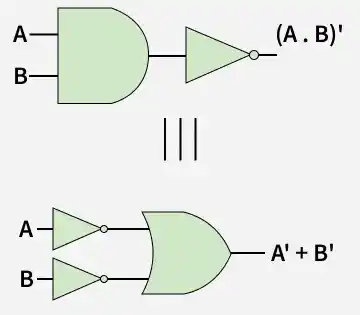
The truth table for the second De Morgan's Law is given as follows:
A | B | A . B | (A. B)' | A' | B' | A' + B' |
|---|---|---|---|---|---|---|
0 | 0 | 0 | 1 | 1 | 1 | 1 |
0 | 1 | 0 | 1 | 1 | 0 | 1 |
1 | 0 | 0 | 1 | 0 | 1 | 1 |
1 | 1 | 1 | 0 | 0 | 0 | 0 |
Solved Question
Question 1: Given that U = {2, 3, 7, 8, 9}, A = {2, 7} and B = {2, 3, 9}. Prove De Morgan's Second Law.
U = {2, 3, 7, 8, 9}, A = {2, 7} and B = {2, 3, 9}
To Prove: (A ∩ B)' = A' ∪ B'
(A ∩ B) = {2}
(A ∩ B)' = {3, 7, 8, 9}
A' = U - A = {2, 3, 7, 8, 9} - {2, 7}
A' = {3, 8, 9}
B' = U - B = {2, 3, 7, 8, 9} - {2, 3, 9}
B' = {7, 8}
A' ∪ B' = {3, 8, 9} ∪ {7, 8}
A' ∪ B' = {3, 7, 8, 9}Hence, (A ∩ B)' = A' ∪ B'
Question 2: Given that U = {1, 4, 6, 8, 9}, A = {1, 9} and B = {4, 6, 9}. Prove De Morgan's First Law.
U = {1, 4, 6, 8, 9}, A = {1, 9} and B = {4, 6, 9}
To Prove: (A ∪ B)' = A' ∩ B'
(A ∪ B) = {1, 4, 6, 9}
(A ∪ B)' = {8}
A' = U - A = {1, 4, 6, 8, 9} - {1, 9}
A' = {4, 6, 8}
B' = U - B = {1, 4, 6, 8, 9} - {4, 6, 9}
B' = {1, 8}
A' ∩ B' = {4, 6, 8} ∩ {1, 8}
A' ∩ B' = {8}
Hence, (A ∪ B)' = A' ∩ B'
Question 3: Simplify the Boolean Expression: Y = [(A + B).C]'
Y = [(A + B).C]'
Applying De Morgan's law (A . B)' = A' + B'
Y = (A + B)' + C'
Applying De Morgan's law (A + B)' = A'. B'
Y = A'. B' + C'
Question 4: Simplify the Boolean Expression: X = [(A + B)' + C]'
X = [(A + B)' + C]'
Applying De Morgan's law (A + B)' = A'. B'
X = [(A + B)']' . C'
X = (A + B). C'
Practice Problems
Q1. Let U = {1, 2, 3, 4, 5, 6, 7}, A = {1, 2, 3, 5}, B = {2, 4, 6}. Verify (A∪B)′ = A′∩B′
Q2. Let U = {1, 2, 3, 4, 5, 6, 7, 8}, A = {1, 3, 5, 7}, B = {2, 3, 6, 7}. Verify (A∩B)′ = A′∪B′
Q3. Simplify the Boolean expression using De Morgan’s Law: X = (A⋅B)′.
Q4. Simplify using De Morgan’s Law: Y = [(A + B)⋅(C + D)]′.
Q5. Using De Morgan’s Law, write the negation of the statement “It is sunny and windy” symbolically and in words.
