
Using logarithmic properties and the chain rule helps simplify and evaluate complex expressions that cannot be solved directly. This approach is especially useful for exponential functions and expressions of the form f(x)g(x).
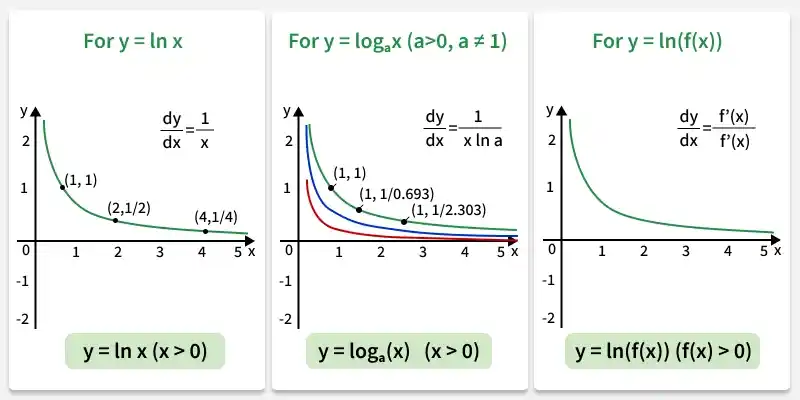
There are three formulas for the derivative of the logarithmic functions.
Derivative of ln x
\frac{d}{dx}\left(\ln x\right) = \frac{1}{x} Where, x > 0
Derivative of logax
\frac{d}{dx}\left(\log_a x\right) = \frac{1}{x \ln a} Where, a ≠ 1
Derivative of ln f(x)
\frac{d}{dx} \ln f(x) = \frac{f'(x)}{f(x)} Where,
- f(x) is any function of x, and
- f'(x) is derivative of function of x.
Proof
Using the first principle of derivative
f'(x) = \lim_{h \to 0} \left[ \frac{f(x+h) - f(x)}{(x+h) - x} \right] Here, f(x) = ln x
= \lim_{h \to 0} \left[ \frac{\ln(x+h) - \ln(x)}{h} \right]
= \lim_{h \to 0} \left[ \frac{\ln\left(\frac{x+h}{x}\right)}{h} \right]
= \lim_{h \to 0}\left[\frac{\ln\left(1 + \frac{h}{x}\right)}{h} \right] Now, putting
\frac{h}{x} = \frac{1}{n} and as limit h→0 then,\frac{1}{n} → ∞
\lim_{n \to \infty} \left( \frac{n}{x} \right)\left[\ln\left(1 + \frac{1}{n}\right)\right]
\lim_{n \to \infty} \frac{1}{x}\,\ln\left(1 + \frac{1}{n}\right)^{n} The value of limn→∞ ln(1 + (
\frac{1}{n} ))n = e= (
\frac{1}{x} ) ln e . . . (1)=
\frac{1}{x} For
\frac{d}{dx}\left(\log_a x\right) = \frac{1}{x \ln a} putting in 1
\frac{d}{dx}\left(\log_a x\right) = \frac{1}{x}\log_a e
\frac{d}{dx}\left(\log_a x\right) = \frac{1}{x}\,\frac{\ln e}{\ln a} So,
\frac{d}{dx}\left(\log_a x\right) = \frac{1}{x \ln a}
Solved Examples
Example 1: Evaluate:
(i) Derivative of log 2
(ii) Derivative of log 3
(iii) Derivative of log 5
(iv) Derivative of log 10
As log 2, log 3, log 5 and log 10 are all constant values, and derivative of any constant is 0.
Thus, Derivative of log 2, log 3, log 5 and log 10 are all equal to 0.
Example 2: Find the following derivatives.
(i) Derivative of log 2x
(ii) Derivative of log10x
(iii) Derivative of log y
(i) Derivative of log2x
⇒ (d / dx) [log 2x] = (d / dx) [log 2x](d / dx) [2x]
⇒ (d / dx) [log 2x] = 2 / (2x)
⇒ (d / dx) [log 2x] = 1 / x
(ii) Derivative of log10x
⇒ (d / dx) [log10x] = 1 / [x ln 10]
(iii) Derivative of log y
⇒ (d / dx) [log y] = [1 / y](dy / dx)
Example 3: Evaluate: ln[(x2sinx) / (2x + 1)]
Let f(x) = ln[(x2sinx) / (2x + 1)]
By using the properties of ln
f(x) = 2lnx + ln(sinx) - ln(2x +1)
Now, differentiating,
f'(x) = 2\frac{d}{dx}\ln x + \frac{d}{dx}\left[\ln(\sin x)\right] - \frac{d}{dx}\left[\ln(2x+1)\right]
= \frac{2}{x} + \frac{\cos x}{\sin x} - \frac{2}{2x+1}
f'(x) = \frac{2}{x} + \cot x - \frac{2}{2x+1}
Example 4: Evaluate the derivative: y = (2x4 + 1)tanx.
Taking logarithm both sides
ln y = ln (2x4 + 1)tanx
⇒ ln y = tanx [ln (2x4 + 1)]
Differentiating
(d / dx)ln y = (d / dx)[tanx [ln (2x4 + 1)]]
Applying formula and product rule
(1 / y) (dy / dx) = [(d / dx)tanx {ln (2x4 + 1)}] + [tan x (d / dx){ln (2x4 + 1)}]
⇒ (1 / y) (dy / dx) = [sec2x ln (2x4 + 1)] + [tan x {8x3 / (2x4 + 1)}]
⇒ (dy / dx) = (2x4 + 1)tanx[sec2x ln (2x4 + 1) + tan x {8x3 / (2x4 + 1)}]
Example 5: Find the derivative y = xx.
y = xx
Taking logarithm both sides
ln y = ln xx
By logarithm properties
ln y = x lnx
Differentiating
(d /dx) ln y = (d /dx) [x ln x]
Applying product rule
(1 /y) (dy /dx) = (d /dx) (x) (ln x) + x(d /dx)( ln x)
⇒ (1 /y) (dy /dx) = ln x + x( 1/x)
⇒ (dy /dx) = y(ln x + 1)
⇒ (dy /dx) = xx(ln x + 1)
Practice Problems
Problem 1: Calculate the derivative of g(x) = 3ln(2x).
Problem 2: Determine the derivative of h(x) = ln(5x2).
Problem 3: Find the derivative of p(x) = ln(4x3 + 2x).
Problem 4: Calculate the derivative of q(x) = ln(1/x).
Problem 5: Determine the derivative of r(x) = ln(3x2 - 7x + 1).
Problem 6: Find the derivative of v(x) = ln(2x3 - 3x2 + 5x - 7).dx[1/x] = -1/x2
