
Free and bound variables are types of variables in mathematics that are used in fields like mathematics, logic, and computer science.
- A free variable is one that is not limited by any quantifiers within a given expression. For example, in the mathematical expression x + y, both x and y are free variables because they can take any value independently.
- Bound variable is one that is restricted by a quantifier such as "for all" (∀) or "there exists" (∃). For example, in the expression ∀ x(x + 1), the variable x is bound by the quantifier ∀, meaning x must satisfy the condition set by the quantifier.
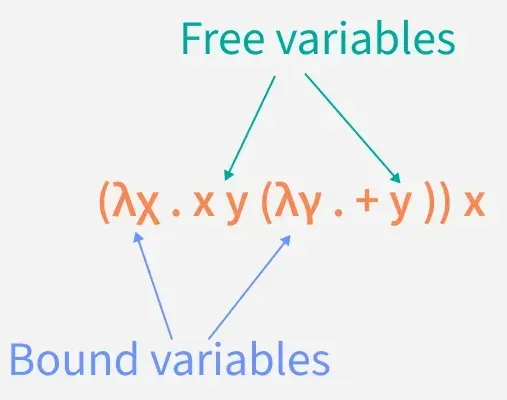
Free Variable
A free variable is a variable in a mathematical expression or equation that is not bound by a quantifier or not within the scope of a definition.
Free variables can take any value within their domain and are not tied to a specific value or condition within the expression. They contrast with bound variables, which are constrained by quantifiers like ∀ (for all) or ∃ (there exists) in logical expressions or by summation and integration limits in calculus.
Examples of Free Variables
Some examples of free variables are:
- Logical Expression: In the logical expression ∀x (x + y = z), x is a bound variable because it is under the scope of the universal quantifier ∀x. Variables y and z are free because they are not limited by any quantifier.
- Function Definition: Consider the function f(x) = x2 + c. Here, x is a bound variable because it is the input to the function. The variable c is free because it can be any constant value not specified within the function's definition.
- Equation: In the equation 3x + 4 = y, x and y are free variables as there are no constraints defining their specific values within the equation itself.
Bound Variable
A bound variable is a variable that is quantified or otherwise constrained within a mathematical expression, logical formula, or integral.
Bound variables are restricted to specific values or conditions imposed by quantifiers, summation, or integration operators. They contrast with free variables, which are not constrained and can take any value within their domain.
Examples of Bound Variables
Some common examples of bound variables are:
- Logical Expression: In the logical expression ∀x (x + y = z), x is a bound variable because it is quantified by the universal quantifier ∀. The variables y and z are free variables because they are not bound by any quantifier.
- Summation: In the summation ∑ni=1i, the variable i is bound by the summation operator ∑ and the limits 1 to n. The variable iii cannot take any value outside this range and is bound within the context of this summation.
- Integration: In the integral ∫21 x2 dx, the variable x is bound by the integration operator ∫ and the limits 0 and 1. The variable x is confined to this interval and cannot take values outside of it within the context of this integral.
- Function Definition: In the function definition f(x) = x2 + c, the variable x is bound because it is the argument of the function f. The variable c is free because it is not specified within the function's definition and can take any constant value.
Free Variables vs Bound Variables
The table below highlights the key differences between free variables and bound variables in logic.
| Free Variable | Bound Variable |
|---|---|
| A variable not constrained by a quantifier or operator. | A variable that is constrained by a quantifier or operator. |
| It can take any value within its domain. | Limited to specific values or conditions defined by the context. |
| In ∀x (x + y = z), y and z are free. | In ∀x (x + y = z), x is bound by ∀. |
| Not applicable as free variables are not part of the summation limits. | In ∑ni=1i, i is bound by the summation limits 1 to n. |
| Not applicable as free variables are not part of the integration limits. | In ∫21 x2 dx, x is bound by the integration limits 0 and 1. |
| In f(x) = x2 + c, c is free. | In f(x) = x2 +c, x is bound as it is the argument of the function. |
| Represents parameters that can be manipulated or solved for. | Represents variables within the scope of operations like summation, integration, or quantification. |
| More flexible, as they can be any value within their domain. | Less flexible, as their values are constrained by the expression's context. |
| Crucial for forming general expressions and broad applicability. | Essential for defining the limits and conditions of mathematical and logical operations. |
Importance in Computer Science
- In programming: Bound variables appear in loops, function parameters, or lambda expressions; free variables are those accessed from outside the function’s scope.
- In formal logic & proofs: Distinguishing them is crucial for substitution, scope, and avoiding mistakes like variable capture.
- In lambda calculus: This distinction determines whether a variable can be replaced during function application.
