
Geometric progression (GP) is a sequence of numbers in which each term is obtained by multiplying the previous term by a fixed non-zero number called the common ratio (r).
Examples: 2, 4, 8, 16, 32, ... or 81, 27, 9, 3, 1, ...
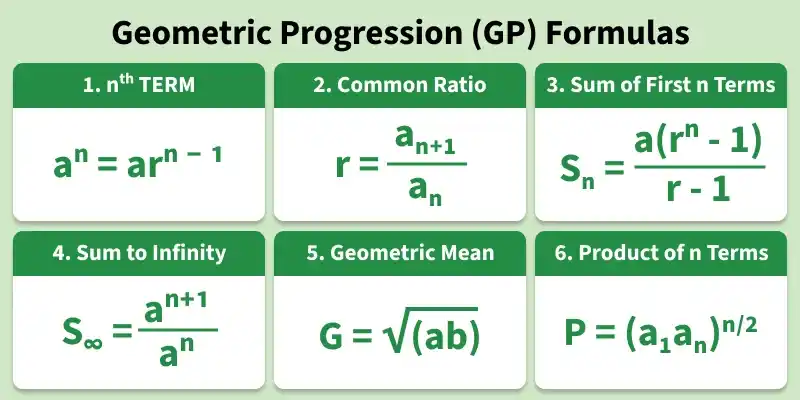
1. nth Term of a Geometric Sequence
The formula to find the nth term ( an ) of a geometric sequence is:
an = a · rn - 1
- an = nth term of the sequence
- a1 = first term of the sequence
- r = common ratio
- n = term number
2. Common Ratio Formula
If you know two consecutive terms an and an+1 of a geometric sequence, the common ratio (r) can be found using:
r = \frac{a_{n+1}}{a_n}
3. Sum of the First n Terms of a Geometric Sequence (Finite Geometric Series)
The to find the sum ( Sn ) of the first 'n' terms of the geometric sequence a, ar, ar2 , ar3 , . . . is:
S_n = a_1 \frac{r^n - 1}{r - 1}
4. Sum of an Infinite Geometric Series
For an infinite geometric series where the absolute value of the common ratio is less than 1 (∣r∣ < 1) i.e. the Convergence Criteria, the sum is:
S_∞ = \frac{a}{(1 - r)}
- S = the sum of the series
- a = the first term
- r = the common ratio
Note: This formula is valid only when ∣r∣ < 1. If r > 1, the infinite geometric sequence diverges, meaning its sum cannot be determined
5. Geometric Mean
The geometric mean of two numbers a and b is:
Geometric Mean =
\sqrt{a \cdot b}
This value is particularly useful in various applications such as growth rates and finance.
6. Product of Terms in a Geometric Sequence
For a geometric sequence with n terms a1, a2, a3, . . . ,an with common ratio r, the product of all the terms is given by:
P = (a1 ⋅ an)n/2
Solved Examples
Example 1: Find the 5th term of a geometric sequence where the first term a1 is 3 and the common ratio r is 2.
The formula for the nth term of a geometric sequence is: an = a1 · rn-1
Here, a1 = 3, r = 2, and n = 5.
a5 = 3 · 25-1
a5 = 3 · 24
a5 = 3 · 16
a5 = 48
So, the 5th term is 48.
Example 2: Find the sum of the first 4 terms of a geometric sequence where the first term a_1 is 2 and the common ratio r is 3.
The formula for the sum of the first n terms S_n of a geometric sequence is:
S_n = a_1 \frac{r^n - 1}{r - 1} Here, a1 = 2, r = 3, and n = 4.
S_4 = 2 \frac{3^4 - 1}{3 - 1} ⇒
S_4 = 2 \cdot \frac{81 - 1}{2} ⇒ S4 = 2 · 80/2 = 2 · 40 = 80
So, the sum of the first 4 terms is 80.
Example 3: Find the common ratio of a geometric sequence where the 2nd term is 12 and the 5th term is 324.
The formula for the nth term of a geometric sequence is:
a_n = a_1 · r^{(n-1)} Let a2 = 12 and a5 = 324.
⇒ a2 = a1 · r1
⇒ 12 = a1 · r
⇒ a1 = 12/r
For the 5th term:
a5 = a1 · r4
\Rightarrow 324 = \left(\frac{12}{r}\right) · r^4 ⇒ 324 = 12 · r3
⇒ r3 = 324/12
⇒ r3 = 27
⇒ r = ∛27 = 3
So, the common ratio is 3.
Example 4: Find the sum to infinity of a geometric series where the first term a1 is 5 and the common ratio r is 1/3.
The formula for the sum to infinity S∞ of a geometric series is: S∞ = a1/(1 - r)
Here, a1 = 5 and r = 1/3.
S∞ = 5/[1 - (1/3)]
⇒ S∞ = 5/[2/3]
⇒ S∞ = 5 · (3/2)
⇒ S∞ = 15/2 = 7.5
So, the sum to infinity is 7.5.
Practice Problem
1. The first term of a GP is 4 and the common ratio is 3. Find the 6th term of the sequence.
2. In a GP, the 3rd term is 20 and the 4th term is 60. Find the common ratio.
3. Find the sum of the first 5 terms of the GP: 2, 6, 18, 54, …
4. Find the geometric mean between 9 and 36.
