
A square matrix is said to be a Hermitian matrix if it is equal to its conjugate transpose matrix.
- It is a square matrix that has complex numbers except for the diagonal entries, which are real numbers.
The conjugate transpose of a matrix is found by changing the sign of every element's imaginary part and then taking the transpose of the matrix.
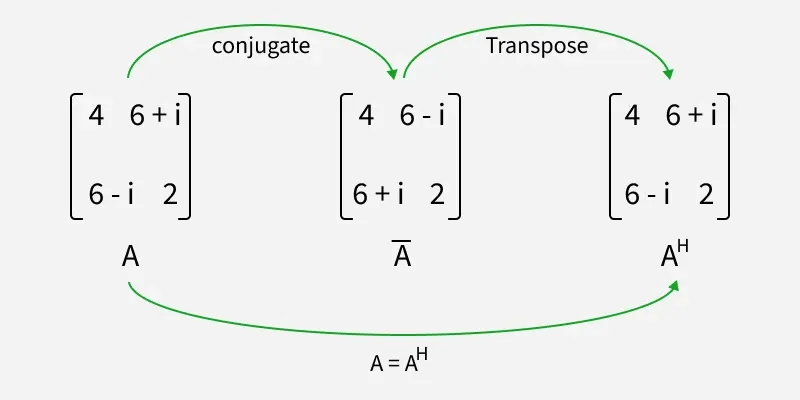
A complex square matrix "An×n = [aij]" is said to be a Hermitian matrix if
A = AH
where,
- AH is the conjugate transpose of matrix A.
In other words, "An × n = [aij] is said to be a Hermitian matrix if aij = āji, where āji is the complex conjugate of aji. The Hermitian matrix is named after the mathematician Charles Hermite.
Examples of Hermitian Matrices
- The matrix given below is a Hermitian matrix of order "2 × 2."
A = \left[\begin{array}{cc} 8 & 1+i\\ 1-i & 5 \end{array}\right] Now, the conjugate of A ⇒
\bar{A}= \left[\begin{array}{cc} 8 & 1-i\\ 1+i & 5 \end{array}\right] The conjugate transpose of matrix A ⇒
A^{H} = (\bar{A})^{T} \left[\begin{array}{cc} 8 & 1+i\\ 1-i & 5 \end{array}\right] We can see that A = AH, so the given matrix is a Hermitian matrix.
- The matrix given below is a Hermitian matrix of order "3 × 3."
B = \left[\begin{array}{ccc} 1 & 2+3i & 4i\\ 2-3i & 0 & 6-7i\\ 4i & 6+7i & 3 \end{array}\right]
Properties of Hermitian Matrix
Some important properties of a Hermitian matrix are discussed below:
- Principal diagonal entries of a Hermitian matrix are always real.
- Non-diagonal entries of a Hermitian matrix are complex numbers.
- If A is a Hermitian matrix of any order and k is a real scalar, then kA is also a Hermitian matrix, as (kA)H = kAH = kA.
- When two Hermitian matrices of the same order are added or subtracted, the resulting matrix is also a Hermitian matrix.
- When two Hermitian matrices are multiplied, the resultant matrix is also a Hermitian matrix if and only if AB = BA.
- The trace of a Hermitian matrix is always a real number.
- The determinant of a Hermitian matrix is always a real number.
- The inverse of the Hermitian matrix is also a Hermitian matrix.
- The conjugate matrix of a Hermitian matrix is also Hermitian.
- If A is a Hermitian matrix of any order, then Aⁿ is also a Hermitian matrix for all positive integers n.
Eigenvalues of Hermitian Matrix
Eigenvalues of a Hermitian matrix are always real. For any Hermitian matrix A such that A' = A and the eigenvalue of A be λ
Now, X is the corresponding eigenvector such that AX = λX, where,
X =
Then X' will be a conjugate row vector. Multiplying X on both sides of AX = λX, we have,
X'AX = X'λX = λ(X'X) = λ(a12 + b12 + ... + an2 + bn2)
Here, (a12 + b12 + … + an2 + bn2) is a real number
Now,
(X'AX)' = X'A(X')' = X'AX,
Hence, X'AX is the Hermitian matrix of order 1.
So X'AX is real, then λ is also real.
Skew-Hermitian Matrix
A complex square matrix is said to be a skew- Hermitian matrix if the conjugate transpose matrix is equal to the negative of the original matrix. A square matrix "An×n = [aij]" is said to be a Hermitian matrix if AH = -A, where AH is the conjugate transpose of matrix A.
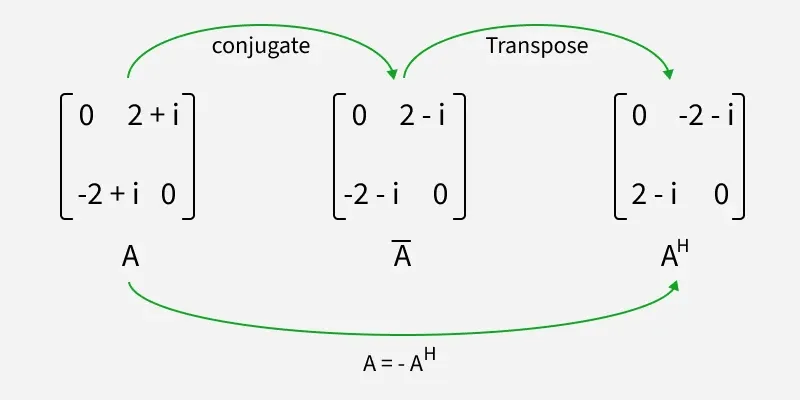
The matrix given below is a Hermitian matrix of order "2 × 2."
A = \left[\begin{array}{cc} ai & -b+ci\\ -b-ci & 0 \end{array}\right] Now, the conjugate of A ⇒
\overline{A} = \left[\begin{array}{cc} -ai & -b-ci\\ -b+ci & 0 \end{array}\right] The conjugate transpose of matrix A ⇒
A^{H} = (\overline{A})^{T} = \left[\begin{array}{cc} -ai & -b+ci\\ -b-ci & 0 \end{array}\right] = -A We can see that AH = −A, so the given matrix is a skew-Hermitian matrix.
Properties of Skew-Hermitian Matrix
- Principal diagonal entries of a skew-Hermitian matrix are always purely imaginary (or zero).
- Non-diagonal entries are complex numbers such that
a_{ij} = -\overline{a_{ji}} (negative of the complex conjugate of the symmetric position). - If A is a skew-Hermitian matrix of any order and k is a real scalar, then kA is also a skew- Hermitian matrix because:
(kA)† = kA† = −kA - When two skew-Hermitian matrices of the same order are added or subtracted, the resulting matrix is also a skew-Hermitian matrix.
- When two skew-Hermitian matrices are multiplied, the product is a Hermitian matrix if and only if AB=BA (they commute).
- The trace of a skew-Hermitian matrix is purely imaginary (or zero).
- The determinant of a skew-Hermitian matrix is always a real number (and for odd order, it is a purely imaginary number times a real factor, often zero in the real case).
- The inverse of a skew-Hermitian matrix (if it exists) is also a skew-Hermitian matrix.
- The conjugate matrix of a skew-Hermitian matrix is skew-symmetric.
- If A is a skew-Hermitian matrix of any order, then Aⁿ is skew-Hermitian for odd n and Hermitian for even n.
Related Articles
Solved Examples on Hermitian and Skew-Hermitian Matrices
Example 1: Determine whether the matrix given below is a Hermitian matrix or not.
Solution:
Given matrix is
P = \left[\begin{array}{cc} -7 & 2+5i\\ 2-5i & 3 \end{array}\right] Now, the conjugate of P ⇒
\bar{P} = \left[\begin{array}{cc} -7 & 2-5i\\ 2+5i & 3 \end{array}\right] The conjugate transpose of matrix P ⇒
P^{H} = (\bar{P})^{T}= \left[\begin{array}{cc} -7 & 2+5i\\ 2-5i & 3 \end{array}\right] = P We can see that P = PH, so the given matrix is a Hermitian matrix.
Example 2: Prove that the trace of a Hermitian matrix is always a real number.
Solution:
Let us consider a "2 × 2" Hermitian matrix to prove that its trace is always a real number.
A = \left[\begin{array}{cc} a & b+ci\\ b-ci & d \end{array}\right] Here, a, b, c, and d are real numbers.
We know that the trace of a matrix is the sum of its principal diagonal entries.
So, the trace of the matrix Q = a + d
As a and d are real numbers, a + d is also real.
So, the trace of the given Hermitian matrix is a real number.
Similarly, we can consider any Hermitian matrix of any other order and check that its trace is a real number.
Hence proved.
Example 3: Prove that the determinant of a Hermitian matrix is always real.
Solution:
Let us consider a "2 × 2" Hermitian matrix to prove that its determinant is always a real number.
A = \left[\begin{array}{cc} a & b+ci\\ b-ci & d \end{array}\right] Here, a, b, c, and d are real numbers.
det A = ad − (b + ci) (b−ci)
|A| = ad − [b2 − c2i2]
|A| = ad − [b2 − c2 (−1)]
|A| = ad −b2 − c2 = real number
So, the determinant of the given Hermitian matrix is a real number.
Similarly, we can consider any Hermitian matrix of any other order and check that its determinant is a real number.
Hence proved.
Example 4: Determine whether the matrix given below is a Hermitian matrix or not.
Solution:
Given matrix is
M = \left[\begin{array}{ccc} 0 & 5+7i & 3i\\ 5-7i & 9 & 1-2i\\ -3i & 1+2i & -11 \end{array}\right] The conjugate transpose of matrix M ⇒
\overline{M} = \left[\begin{array}{ccc} 0 & 5-7i & -3i\\ 5+7i & 9 & 1+2i\\ 3i & 1-2i & -11 \end{array}\right] The conjugate transpose of matrix M ⇒
M^{H} = (\overline{M})^{T} = \left[\begin{array}{ccc} 0 & 5+7i & 3i\\ 5-7i & 9 & 1-2i\\ -3i & 1+2i & -11 \end{array}\right] = M We can see that M = MH, so the given matrix is a Hermitian matrix.
Example 5: Determine whether the matrix given below is skew-Hermitian or not:
Solution:
Given matrix is
M = \left[\begin{array}{ccc} 0 & i\\ i & 0\\ \end{array}\right] The conjugate transpose of matrix M ⇒
\overline{M} = \left[\begin{array}{ccc} 0 & -i\\ -i & 0\\ \end{array}\right] We can see that M = - MH, so the given matrix is a Skew - Hermitian matrix.
Example 6: Determine whether the matrix given below is skew-Hermitian or not:
Solution:
Given matrix is
M = \left[\begin{array}{ccc} 5i & 2-3i & 4+i\\ -2-3i & 0 & 6i\\-4+i & 6i &-5i \\ \end{array}\right] The conjugate of matrix M ⇒
\overline{M} = \left[\begin{array}{ccc} -5i & 2+3i & 4-i\\ -2+3i & 0 & -6i\\-4-i & -6i & 5i \\ \end{array}\right] The conjugate transpose of matrix M ⇒
{M}^H = \left[\begin{array}{ccc} -5i & -2+3i & -4-i\\ 2+3i & 0 & -6i\\4-i & -6i & 5i \\ \end{array}\right] We can see that M = - MH, so the given matrix is a Skew - Hermitian matrix.
