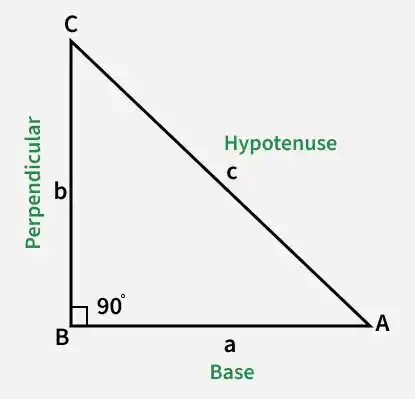
A right-angle triangle is a type of triangle that has one angle measuring exactly 90 degrees (90°).
To find an angle in a right-angled triangle, trigonometric ratios are used. These relate the angles to the sides of the triangle.
Trigonometric Ratios
Trigonometric ratios are used to find unknown sides or angles in a right-angled triangle. The six ratios are sine, cosine, tangent, cosecant, secant, and cotangent.
In a Right-Angled Triangle:
Hypotenuse: The longest side, opposite the right angle
Opposite Side: The side opposite the given angle (θ)
Adjacent Side: The side next to the given angle (θ)
Primary Trigonometric Ratios:
sin θ = Opposite / Hypotenuse
cos θ = Adjacent / Hypotenuse
tan θ = Opposite / Adjacent
Reciprocal Trigonometric Ratios:
cosec θ = Hypotenuse / Opposite
sec θ = Hypotenuse / Adjacent
cot θ = Adjacent / Opposite
Finding Angles in a Right-Angled Triangle
To find an unknown angle in a right-angled triangle, we use inverse trigonometric functions. These functions help determine the angle when the sides of the triangle are known.
θ = sin⁻¹ (Opposite / Hypotenuse)
θ = cos⁻¹ (Adjacent / Hypotenuse)
θ = tan⁻¹ (Opposite / Adjacent)
θ = cosec⁻¹ (Hypotenuse / Opposite)
θ = sec⁻¹ (Hypotenuse / Adjacent)
θ = cot⁻¹ (Adjacent / Opposite)
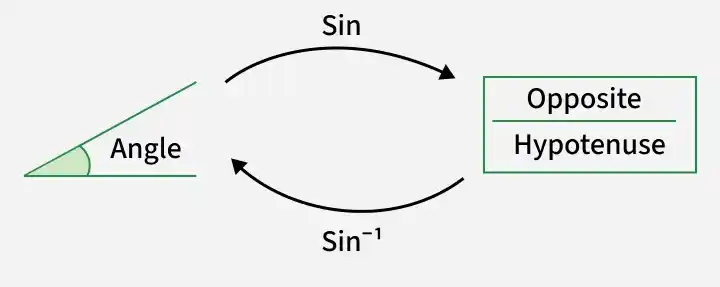
Understanding sin θ and sin⁻¹ θ
sin θ (sine) takes an angle and gives the ratio: Opposite / Hypotenuse
sin⁻¹ (inverse sine) gives the angle θ from the ratio (Opposite / Hypotenuse).
Note: Trigonometric ratios are used for right-angled triangles. For other triangles, the Sine Rule and Cosine Rule are used.
Sine Rule (Law of Sines)
Triangle ABC
The Sine Rule shows the relationship between the sides and angles of any triangle (not necessarily right-angled). In a triangle ABC, where sides a, b, c are opposite angles A, B, C respectively:
sin A/a = sin B/b = sin C/c (or) a/sin A = b/sin B = c/sin C
Cosine Rule or the law of cosines
The Cosine Rule is used to find an unknown side or angle in any triangle. In a triangle ABC, where sides a, b, c are opposite angles A, B, C respectively:
a2 = b2 + c2 - 2ab cos A (or) cos A = (b2 + c2 - a2)/2bc
b2 = a2 + c2 - 2ac cos B (or) cos B = (a2 + c2 - b2)/2ac
c2 = a2 + b2 - 2ab cos C (or) cos C = (a2 + b2 - c2)/2ab
Solved Examples
Problem 1: Find ∠Z (in degrees) of right-angled triangle XYZ when XY = 6 cm and YZ = 8 cm.
Solution:
Triangle XYZ
Given XY = 6 cm and YZ = 8 cm. Since we know the opposite and adjacent sides, we use the tangent function:
tan Z = XY / YZ = 6 / 8 = 3 / 4 ⇒ ∠Z = tan⁻¹ (3 / 4) = 36.87°
Hence, ∠Z = 36.87°.
Problem 2: Find ∠A (in degrees) of right-angled triangle ABC when AB = 3 cm and AC = 5 cm.
Solution:
Triangle ABC
Given AB = 3 cm and AC = 5 cm. Since we know the adjacent side and hypotenuse, we use the cosine function:
cos A = AB / AC = 3 / 5 ⇒ ∠A = cos⁻¹ (3 / 5) = 53.13°
Hence, ∠A = 53.13°.
Problem 3: Find ∠P (in degrees), ∠R (in degrees), and the length of the hypotenuse of a right-angled triangle PQR, right-angled at Q, if PQ = 24 cm and QR = 7 cm.