
Compound events are events in probability that involve two or more simple events occurring together. A simple event has only one outcome, while a compound event combines multiple outcomes.
Types of Compound Events
There are two main types of compound events:
- Independent Events: Two events are considered independent if their occurrences are unrelated to one another.
- Dependent Events: Two events are said to be dependent on one another if their occurrence influences the other.
To calculate the probability of a compound event, generally use various concepts that are added below
For Independent Event
For the case of independent events, we can find the probability of both events occurring is the multiplication of their individual probabilities.
P(A and B) = P(A) × P(B)
Example: Suppose we roll two fair six-sided dice. What is the probability of rolling a 4 on the first die and a 5 on the second die?
Solution:
Probability of rolling a 4 on the first die, P(A):
P(A) = 1/6
Probability of rolling a 5 on the second die, P(B):
P(B) = 1/6
Probability of both event occurring together:
P( A and B) = 1/6 × 1/6 = 1/36
Example: What is the probability of flipping two heads when flipping two fair coins?
Solution:
Probability of flipping a head on the first coin, P(A):
P(A) = 1/2
Probability of flipping a head on the second coin, P(B):
P(B) = 1/2
Probability of both event occurring together:
P( A and B) = 1/2 × 1/2 = 1/4
For Dependent Events
For dependent events, the probability of both events occurring is the product of the probability of the first event and the conditional probability of the second event given that the first event has occurred.
P(A and B) = P(A) × P(B∣A)
Let's understand dependent event with an example.
Example: Suppose we draw two cards from a standard deck of 52 cards without replacement. What is the probability of drawing an Ace first and a King second?
Solution:
Probability of drawing an Ace on the first draw, P(A):
P(A) = 4/52 = 1/13
Probability of drawing a King on the second draw given that an Ace has already been drawn, P(B∣A) :
P(B|A) = 4/51
Probability of both event occurring together:
P( A and B) = 1/13 × 4/51 = 4/663
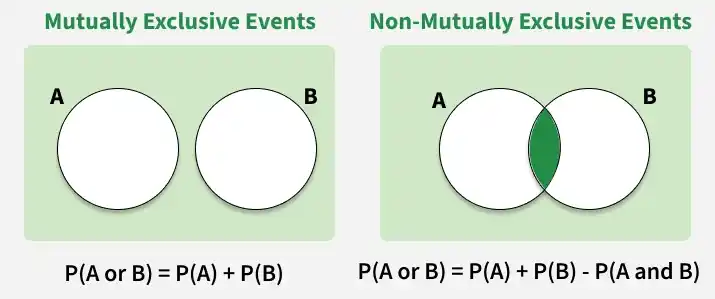
Mutually Exclusive Events
If two events are not possible to happen simultaneously, they are mutually exclusive. The probability of either event occurring is the sum of their individual probabilities.
P(A or B) = P(A) + P(B)
Example: What is the probability of rolling a 3 or a 5 on a fair six-sided die?
Solution:
Probability of rolling a 3, P(A):
P(A) = 1/6
Probability of rolling a 5, P(B):
P(B) = 1/6
Probability of either event occurring:
P(A or B) = 1/6 + 1/6 = 2/6 = 1/3
Non-Mutually Exclusive Events
When two events are not mutually exclusive, the likelihood of either happening is equal to the sum of their respective probabilities less the probability of both happening.
P(A or B) = P(A) + P(B) - P(A and B)
Example: What is the probability of drawing a red card or a king from a standard deck of 52 cards?
Solution:
Probability of drawing a red card, P(A):
P(A) = 26/52 = 1/2
Probability of Drawing a King P(B):
P(B) = 4/52 = 1/13
Calculate the Probability of Drawing a Red King (Intersection of Events A and B):
P(A and B) = 2/52 = 1/26
Now we will, Apply the Formula for Non-Mutually Exclusive Events:
P(A or B) = P(A) + P(B) − P(A and B)
P(A or B) = 1/2 + 1/13 - 1/26
= 7/13
Related Articles
Solved Examples
Example 1: What is the probability of drawing two aces consecutively from a standard deck of 52 cards without replacement?
Solution:
Probability of drawing an Ace on the first draw:
P(A) = 4/52 = 1/13
Probability of drawing an Ace on the second draw given an Ace was drawn first:
P(B/A) = 3/51 = 1/17
Probability of occurring of both events
P(A and B) = 1/13 × 1/17 = 1/221
Example 2: What is the probability of getting at least one head when flipping two fair coins?
Solution:
Probability of not getting any heads (both tails):
P(TT) = 1/4
Probability of getting at least one head:
P(at least one head) = 1 − P(TT) = 1 - 1/4 = 3/4
Probability of Either Event Occurring (Mutually Exclusive)
Example 3: What is the probability of rolling a die and getting either a 2 or a 5?
Solution:
Probability of rolling a 2 = 1/6
Probability of rolling a 5 = 1/6
Probability of either event occurring (since they are mutually exclusive) = 1/6 + 1/6 = 1/3
Example 4: If the probability of an event A happening is 0.4, and the probability of event B happening is 0.5, and the events are independent. What is the probability that at least one of the events occurs?
Solution:
Probability of not occurring A = 1 - 0.4 = 0.6
Probability of not occurring B = 1 - 0.5 = 0.5
Probability of neither A nor B occurring = 0.6 * 0.5 = 0.3
Probability of at least one event occurring = 1 - 0.3 = 0.7
Example 5: A jar contains 3 red, 4 blue, and 5 green marbles. Two marbles are drawn with replacement. What is the probability that both are red?
Solution:
Total marbles = 3 + 4 + 5 = 12
Probability of drawing a red marble = 3/12 = 1/4
Probability of drawing a red marble again = 1/4
Probability of both events occurring = 1/4 × 1/4 = 1/16
Example 6: A deck of 52 cards is shuffled, and two cards are drawn one after the other without replacement. What is the probability that both cards are aces?
Solution:
Probability of drawing the first ace = 4/52 = 1/13
Probability of drawing the second ace (after drawing the first ace) = 3/51
Probability of both events occurring = 1/13 × 3/51 = 1/221
Example 7: In a survey, 60% of people like tea, 50% like coffee, and 30% like both. What is the probability that a person who likes tea also likes coffee?
Solution:
Probability of liking tea = 0.6
Probability of liking both = 0.3
Probability of liking coffee given that the person likes tea = 0.3/0.6 = 0.5
Practice Questions
Question 1: What is the probability of rolling a 3 or a 5 on a standard six-sided die?
Question 2: If you flip a coin and roll a six-sided die, what is the probability of getting heads and rolling a 4?
Question 3: A card is drawn from a standard deck, replaced, and then another card is drawn. What is the probability of drawing a king and then a queen?
Question 4: A box contains 5 red and 7 blue marbles. If one marble is drawn, replaced, and then another is drawn, what is the probability of drawing a red marble followed by a blue marble?
Question 5: A bag contains 4 red and 6 green balls. Two balls are drawn without replacement. What is the probability of both balls being red?
Question 6: In a standard deck of cards, what is the probability of drawing an ace and then a king without replacement?
Question 7: What is the probability of not rolling a 6 on a standard six-sided die?
