
A trapezium is a quadrilateral with one pair of parallel opposite sides, according to Euclidean geometry. A trapezium is derived from the Greek word "trapeza," which means "table." It is a two-dimensional quadrilateral (made up of four straight lines) with two parallel opposite sides. The opposite parallel sides are referred to as the trapezium's base, while the non-parallel sides are referred to as its legs. It has four sides and four corners and is a closed plane shape. It is also called a trapezoid.
Since a trapezium is a quadrilateral, it has 4 different sides and 4 different edges. The measures of all 4 internal angles of a trapezium always sum up to 360°.
Steps To Find the Distance Between Parallel Sides Of A Trapezium
To find the distance between the parallel sides of a trapezium (also known as a trapezoid in some regions), which is the height (or altitude) of the trapezium, follow these steps:
Given:
- Lengths of the two parallel sides a and b (
a<b ) - Lengths of the non-parallel sides c and d.
- Area of the trapezium A (if provided).
Method 1: Using Area (if Area is given)
1. Formula for Area of a Trapezium:
where,
2. Rearrange the formula to solve for height
3. Substitute the known values into the formula:
- If the area
A and the lengths of the parallel sidesa\:and\:b are known, plug these values into the formula to findh .
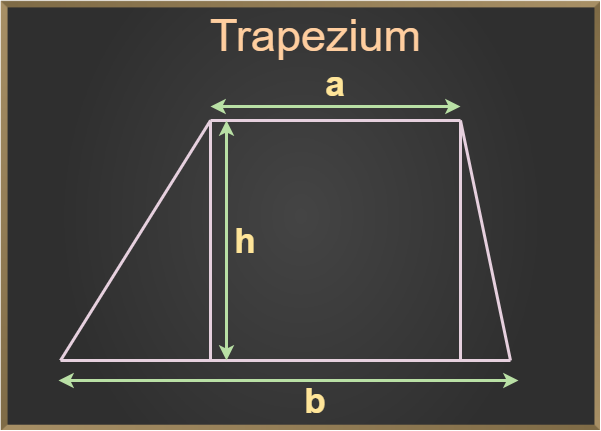
Example:
Suppose a trapezium ABCD with an area of 350 cm2 has parallel sides of the measures 25 cm and 10 cm respectively. Then, its height, i.e. the distance between its parallel sides can be calculated by substituting the given values in the formula for the area of a trapezium.
Solution:
Area = 1/2×[(sum of parallel sides)×(height of trapezium)]
Area = 1/2×(25 + 10)×H
350 = 1/2×35×H
H = 20 cm
Method 2: Using Pythagorean Theorem (if Area is not given)
1. Divide the trapezium into two right triangles and a rectangle by drawing the height from one of the vertices on the shorter parallel side to the longer parallel side.
2. Calculate the bases of the right triangles:
- Let the point where the height meets the longer parallel side divide it into segments
x anda-x . - The length of the segment of the longer side that overlaps with the shorter side is
b . Hence, the lengths of the two segmentsx anda-x satisfy:
- Simplifying, you get
b as the middle segment, and the two right triangles have bases ofx anda-b-x .
3. Use the Pythagorean Theorem to find the height
- In the right triangles formed, apply the Pythagorean theorem:
4. Solve for
- Rearrange the equations to solve for
h :
- Find
x that satisfies both equations.
Related Resources:
Solved Examples
Example 1: Find the height of a trapezium whose parallel sides sum up to 100 cm and area is 2500 cm2.
Solution:
Area of the trapezium = 2500 cm2
Sum of the parallel sides of the trapezium = 100 cm
As we know that
Area of trapezium = 1/2 × (Sum of the parallel sides) × Height
2500 = 1/2 × 100 × Height
Height = (2500 × 2)/100
Height = 50 cm
Therefore,
Height of the trapezium is 50 cm.
Example 2: Find the sum of parallel sides of a trapezium whose height is 60 cm and the area is 1200 cm2.
Solution:
Area of the trapezium = 1200 cm2
Height of the trapezium = 60 cm
As we know that,
Area of trapezium = 1/2 × (Sum of the parallel sides) × Height
1200 = 1/2 × (Sum of the parallel sides) × 60
Sum of the parallel sides = (1200 × 2)/60
Sum of the parallel sides = 40 cm
Example 3: Find the area of the trapezium with the sum of the parallel sides of 70 m and the height of 10 m.
Solution:
Sum of the parallel sides = 70 m
Height of the trapezium = 10 m
As we know that,
Area of trapezium = 1/2 × (Sum of the parallel sides) × Height
Area of trapezium = 1/2 × (70) × 10
Area of trapezium = 350 m2
Therefore,
Area of trapezium is 350 m2.
Example 4: If the sum of the parallel sides of the trapezium is twice the height and the area of the trapezium is 900 m2. Then find the sum of the parallel sides of the trapezium and its height.
Solution:
Area = 900 m2
Sum of the parallel sides of the trapezium is double its height
Assume,
Height of the trapezium = x, than
Sum of the parallel sides of the trapezium = 2x
As we know that,
Area of trapezium = 1/2 × (Sum of the parallel sides) × Height
900 = 1/2 × 2x × x
900 = 1/2 × 2x2
900 = x2
x = √900
x = 30 m
Thus,
Height of the trapezium = x = 30 m
Sum of the parallel sides of the trapezium = 2x = 2 × 30 = 60 m
