
Integration by Parts is a technique used to evaluate the integral of a product of two functions. This method simplifies the integral of a product by breaking it down into simpler integrals.
Example: Calculate ∫ x sin x dx.
Solution:
Let I = ∫ x sin x dx
Choosing u and v
u = x
v = sin xDifferentiating u
u'(x) = d(u)/dx
⇒ u'(x) = d(x)/dx
⇒ u'(x) = 1Using the Integration by part formula,
⇒ I = ∫ x sin x dx
⇒ I = x ∫sin x dx − ∫1 ∫(sin x dx) dx
⇒ I = − x cos x − ∫−cos x dx
⇒ I = − x cos x + sin x + C
Steps:
Suppose we have to simplify ∫uv dx, steps to find the integral by parts are the following:
Step 1: Choose the first and the second function. Suppose we take u as the first function and v as the second function.
Step 2: Differentiate u(x) with respect to x that is, Evaluate du/dx.
Step 3: Integrate v(x) with respect to x that is, Evaluate ∫v dx.
Use the results obtained in Step 1 and Step 2 in the formula,
∫uv dx = u∫v dx − ∫((du/dx)∫v dx) dx
Step 4: Simplify the above formula to get the required integration.
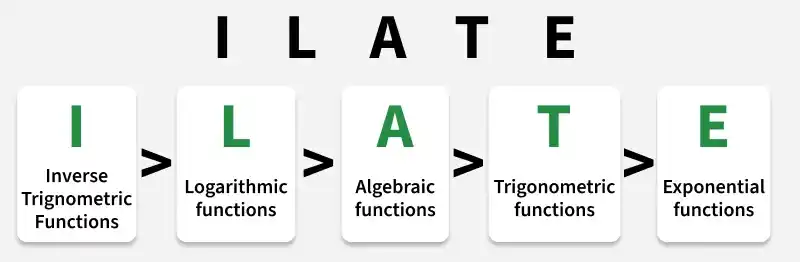
The order to choose the First function and the Second function is very important, and the concept used in most cases to find the first function and the second function is the ILATE concept.
ILATE Rule
The ILATE rule tells us about how to choose the first function and the second function while solving the integration of the product of two functions. Suppose we have two functions of x, u and v, and we have to find the integration of their product; then we choose the first function by the ILATE rule.
Example 1: Find ∫ ex x dx.
Solution:
Let I = ∫ ex x dx
Choosing u and v using ILATE rule
u = x
v = exDifferentiating u
u'(x) = d(u)/dx
⇒ u'(x) = d(x)/dx
⇒ u'(x) = 1∫v dx = ∫ex dx = ex
Using the Integration by part formula,
⇒ I = ∫ ex x dx
⇒ I = x ∫ex dx − ∫1 (∫ ex dx) dx
⇒ I = xex − ex + C
⇒ I = ex(x − 1) + C
Example 2: Find ∫ sin⁻¹ x dx.
Solution:
Let I= ∫ sin−1 x dx
⇒ I = ∫ 1.sin−1 x dx
Choosing u and v using ILATE rule
u = sin−1 x
v = 1Differentiating u
u'(x) = d(u)/dx
⇒ u'(x) = d(sin−1 x )/dx
⇒ u'(x) = 1/√(1 − x 2)Using the Integration by part formula,
⇒ I = ∫ sin−1 x dx
⇒ I = sin−1 x ∫ 1 dx − ∫ 1/√(1 − x 2) ∫(1 dx) dx
⇒ I = x sin−1 x − ∫( x/√(1 − x 2 ) )dxLet, t = 1 − x 2
Differentiating both sides
dt = −2x dx
⇒ −dt/2 = x dx
⇒ I = ∫ sin−1 x dx = x sin−1 x − ∫−(1/2√t ) dt
⇒ I = x sin−1 x + 1/2∫t−1/2 dt
⇒ I = x sin−1 x + t1/2 + C
⇒ I = x sin−1 x + √(1 − x2 ) + C
We can use this to easily find the integration of complex functions like inverse and logarithmic functions.
Logarithmic Function
∫ logx.dx = ∫ logx.1.dx
Taking log x as the first function and 1 as the second function.
= logx. ∫1.dx - ∫ ((logx)'.∫ 1.dx).dx
= logx.x -∫ (1/x .x).dx
= xlogx - ∫ 1.dx
= x logx - x + C
Inverse Trigonometric Function
∫ tan-1x.dx = ∫tan-1x.1.dx
Taking tan-1 x as the first function and 1 as the second function.
= tan-1x.∫1.dx - ∫((tan-1x)'.∫ 1.dx).dx
= tan-1x. x - ∫(1/(1 + x2).x).dx
= x. tan-1x - ∫ 2x/(2(1 + x2)).dx
= x. tan-1x - ½.log(1 + x2) + C
Integration by Parts Formulas
Some of the important formulas derived using this technique are
\int e^x\big(f(x)+f'(x)\big)\,dx = e^x f(x)+C \int \sqrt{x^2+a^2}\,dx = \frac{x}{2}\sqrt{x^2+a^2} + \frac{a^2}{2}\log\left|x+\sqrt{x^2+a^2}\right| + C \int \sqrt{x^2-a^2}\,dx = \frac{x}{2}\sqrt{x^2-a^2} - \frac{a^2}{2}\log\left|x+\sqrt{x^2-a^2}\right| + C \int \sqrt{a^2-x^2}\,dx = \frac{x}{2}\sqrt{a^2-x^2} + \frac{a^2}{2}\sin^{-1}\left(\frac{x}{a}\right) + C \int e^{ax} \cos(bx) \, dx = \frac{e^{ax}}{a^2 + b^2} \left( a \cos(bx) + b \sin(bx) \right) + C \int e^{ax} \sin(bx) \, dx = \frac{e^{ax}}{a^2 + b^2} \left( a \sin(bx) - b \cos(bx) \right) + C
Practice Problems
Question 1. Evaluate the integral
Question 2. Evaluate the integral
Question 3. Evaluate the integral
Question 4. Evaluate the integral
Question 5. Evaluate the integral
