
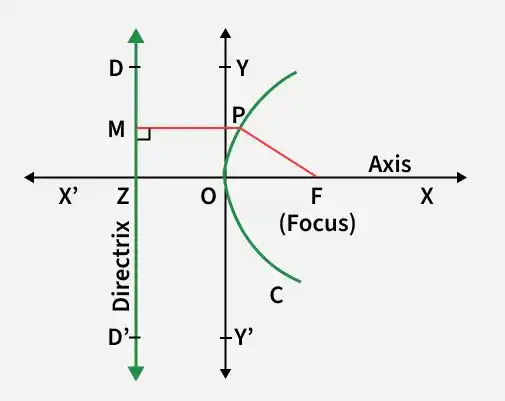
A parabola is a conic section defined as the locus of all points in a plane that are equidistant from a fixed point, called the focus, and a fixed straight line, called the directrix. It is a symmetric, U-shaped curve in coordinate geometry.
Parabola Shape
A parabola is a U-shaped curved line where every point on the line is at an equal distance from the focus and directrix of the parabola.

Parabola Equation
The equation of a parabola depends on its orientation and vertex.
y = a(x − h)² + k → vertical parabola
- a > 0 → opens upward
- a < 0 → opens downward
x = a(y − k)² + h → horizontal parabola
- a > 0 → opens right
- a < 0 → opens left
Here, (h, k) is the vertex.
Standard Equations of a Parabola
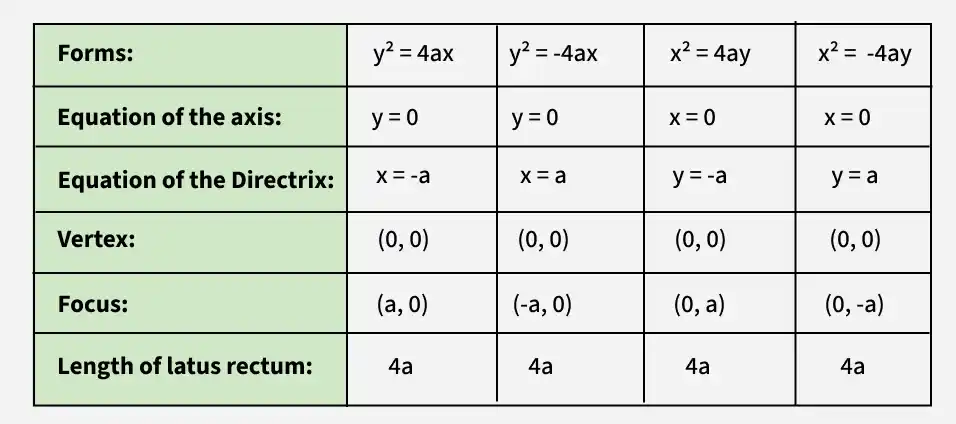
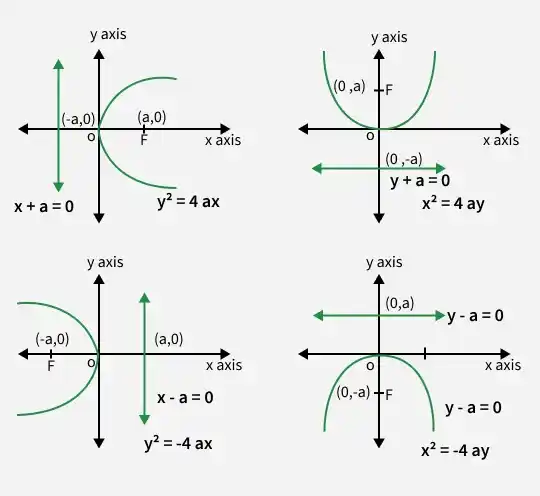
There are four standard equations of a parabola:
- y² = 4ax → opens to the right
- y² = −4ax → opens to the left
- x² = 4ay → opens upward
- x² = −4ay → opens downward
The image below presents the four standard equations and forms of the parabola.
Latus Rectum of Parabola
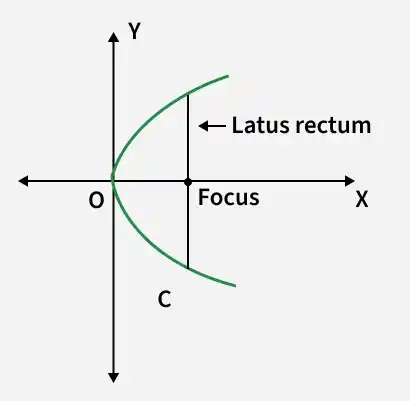
The latus rectum is a line segment of a parabola that passes through the focus and is perpendicular to the axis. Its endpoints lie on the parabola, and its length is 4a, where a is the distance between the vertex and the focus.
Eccentricity of a Parabola
The eccentricity of a parabola is defined as the ratio of the distance of any point on the parabola from the focus to its perpendicular distance from the directrix.
For a parabola, this ratio is always equal to 1. This means that every point on the parabola is equally distant from the focus and the directrix.
Chord Joining Two Points
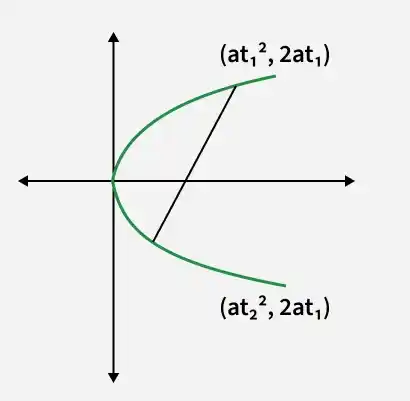
For the parabola y² = 4ax, the equation of the chord joining two points with parameters t₁ and t₂ is:
2x − y(t₁ + t₂) + 2a t₁t₂ = 0
Equation of Tangent to a Parabola
A tangent to a parabola is a straight line that touches the curve at exactly one point.
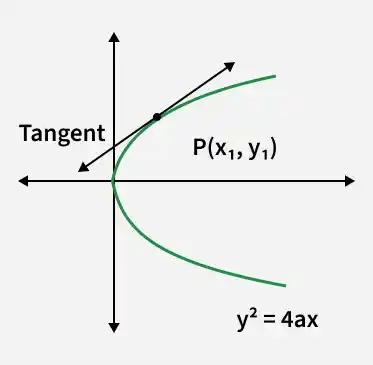
For the parabola y² = 4ax, the equation of the tangent can be written in the following forms:
- Slope Form: y = mx + a/m (m ≠ 0); gives the tangent in terms of slope m with point of contact (a/m², 2a/m).
- Cartesian Form: yy₁ = 2a(x + x₁); gives the tangent at a known point (x₁, y₁) on the parabola.
- Parametric Form: ty = x + at² gives the tangent at parameter t, with point of contact (at², 2at).
Equation of Normal to a Parabola
A normal to a parabola is a straight line that is perpendicular to the tangent at a given point and passes through that point.
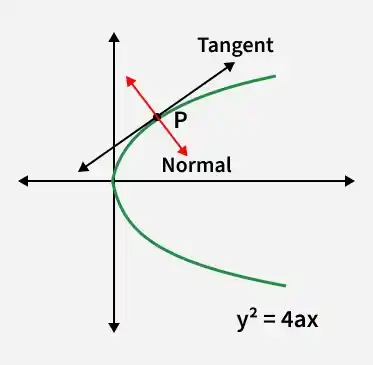
For the parabola y² = 4ax, the equation of the normal can be written in the following forms:
- Slope Form: y = mx − 2am − am³ (m ≠ 0); gives the normal in terms of slope m with the point of contact (am², −2am).
- Cartesian Form: y − y₁ = (−y₁ / 2a)(x − x₁); gives the normal at a known point (x₁, y₁) on the parabola.
- Parametric Form: y + tx = 2at + at³ gives the normal at parameter t, with point of contact (at², 2at).
Graphing a Parabola
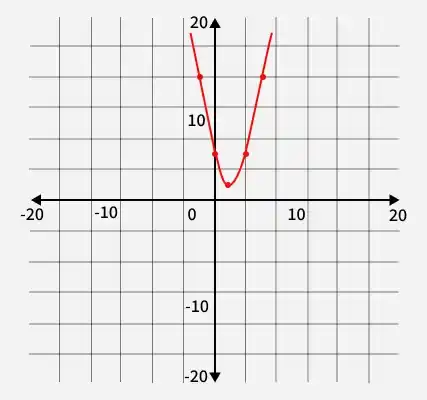
Consider the quadratic equation y = 3x² − 6x + 5
Here, a = 3, b = −6, and c = 5.
Solution:
- Direction: Since a > 0, the parabola opens upward.
- Vertex (h, k):
h = −b / 2a = 6 / (2 × 3) = 1
k = f(1) = 3(1)² − 6(1) + 5 = 2
⇒ Vertex = (1, 2)- Axis of Symmetry: x = 1
- Focus: h, k + 1/4a) = (1, 25/12)
- Directrix: y = k − 1/4a = 23/12
- Length of Latus Rectum: 1/a = 1/3
Derivation of Parabola Equation
Take a point P with coordinates (x, y) on the parabola, which lies on the xy-plane. By the definition of the parabola, the distance of any point on the parabola from the focus and from the directrix is equal.
Now, the distance of P from the directrix is given by PB, where the coordinates of B are (-a, y) as it lies on the directrix, and the distance of P from the focus is PF.
An image of a parabola is shown below:
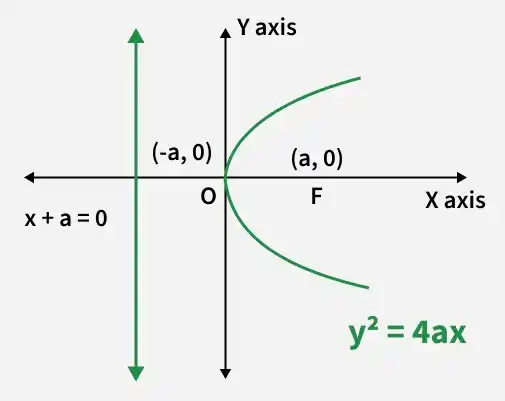
By the definition of parabola, PF = PB . . . .(1)
Using Distance Formula, we get
PF = √(x-a)2+(y-0)2= √{(x-a)2+y2} . . . .(2)
PB = √{(x+a)2} . . . .(3)
By using, equations (1), (2), and (3), we get
√{(x-a)2+y2} = √{(x+a)2}
⇒ (x - a)2 + y2 = (x + a)2
⇒ x2 + a2 - 2ax + y2 = x2 + a2 + 2ax
⇒ y2 - 2ax = 2ax
y2 = 4ax
Similarly, the equations for other parabolas, i.e., x2 = 4ay, y2 = -4ax, and x2 = -4ay, can also be proved.
Parabola Formulas
Some important parabola formulas are added in the table below:
| Formula/Property | Equation or Description |
|---|---|
| Standard Equation of a Parabola | y2 = 4ax (or x2 = 4ay for a different orientation) |
| Focus | (a, 0) for y2 = 4ax (or (0, a) for x2 = 4ay) |
| Directrix | x = -a for y2 = 4ax (or y = -a for x2 = 4ay) |
| Latus Rectum | 4a |
| Eccentricity | 1 |
| General Equations of a Parabola | y = a(x – h)2 + k OR x = a(y – k)2 + h |
| Parametric Equation of a Parabola | x = 2at, y = at2 |
| Equation of Tangent | yy1 = 2a(x + x1) |
| Equation of Tangent in Parametric Form | ty = x + at2 [where, (at2, 2at) is the point of contact] |
| Equation of Tangent in Slope Form | y = mx + a/m [where m is the slope of the tangent] |
| Pair of Tangents from an External Point | (y2 - 4ax)( y12 -4ax1) = [yy1 – 2a(x + x1)]2 |
| Director Circle | Directrix, i.e., x = -a [For y2 = 4ax] |
| Chord of Contact | yy1 – 2a(x + x1) = 0 |
| Equation of Normal in Slope Form | y = mx – 2am – am3 |
| Equation of Normal in Normal Form | y – y1 = (-y1/2a)(x – x1) |
| Equation of Normal in Parametric Form | y = -tx + 2at + at3 |
Solved Examples
Example 1: The ind. coordinates of the focus and axis, the equation of the directrix, and the latus rectum of the parabola y2 = 16x.
Solution:
Given equation of the parabola is: y2 = 16x
Comparing with the standard form y2 = 4ax,
4a = 16 ⇒ a = 4
The coefficient of x is positive so the parabola opens to the right.
Also, the axis of symmetry is along the positive x-axis.
Therefore,
Focus of the parabola is (a, 0) = (4, 0).
Equation of the directrix is x = -a, i.e. x = -4
Length of the latus rectum = 4a = 4(4) = 16
Example 2: Find the equation of the parabola that is symmetric about the y-axis and passes through the point (3, 4).
Solution:
Since the parabola is symmetric about the y-axis and has vertex at the origin, its equation is of the form:
x² = 4aySubstituting the point (3, 4):
(3)² = 4a(4)
9 = 16a
a = 9/16So, the equation becomes:
x² = 4 × (9/16)y
x² = (9/4)yMultiplying both sides by 4:
4x² = 9y
Example 3: Find the coordinates of the focus and axis and the equation of the directrix and latus rectum of the parabola y2 = 8x.
Solution:
Given equation of the parabola is: y2 = 8x
Comparing with the standard form y2 = 4ax,
4a = 8
a = 2
The coefficient of x is positive so the parabola opens to the right.
Also, the axis of symmetry is along the positive x-axis.
Therefore,
Focus of the parabola is (a, 0) = (2, 0).
Equation of the directrix is x = -a, i.e. x = -2
Length of the latus rectum = 4a = 4(2) = 8
Example 4: Find the coordinates of the focus, the axis, the equation of the directrix, and the latus rectum of the parabola y2 = 52x.
Solution:
Given equation of parabola is: y2 = 52x
Comparing with the standard form y2 = 4ax,
4a = 52
a = 13
The coefficient of x is positive so the parabola opens to the right.
Also, the axis of symmetry is along the positive x-axis.
Therefore,
Focus of the parabola is (a, 0) = (13, 0).
Equation of the directrix is x = -a, i.e. x = -13
Length of the latus rectum = 4a = 4(13) = 52
Example 5: Find the coordinates of the focus, the axis, the equation of the directrix, and the latus rectum of the parabola x2 = 16y.
Solution:
Given equation of parabola is: x2 = 16y
Comparing with standard form x2 = 4ay,
4a = 16
a = 4
The coefficient of x is positive so the parabola opens upward.
Also, the axis of symmetry is along the positive x-axis.
Therefore,
Focus of the parabola is (0,a) = (0, 4).
Equation of the directrix is y= -a, i.e. y = -4
Length of the latus rectum = 4a = 4(4) = 16
Practice Questions
Q1. Find the vertex, focus, and directrix of the parabola with the equation y = x² - 4x + 3.
Q2. Determine whether the parabola with the equation y = -2x² + 4x - 1 opens upward or downward, and find its vertex.
Q3. Given the equation 4x - 16y = 0, rewrite it in standard form and find the vertex, focus, and directrix of the parabola.
Q4. Solve for x in the equation 2x - 3x - 5 = 0, and determine the nature of the roots with respect to the corresponding parabola.
Answer:-
- Vertex: (2, −1), Focus: (2, −3/4), Directrix: y = −5/4.
- downward, Vertex: (1, 1).
- Vertex: (0, 0), Focus: (0, 1), Directrix: y = −1.
- x = -1, 5/2 real and distinct.
